AI SEO in 2026: How Different Models Rank Content
Stop optimising for one algorithm. Discover how Perplexity, Gemini, Claude, and Grok handle SEO differently. Expert insights from a Leeds SEO consultant on winning in 2026.
SEO CONTENTSEO TOOLS AND TECHNOLOGYTECHNICAL SEOSMESAGENCY SEOLOCAL SEOMULTILINGUAL SEO
12/23/202511 min read


How Different AI Models Actually Handle SEO: What Content Creators Need to Know in 2026
I've spent the last year watching the AI search landscape splinter in ways I honestly didn't see coming. As a freelance SEO consultant here in Leeds, I've had to completely rethink how I approach content strategy—not because Google changed another algorithm update, but because the entire game has multiplied into eight different games, each with its own rulebook.
We're not optimising for one search engine anymore. We're optimising for an ecosystem of AI models, and each one treats content fundamentally differently. Let me walk you through what I've learned about how these platforms actually work from an SEO perspective, because the differences are genuinely fascinating—and they matter for how we create content in 2026.
A quick note before we dive in: Most of what follows is based on testing, log analysis, and pattern-spotting rather than official documentation. These platforms don't publish ranking algorithms, so this is observational work—but it's work that's shaping how I build strategies for clients right now.
The Core Problem: Fragmentation Isn't Just About Search
Here's what's become clear to me: when we talk about "AI search optimisation" as if it's one thing, we're missing the entire point. These models don't just have different interfaces or brand personalities—they have genuinely different approaches to how they retrieve, rank, and present information. And those differences directly impact what kind of content performs well on each platform.
I'm increasingly convinced that the old SEO playbook of "create great content and optimise for one algorithm" doesn't work anymore. Instead, we need to understand the philosophical differences between these platforms and build content that can flex across them.
Perplexity: The Real-Time Research Engine
Let's start with Perplexity, because it's the one that's forced me to completely rethink freshness as a ranking factor.
Perplexity has built much of its product positioning around real-time retrieval. When someone asks a question on Perplexity, it's actively searching the web for the most recent information available. This is clearly a core differentiator—they're betting that for research-heavy queries, users want the absolute latest information, not what some language model "remembers" from its training data.
From a content perspective, this creates really interesting opportunities. If you're publishing content that needs to be discovered quickly—breaking news, emerging trends, real-time analysis—Perplexity is probably going to surface it faster than any other platform. I've seen articles appear in Perplexity answers within hours of publication, sometimes even minutes.
But here's the catch: pure recency isn't enough. Perplexity still needs to trust your source. In my experience, they're heavily weighting domain authority and source credibility alongside freshness. So if you're a brand-new blog, don't expect to outrank established publications just because you published five minutes ago. But if you've got decent domain authority and you're consistently publishing fresh, well-researched content? Perplexity can become a meaningful traffic driver—I've had clients see noticeable upticks once they started timing publication strategically.
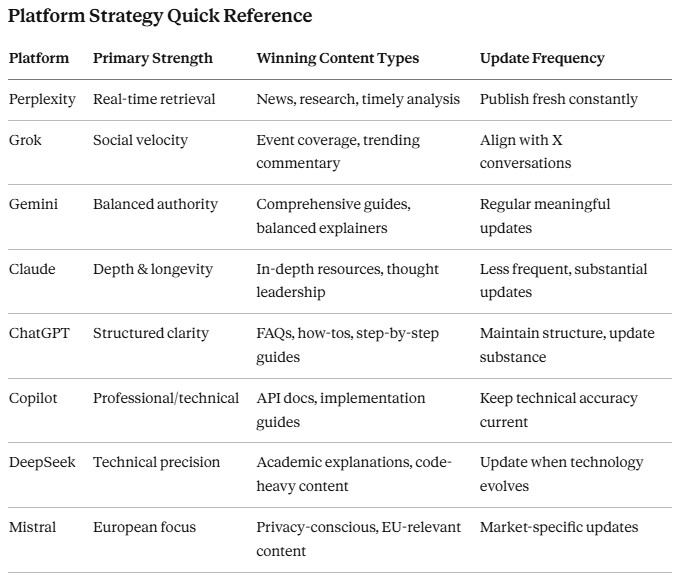
Best content formats: News-style articles, research pieces with clear citations, timely analysis with proper sourcing
When to prioritise: When you're covering breaking topics, emerging trends, or anything where being first matters
My practical advice here: if you're targeting Perplexity, treat your content like journalism. Fast, accurate, properly cited, and genuinely newsworthy. The days of keyword-stuffed blog posts are over on this platform—it's looking for legitimate information that would hold up in a research context.
Grok: Social Velocity as a Ranking Signal
Grok is the most unusual platform in this entire landscape, and I'll be honest—it took me a while to figure out how to approach it from an SEO perspective.
Grok is tightly integrated with X (formerly Twitter), and its results seem strongly shaped by what's currently trending on that platform. This means it's not just looking at when you published something—it's looking at whether people are actually talking about it. Social velocity matters more than publication dates.
I've started thinking about Grok optimisation less like traditional SEO and more like social media marketing. If you want Grok to surface your content, you need two things: timeliness and social proof. You need to publish when a conversation is heating up, and you need to make sure people on X are actually engaging with your content.
This creates some interesting tactical opportunities. Let's say there's a trending topic on X related to your niche. If you can publish a thoughtful piece on that topic while the conversation is still hot, and then get some engagement on the platform, Grok is far more likely to reference your content in its answers. The platform appears to use social signals as a proxy for relevance and quality.
The downside? Grok is heavily biased toward recent, trending content in most of the testing I've run so far. If you're creating evergreen resources, Grok probably isn't your primary target audience. But for event-driven content, cultural moments, or anything tied to current conversations, it's incredibly powerful.
Best content formats: Timely commentary, event coverage, cultural analysis that ties to trending conversations
When to prioritise: When you're working in fast-moving niches where social conversation drives discovery
My approach with clients: if we're targeting Grok, we build content specifically for moments. We watch for trending topics, we publish fast, and we make sure to promote the content on X immediately. It's a different muscle from traditional SEO, but it works.
Gemini: Google's Measured Approach
Gemini feels like the most familiar platform for anyone coming from traditional SEO, and that's not surprising—it's carrying forward much of Google's existing philosophy around content quality and ranking.
What I've noticed with Gemini is that it's trying to balance multiple signals: recency, authority, depth, and user intent. It's not purely chasing the newest content like Perplexity, and it's not obsessed with social signals like Grok. Instead, it's trying to provide balanced, authoritative answers that draw from trusted sources.
In practice, this means Gemini rewards content that would traditionally rank well in Google Search. Well-structured articles from authoritative domains, properly optimised for user intent, with strong E-E-A-T signals. If you've been doing solid SEO for years—assuming you haven't relied on thin or heavily templated content—you're probably already positioned reasonably well for Gemini.
But there's a twist: Gemini is much better at understanding context and nuance than traditional search. I've found that overly optimised, keyword-heavy content actually performs worse with Gemini than more natural, conversational pieces. The model can tell when you're writing for algorithms versus writing for humans, and it clearly prefers the latter.
Best content formats: Comprehensive guides, well-researched explainers, content that balances depth with readability
When to prioritise: For queries where users want balanced, authoritative information rather than just the latest take
My content strategy for Gemini: focus on genuine expertise, clear structure, and natural language. Don't abandon SEO fundamentals—things like proper heading structure, internal linking, and topical authority still matter—but write like you're explaining something to a colleague, not stuffing keywords into a template.
Claude: Depth Over Timeliness
I'll admit I'm slightly biased here since I use Claude constantly in my own work, but I think Claude represents something genuinely different in how AI models approach information retrieval.
Claude tends to favour comprehensive, thoughtful resources in many of the queries I've tested. When I've compared results across platforms, Claude is more likely to reference in-depth, well-researched pieces—even if they're a few years old—over breaking news or trending content. It's playing a different game.
From an SEO perspective, this makes Claude the ideal platform for evergreen content. If you're creating in-depth guides, comprehensive resources, or thought leadership pieces, Claude is more likely to surface and reference that work than platforms chasing recency.
What I've learned is that long-form guides with clear sections, strong internal structure, and genuine substance tend to surface more often in testing. Shallow, surface-level content doesn't perform well. But if you're willing to invest in creating something genuinely valuable—something that will still be useful in two or three years—Claude is more likely to recommend it.
Best content formats: In-depth guides, comprehensive resources, detailed analyses, thought leadership
When to prioritise: When you're building lasting authority rather than chasing traffic spikes
My approach: when I'm creating content targeting Claude users, I'm thinking long-term. I'm building resources that establish expertise, that go deeper than competitors, that provide genuine insight rather than quick answers. And I'm not worried if it takes a few weeks to get traction—Claude isn't rewarding the freshest content, it's rewarding the best content.
ChatGPT: The Conversational Default
ChatGPT is the elephant in the room—it's the most widely used AI assistant by far, and yet it's also the most opaque from an SEO perspective.
Here's what I've pieced together: ChatGPT with search capabilities (via tools like Browse/Bing integration or through AI Overview-style features) blends its training data with real-time web search for queries where freshness matters. But unlike Perplexity, it's not always searching—it's making decisions about when to search based on the query.
This creates an interesting dynamic. For non-fresh queries, it's often leaning on content that already earned visibility and links when the training snapshot was taken—which means the content that performed well in traditional SEO has already influenced its baseline knowledge. For queries where it searches, it seems to prioritise authoritative sources with clear, direct answers.
From a content strategy perspective, I think about ChatGPT in two ways. First, I'm creating comprehensive, authoritative content that might influence future training data—thinking about this as long-term brand building rather than immediate traffic. Second, for time-sensitive queries, I'm making sure our content is structured to be easily digestible—clear headings, direct answers, and proper schema markup where relevant. (If you're unfamiliar with schema, I've written a complete guide to schema markup for UK SMEs that breaks down exactly how to implement it.)
One thing I've noticed: ChatGPT seems particularly good at pulling from structured content. FAQs, step-by-step guides, clearly defined processes—these formats seem to perform well when ChatGPT searches the web. Specifically, FAQ schema, HowTo schema, and Product schema appear to be repurposed cleanly across AI assistants. It's looking for clarity and directness.
Best content formats: Structured guides, FAQs with schema, step-by-step tutorials, content with clear information hierarchy
When to prioritise: For queries where users want clear, actionable answers rather than exploratory reading
Microsoft Copilot: Enterprise Integration Matters
Copilot is interesting because it exists in two distinct contexts. In enterprise environments, Copilot will often prioritise your internal SharePoint, OneDrive, and email content over public sources—which is brilliant for internal knowledge management but outside our scope here. In consumer mode, it leans heavily on established public sources.
From a public content SEO perspective, Copilot seems to heavily favour established, authoritative sources. Microsoft has clearly made editorial decisions about which sources to trust, and those sources get preferential treatment in answers.
What's particularly interesting for B2B content creators is how Copilot handles technical and professional queries. I've found it tends to surface detailed, technical content over simplified explainers. If you're writing for a professional audience, Copilot is probably the most receptive platform to depth and expertise.
Best content formats: Implementation guides, API documentation, detailed troubleshooting articles, technical white papers
When to prioritise: For B2B, technical, and professional content where enterprise users are your target
My approach with B2B clients: create content that would be valuable in a professional context. Think white papers, detailed case studies, technical documentation. Copilot seems to understand professional intent better than most platforms, and it rewards content that matches that intent.
DeepSeek: The Technical Specialist
DeepSeek is less mainstream than some of these other platforms, but it's worth understanding because it represents a particular approach to AI search—one that's heavily focused on technical and scientific content.
From limited testing and public evaluations, DeepSeek appears particularly strong on technical and scientific queries. It's pulling from academic papers, technical documentation, and specialised sources. If you're creating content in technical fields—engineering, computer science, advanced mathematics—DeepSeek is worth considering.
The key insight here: DeepSeek isn't looking for simplification. You're less penalised for staying fully technical here than on more consumer-oriented assistants. This is one of the few platforms where technical depth and complexity seem to be advantages rather than liabilities. If you're explaining quantum computing or advanced machine learning concepts, DeepSeek can handle—and may actually prefer—the technical version.
Best content formats: Academic-style explanations, technical documentation, code-heavy tutorials, research summaries
When to prioritise: When your audience is highly technical and values precision over accessibility
Mistral: The European Alternative
Mistral is particularly interesting from a European perspective, and as someone based in the UK, I'm keeping a close eye on how Mistral-powered assistants and products develop.
What I've noticed is that Mistral-based systems seem to balance privacy concerns with information retrieval in interesting ways. They're less aggressive about tracking and personalisation than some American platforms, which means they're potentially more predictable from an SEO perspective—what works for one user is more likely to work for another.
In many deployments, results skew more European, which makes sense given Mistral's ecosystem and customer base. If you're creating content for European audiences, Mistral-powered tools are worth considering as part of your distribution strategy—particularly in contexts where data sovereignty and GDPR compliance are priorities for users.
Best content formats: Content that serves European audiences, particularly in privacy-conscious sectors
When to prioritise: When targeting European markets or working with organisations that prioritise EU-based technology stacks
Practical Strategies for 2026
Right, so how do we actually apply all of this? Here's what I'm doing with clients:
Build a content foundation that works everywhere
This means high-quality, well-researched, properly structured content that demonstrates genuine expertise. This is your baseline—it should perform reasonably well across all platforms. Think comprehensive guides with clear structure, strong E-E-A-T signals, natural language, and proper schema implementation.
Layer on platform-specific optimisation
For Perplexity, we're adding rapid-response content around breaking news and emerging trends. For Grok, we're timing publication around social conversations and promoting strategically on X. For Claude, we're investing in comprehensive, lasting resources. For ChatGPT, we're adding structured, clear formats with FAQ and HowTo schema.
Think in terms of content portfolios, not individual pieces
Instead of trying to make every piece of content work on every platform, we're building portfolios where different pieces serve different purposes. Some content is designed for immediate impact on Perplexity and Grok. Other content is designed for long-term value on Claude and Gemini. Yet other content targets the professional audience on Copilot.
Measure differently
Traditional SEO metrics like rankings and traffic are still important, but I'm also tracking:
Percentage of branded vs non-branded citations in AI answers
Frequency of domain mentions across assistants from scripted test queries
Which platforms are citing specific content types
How content performs in conversational contexts versus traditional search
Accept that freshness is now contextual
The old approach of regularly updating content just to maintain a fresh timestamp doesn't work anymore. AI Overviews and assistants don't just look at last-updated dates—they look at whether the update materially changes the answer. I've written more about how the AI search revolution is changing content requirements, but the key point is this: we're being strategic, updating content when there's a genuine reason to update it, when new information emerges, or when we're specifically targeting a platform like Perplexity that rewards meaningful recency.
The Bigger Picture
Here's what keeps me up at night: we're still in the early days of understanding how these platforms actually work. The strategies I've outlined here are based on observation, testing, and educated guesses—but these platforms are evolving rapidly, and what works today might not work in six months.
What I am confident about is this: the era of optimising for a single algorithm is over. The future of content strategy is about understanding how different platforms think about information, building content that can adapt across platforms, and being genuinely useful to humans regardless of how they're finding your content. As I explored in my piece on the new SEO branches every UK small business should know, we're dealing with a fundamentally fragmented landscape now.
We're not just SEO consultants anymore—we're information architects, content strategists, and platform specialists rolled into one. It's messy, it's complicated, and honestly, it's some of the most interesting work I've ever done.
The content that will win in 2026 isn't the content that games one algorithm—it's the content that's genuinely valuable enough to surface across multiple platforms, flexible enough to adapt to different contexts, and human enough to resonate regardless of how it's discovered.
That's what I'm building toward, anyway. The landscape is fragmenting, but that fragmentation is creating opportunities for those of us willing to understand the nuances and adapt our strategies accordingly.
Related blog posts:
SEO Localisation: A Guide for Leeds Businesses and British Expats in Spain
Best Spanish Cities for UK Expats: 2025 Business Guide with Bilingual SEO Tips
Spanish SEO for British Expats: Meta Tags & Local Tips
The Complete Guide to Schema Markup for UK SMEs: Boost Rankings & Dominate AI Search Results
Expertise
Driving organic traffic and qualified leads with tailored SEO solutions.
Growth
Results
Mail to: jj@jjseo.co.uk
© 2025 JJSEO. All rights reserved. | Expert SEO Consultant in Leeds
Free SEO Toolsour text here...