
What Happens When the Next Generation Doesn't Know Your Funeral Home Exists?
Your reputation took decades to build. But today's families search online first. Here's why visibility matters more than ever for funeral directors.
FUNERAL SERVICES SEOSMESLOCAL SEO
Jorge Jaroslavsky
7/21/202611 min read
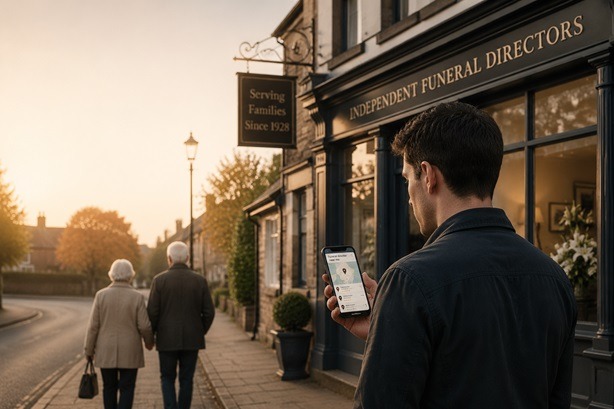
When Was the Last Time a Grandchild Called Your Funeral Home by Name?
For decades, many independent funeral directors have built their businesses on trust, word of mouth and generations of loyal families. That is something national chains cannot easily replicate. A family who used your services in 1985 is often still with you today — not because of a clever marketing campaign, but because your firm was there for them when it mattered, and they never forgot it.
If you are reading this, there is a good chance your own business has a story like that. Perhaps your grandfather started the firm. Perhaps you took it over from your father, or from the family who built it before yours. You have likely spent your career maintaining the standards that earned that trust in the first place: showing up at 3am, treating every family the way you would want your own to be treated, and quietly becoming part of the fabric of your town.
So here is a question worth sitting with for a moment.
What happens when the next generation doesn't know your funeral home exists?
Your instinct might be to dismiss the question. "We've been here for eighty years," you might think. "Everyone around here knows us."
Exactly. Everyone around here knows you. The question is: who is "everyone" today, and where do they go to find you?
Something subtle has changed
The people making funeral arrangements today are increasingly the sons, daughters and grandchildren of the families your firm has served for years. Many of them have moved away for work or family reasons. Many don't read the local paper their parents read every week. Many have never had a reason to think about funeral directors at all — until, suddenly, they do.
And when that moment arrives, they don't reach for an address book. They don't ask a neighbour over the garden fence. They pick up their phone and they search.
This isn't a criticism of your reputation. Your reputation is almost certainly intact, and probably stronger than you realise among the people who already know you. The issue is something quieter and, in some ways, more important: that reputation hasn't been transferred to the next generation. It exists in the memories of people in their seventies and eighties. It has not yet found its way into the search results, the reviews and the websites that their children and grandchildren will actually look at.
That is a very different problem to "losing your reputation." And it's one that can be fixed — but only if you understand what's actually happening.
1. Reputation used to be inherited
For most of the history of the funeral profession, reputation worked in a fairly simple way. Families knew the local names. If your grandmother had used a particular funeral director, that was very likely who your family would call when the time came, decades later. The name was passed down the same way a family doctor or a family solicitor might be passed down — through conversation, through habit, through simply knowing.
This is why so many independent firms have survived, and even thrived, for fifty, seventy, a hundred years or more, often with barely any formal marketing at all. The reputation did the work. It travelled through families, through communities, through the natural, unhurried rhythm of small-town and suburban life.
It's a remarkable thing to have built, and it shouldn't be taken for granted. Most businesses, in any sector, would love to have earned that kind of multi-generational trust.
But inherited reputation depends on one thing: the next generation staying close enough, and paying enough attention, for the name to be passed on. And that is precisely the link that has started to weaken.
2. Today, visibility is discovered
Ask yourself honestly: when did you last see someone under 45 open a local newspaper, or a printed directory, to find a service they needed? For most people, that habit is gone. It has been replaced by a search bar.
When someone today needs to find a funeral director, they typically search for things like:
funeral director near me
direct cremation
woodland burial
funeral costs
They are not typing your firm's name, because in many cases they don't know it yet. They are describing what they need, and letting a search engine decide who to show them.
This is the heart of the shift. Reputation has not disappeared — it has simply moved. It used to live in conversations at the school gate, at church, in the pub, at the local Rotary club. Increasingly, it lives on page one of Google. If your firm isn't clearly and prominently visible there, in the eyes of someone searching for the first time, it may as well not exist — regardless of how many decades of trust you've built offline.
This is uncomfortable to hear, particularly if your firm has never needed to think this way before. But it is worth taking seriously, because it explains something that many long-established, highly respected funeral directors have quietly noticed over the past several years: enquiries that used to come "because everyone knows us" are increasingly coming from people who found them online — and, just as concerning, some families who might once have called are instead calling someone else, simply because that other firm appeared first.
3. Artificial intelligence is accelerating this
If search engines have changed how people find funeral directors, artificial intelligence is now changing it again — and more quickly than most people in the profession have noticed.
Increasingly, people don't type a search term into Google and click through ten different websites, comparing prices and reading reviews one by one. Instead, they ask a question in plain language, to a tool like ChatGPT or Google's AI-powered search results, such as:
"Recommend a compassionate funeral director in Leeds."
The tool then gives them an answer — often naming two or three firms, with a short description of each. The person asking rarely goes further than that. Whichever firms are named in that answer have, in effect, just been handed the enquiry. Whichever firms aren't named have, in effect, just been passed over — without the family ever knowing they existed.
This matters enormously, because it means visibility is no longer only about being on page one of a list of search results. It is now also about whether an AI system has enough clear, accurate, well-structured information about your firm to confidently recommend you by name. Firms that have strong websites, clear service information, genuine reviews and a consistent online presence are far more likely to be the ones recommended. Firms that have a thin, outdated website — or barely any online presence at all — are far more likely to be invisible in these conversations, no matter how excellent their actual service is.
This is a genuinely new development, and it is moving fast. It rewards firms that get their digital foundations right now, and it will make it progressively harder for firms that don't to catch up later.
Picture two long-established funeral directors, both family-run, both with decades of impeccable service behind them, both roughly ten minutes apart in the same town. One has a clear, well-written website, genuine reviews from local families, and accurate information about services and costs. The other has a website that hasn't been meaningfully updated in years, no reviews to speak of, and very little information beyond an address and a phone number.
A grandson living two hours away, arranging his grandmother's funeral because his mother is too distraught to manage it, asks an AI assistant to recommend a funeral director near his grandmother's home. The assistant, drawing on whatever information it can find, names the first firm with confidence, and mentions its reputation for compassionate service. It says nothing about the second firm — not because that firm is any less compassionate, but because there is simply nothing for the assistant to find and repeat.
The grandson calls the first firm. He has no idea the second firm exists, let alone that it may have arranged funerals for three generations of his own family. This is not a hypothetical curiosity. It is already happening, in some form, in towns across the country.
4. National chains understand this
It's worth being clear about something here: national funeral chains have not grown their market share because they offer better care than independent firms. In most cases, families who have experienced both would say the opposite is often true.
What national groups have generally understood, earlier and more consistently than most independents, is the importance of digital visibility. They have invested steadily in websites, in local search presence, in structured information about their services and prices, and in making sure that when someone searches for a funeral director in a particular town, their branch appears clearly and professionally.
There's no need to name names, and no need to view this as some kind of unfair advantage. It's simply a business decision they made some years ago, and one that is now paying off in exactly the way described above: when the next generation searches, they find the firms that show up.
The good news is that this is not a battle independents are destined to lose. It is a battle that, until recently, most independents simply hadn't realised they were in.
5. Independent firms still have a huge advantage
Here is the turn in this story, and it's an important one: none of this means independent funeral directors are at a disadvantage where it really counts. If anything, the opposite is true.
Families who are arranging a funeral are not looking for the most polished corporate brand. They are looking for genuine care, at one of the most difficult moments of their lives. And that is precisely where independent firms excel:
Community involvement — being a real, known presence in the town, not a branch of a distant organisation.
Local trust — the kind that has been earned over years, funeral by funeral, family by family.
Personal service — the owner or a senior member of staff who actually knows the family, rather than a call centre.
Generational relationships — having served a grandparent, a parent, and now potentially the grandchildren too.
These qualities are exactly what most families say matters most to them when choosing a funeral director. Survey after survey in this profession confirms it: people want to feel cared for, not processed. Independent firms are, in many cases, simply better positioned to deliver that.
The problem was never a lack of substance. It has been a lack of visibility. Those qualities only help a family if that family finds you in the first place. Once they do — once they land on your website, read about your firm, see genuine reviews from people in their own community — the advantage swings firmly back in your favour.
So what does this actually mean for your business?
It means the task in front of most independent funeral directors today isn't to build a reputation from scratch. That work is already done, and done well, often over multiple generations. The task is to make sure that reputation is visible to the people who will need it next — the sons, daughters and grandchildren of the families who already trust you, plus all the new families in your area who have never had a reason to know your name before now.
In practice, that means a few things worth thinking about:
Your website needs to answer the questions people are actually asking. Not just "who we are" and "our history" — important as that is — but clear, honest information about direct cremation, burial options, costs, and what to do in the first few hours after a death. These are the searches happening right now, in your own town, from people who have no idea your firm exists.
Your online reviews matter more than you might think. When someone unfamiliar with your firm searches for a funeral director, genuine reviews from local families are often the deciding factor between clicking through to your site or moving on to a competitor's.
Being findable is no longer optional — it's the modern equivalent of having a shopfront on the high street. Decades ago, a visible, well-kept premises on the local high street told the community you were established and trustworthy. Today, that same signal is sent by a clear, well-maintained online presence.
AI-driven search is only going to grow. The firms that get their digital information right now — clear, accurate, well-structured, easy for both people and AI systems to understand — will be the ones recommended by name over the coming years. This is not a distant, futuristic concern. It is already shaping enquiries today.
"But we already tried this"
If you're an experienced business owner, it's entirely possible you're reading this thinking, "We already have a website. We already tried some digital marketing a few years ago, and it didn't really change anything."
That reaction is understandable, and it's worth addressing directly, because it's one of the main reasons independent funeral directors fall behind in this area — not through lack of effort, but because an early attempt didn't work, and the conclusion drawn was that digital visibility "isn't for firms like us."
In most cases, what actually happened is one of a few things. Perhaps a website was built years ago and never updated since, so it no longer reflects current services, current pricing approaches, such as direct cremation, or current search habits. Perhaps a well-meaning but generic marketing package was purchased, the kind sold to hundreds of small businesses regardless of sector, with no real understanding of how families search for a funeral director, what reassures them, or what an AI system needs to see to recommend a firm confidently. Or perhaps some work was done, but never given long enough, or consistently enough, to actually take effect — digital visibility tends to build steadily over months, not overnight.
None of this means the underlying opportunity has gone away. It usually means the earlier attempt wasn't built around how this particular profession, and its particular families, actually behave. A generic approach borrowed from a different industry was never likely to capture the specific, sensitive, trust-based nature of funeral arrangements.
"We don't want to seem like we're chasing business at a sad time"
This is one of the most common, and most understandable, hesitations among funeral directors when the subject of marketing comes up. There is a genuine, and admirable, discomfort at the idea of anything that feels like commercial opportunism around grief.
It's worth separating two very different things here. Chasing business would mean adverts, aggressive promotions, or pressure tactics aimed at people in distress. That has no place in this profession, and most independent firms rightly want nothing to do with it.
What is being described in this article is something different: simply making sure that when a family is already searching, already in need, already going to choose somebody, your firm is one of the options they can actually find. That isn't chasing anyone. It's making sure the door is visible to people who are already walking towards it. A family arranging a funeral is going to find a funeral director one way or another. The only question is whether your firm, with everything it genuinely has to offer, is among the firms they're able to discover.
Your reputation still matters
None of this diminishes what you have built. Eighty years of trust, or forty, or twenty, is not something that disappears because of changing technology. It remains the foundation of everything your firm offers, and it is precisely why families who do find you tend to stay with you for life, and pass you on to their own children in turn.
But today, reputation begins with being found.
If the next generation never discovers your funeral home online, they will never have the opportunity to experience the care that has built your reputation over decades. Not because they chose someone else over you. Not because your service was found wanting. Simply because they searched, and someone else appeared, and they never knew there was another option — your option, the one their grandparents trusted without a second thought.
That would be a quiet, avoidable loss. Not just for your business, but for the families in your community who deserve to know that the kind of care your firm has always provided is still there, waiting for them, if only they can find it.
Written for independent funeral directors thinking seriously about visibility in the age of AI search. If you'd like to talk through what this looks like for your own firm, get in touch.
Expertise
Senior technical SEO for SMEs in regulated, automotive, funeral and multilingual markets.
Mail to: jj@jjseo.co.uk
© 2026 JJSEO | Jorge Jaroslavsky, Senior SEO Consultant, Leeds