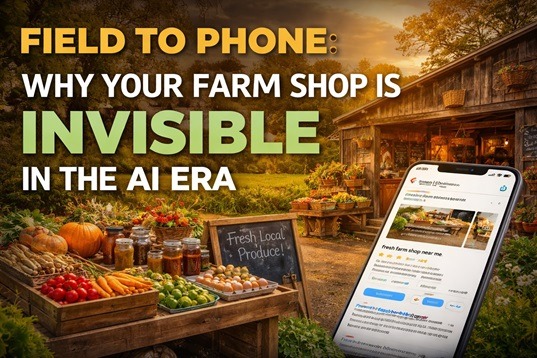
Field to Phone: Why Your Farm Shop Is Invisible in the AI Era
Farm shop websites are quietly losing customers to supermarkets without ever knowing why. Here's exactly what's going wrong and how to fix it.
SMESLOCAL SEO
Jorge Jaroslavsky
3/17/202611 min read
Great Produce Doesn't Find Itself
You've built something worth visiting. Proper local meat, seasonal produce picked at the right time, a story behind every product on the shelf. The customers who find you tend to love you — they come back, they tell their neighbours, they drive past the supermarket on purpose. The problem is, not enough people are finding you in the first place. And in 2026, that's almost certainly a website issue rather than a product one.
This isn't a technical article. I'm not writing this for web developers or digital marketing agencies. I'm writing it for the person who gets up at five in the morning to sort the livestock before opening the shop at nine, who built something genuinely good, and who suspects their website isn't pulling its weight but hasn't had the time — or the right conversation — to find out why.
Here are the five things I see going wrong, time and again, when I look at farm shop and butcher's websites across Yorkshire and the North West. Some of them will surprise you.
1. The Invisible Handbrake: Your Website Looks Lovely, But Does It Load Quickly?
Every farm shop website I've ever been asked to look at has the same thing in common: someone has clearly cared about how it looks. There are beautiful photographs of the counter at Christmas, shots of the farm in summer, a logo that was properly designed. The visual identity is there. The pride is obvious.
And then I run a speed test, and the whole thing falls apart.
A slow website is the single most common technical problem I find when I look under the bonnet of a small food business site. The causes are almost always the same: high-resolution photographs that were uploaded straight from a camera without being properly compressed first, decorative fonts that take a noticeable moment to load in, a homepage that's trying to do too many things at once. Together, these create what I call the invisible handbrake — something that's silently slowing everything down without anyone realising it's there.
Here's why it matters. Think about how you use your own phone when you're looking something up. If a page doesn't load almost immediately, you're gone. You don't wait. You go back and click the next result. Your customers are exactly the same — in fact, research consistently shows that more than half of mobile users will abandon a page that takes longer than three seconds to load.
If your website takes four or five seconds — and many farm shop sites do — there's a very real chance that potential customers are bouncing straight off it and ending up on a supermarket website instead. Not because they prefer the supermarket. Not because the supermarket has better meat or better produce. Simply because the supermarket's website was faster.
The cruel irony is that Google knows this is happening. It measures how long your pages take to load, and it uses that information as part of how it decides where to rank you in search results. A slow site gets pushed down. A fast site gets a quiet but meaningful boost.
The fix isn't complicated, but it does need someone to actually go and do it. Images need to be compressed and resized properly before they go on the site. Fonts need to be loaded efficiently. In some cases, the hosting itself needs to be looked at. None of this is glamorous work, but it is the foundation that everything else sits on. You can have the best content in Yorkshire, but if the page loads like it's still 2009, Google isn't going to show it to anyone. It's exactly this kind of issue I cover in my SME SEO work — the unglamorous fixes that make the biggest difference.
2. The New Reality: AI Overviews Are Changing Everything, and Most Farm Shops Aren't Ready
This is the change that I think matters most right now, and it's the one that the vast majority of small food businesses haven't heard about yet, let alone prepared for.
When someone types a question into Google — something like "where can I buy a proper free-range chicken near Skipton" or "best place to get dry-aged beef in West Yorkshire" — something different happens in 2026 compared to even eighteen months ago. Before the list of websites appears, Google now generates its own answer. It's called an AI Overview, and it sits right at the top of the page, above everything else. It pulls together information from a small number of sources it considers reliable, summarises it, and presents it as if Google itself is answering the question.
If your business is one of those sources, you're golden. Your name, your location, your product — potentially right there at the very top of the page, before anyone has to scroll at all.
If you're not one of those sources, you're invisible to that search. It doesn't matter if you're ranked number two or number three in the traditional results beneath it. Most people never get that far. The AI Overview has already given them what they were looking for, and they've clicked on one of the links it suggested, or they've just read the summary and picked up the phone.
This is a fundamental shift in how search works, and it rewards a very specific kind of website. Google's AI looks for pages that directly and clearly answer the questions people are asking. It favours businesses that have their basic information — opening hours, location, what they sell — properly structured and consistent across the web. It trusts sites that other reputable local sources link to or mention. And it particularly rewards content that's written in plain, honest language that answers real questions rather than stuffed with keywords in a way that reads like a robot wrote it.
The good news for farm shops is that this kind of content is actually easier for you to produce than it is for a faceless online retailer. You have a real story. You have genuine expertise about your products — where they come from, how they're reared or grown, why they taste different to what's in the chiller cabinet at the supermarket. That kind of specific, honest, locally rooted content is exactly what Google's AI is looking for when it decides whose website to quote.
The question is whether your website is currently written in a way that makes any of that easy for Google to find and understand. In most cases I look at, the answer is no — not because the business isn't good, but because the website was built to look attractive to humans rather than to communicate clearly to a search engine. Both things are possible. I wrote a piece recently on how AI Overviews are changing SEO for UK businesses that goes into more depth on this if you want to understand the mechanics.
Being third on Google used to be perfectly respectable. In 2026, it's often not enough. You need to be the source the AI quotes. Getting there is achievable — but it requires a deliberate approach, and most of your local competitors haven't started yet.
3. The "Who We Are" Trap: Why Your Family Story Might Be Hurting You
This one genuinely surprises people when I point it out, because it feels counter-intuitive. Your story is one of your strongest assets. Three generations farming the same land. A commitment to breeds that the supermarkets abandoned decades ago. A butcher who trained properly and still does things the old way. That heritage is what makes you different, and most farm shops quite rightly put it front and centre on their website.
The problem I see, again and again, is the way that story is being presented — particularly on mobile phones.
I was recently reviewing a farm shop website where the family background section was genuinely compelling. Real history, proper passion, the kind of thing that makes you want to go and visit. But when I looked at it on a phone — which is how the majority of that shop's potential customers would be seeing it — the layout had completely broken down. A large image was sitting in the middle of the text and pushing half the words off the edge of the screen. Sentences were cut in two. Paragraphs overlapped. The whole thing was effectively unreadable unless you pinched and zoomed and scrolled sideways, which nobody does.
The shop owner had no idea. It looked perfectly fine on the desktop computer they'd used to check it when the site was built. But their customers weren't using a desktop computer. They were standing in a car park, or sitting on the sofa on a Sunday morning thinking about where to get their meat for the week, looking at a page that was a jumbled mess.
Here's the thing that makes this directly relevant to your Google ranking: Google knows when a page is difficult to read on a mobile phone. It checks. It sends out what are called crawlers — automated programmes that visit your site and assess it — and those crawlers specifically evaluate how well your pages work on smaller screens. When they find layouts that are broken or text that's hard to read, they mark the site down as lower quality and rank it accordingly.
So you can have the most compelling family story in the Yorkshire Dales, and it can actively work against you in search if it's presented in a way that doesn't work on a phone. Layout isn't a cosmetic consideration. It's an SEO signal. Google is making a judgement about the quality of your business based in part on whether your website works properly on the device that most of your customers are using.
The fix is usually straightforward once someone identifies the problem. But you have to know to look for it first. It's the kind of thing that comes up consistently when I'm working through an SEO audit for a small business — even when the content itself is strong, the presentation can be quietly undermining it.
4. Security: A Threat That Most Small Food Businesses Don't Know They're Facing
I want to talk about something that doesn't get mentioned often enough in conversations about small business websites, because it's becoming increasingly common and the consequences when it goes wrong are genuinely serious.
Earlier this year, I came across a sophisticated phishing operation that had been set up to impersonate a local farm shop. Whoever was behind it had gone to considerable effort — they'd copied the shop's branding, reproduced their product photographs, even mirrored the general look and feel of the original website. They'd then set up a convincing fake version of the site designed to take payments from customers who believed they were buying from a business they knew and trusted.
The farm shop had absolutely no idea this was happening. They weren't involved. They hadn't done anything wrong. But their reputation was being used as bait, and their customers were at risk of being defrauded.
This kind of thing is happening more frequently to small, well-regarded local businesses — precisely because they have a good reputation and a loyal customer base, which makes them valuable to impersonate. And while there's a limit to what any individual business can do to prevent someone setting up a fake site elsewhere on the internet, there's a great deal you can do to make your own website a less attractive target, and to make sure that you — and Google — can clearly distinguish your legitimate site from any imitation.
Most farm shop websites run on WordPress. It's a perfectly good platform and there's nothing wrong with that. But WordPress sites that aren't regularly maintained become vulnerabilities. Outdated plugins — the add-on pieces of software that handle things like contact forms, image galleries, or booking systems — are one of the most common entry points for malicious activity. When plugin developers discover a security flaw, they release an update. If you don't apply that update, the flaw stays open.
I've reviewed sites where core components haven't been updated in two or three years. The owners didn't know, because nobody had told them, and nothing had visibly gone wrong yet. But "nothing has gone wrong yet" isn't the same as "the site is secure."
There's a direct connection between website security and SEO that most people don't realise. Google actively monitors for sites that have been compromised or that are serving suspicious content. If your site is flagged as a security risk — even if you had nothing to do with how it happened — Google will either reduce your rankings or, in serious cases, show a warning to anyone who tries to visit it. That warning, a red screen telling users that the site may be dangerous, is not something you recover from quickly in terms of customer trust.
Keeping your site updated, having proper backups, and having someone monitor it for unusual activity isn't a luxury for a small business. It's basic hygiene — and it's part of your SEO strategy whether you think of it that way or not. If you want to understand how this fits into the bigger picture of SEO for small and medium businesses, it's something I look at as standard whenever I take on a new client.
5. The Slow Burn and the Quick Win: What to Expect, and When
I want to be straightforward with you about timescales, because I think one of the reasons small businesses put off dealing with their website is that someone has told them SEO takes forever and the results are uncertain. That's partly true and partly misleading, and it's worth separating the two.
The honest answer is that if you start working properly on your website's SEO today, you are unlikely to see a dramatic uplift in footfall next month. Search engines update their rankings regularly, but they also move cautiously — they're looking for sustained signals of quality and relevance, not overnight changes. A realistic window for seeing meaningful improvement in where you appear in search results is somewhere between three and six months. For competitive search terms in a busy area, it can take longer.
That's the slow burn part. You can't harvest a crop the day you plant the seed.
But here's what people often miss: the technical fixes are different. When you address the speed issues, when you fix the mobile layout problems, when you sort out the security basics — these don't take months to implement. A competent person can often make significant technical improvements to a small business website in a matter of days. And those improvements have a compounding effect. They make your site faster and more stable immediately. They create the foundation that your content and your local presence can build on. And Google does notice technical improvements relatively quickly — not always dramatically, but the signal goes in the right direction fast.
The businesses that are winning local search in Yorkshire and the North West right now — the farm shops, the butchers, the independent food producers appearing in those AI Overviews and at the top of Google Maps — didn't get there by accident. They, or someone working with them, started doing this work twelve to eighteen months ago. The businesses that wait another season are making the gap harder to close.
There's also a practical consideration about timing. Right now, most of your local competitors haven't addressed any of this. The average independent farm shop website has the same speed problems, the same mobile layout issues, the same thin content that doesn't answer any of the questions their customers are asking. That means the opportunity to get ahead is genuinely available, and the effort required to take it is still relatively modest. That window won't stay open indefinitely. I've written about this broader opportunity for local businesses across West Yorkshire if you want to see how it plays out in practice.
SEO is a long-term investment — but the technical foundation can be built quickly, and building it now puts you in the right position when the slower results start to come through.
So What Should You Actually Do?
If you've read this far, you're probably wondering whether your own website has any of these problems. The honest answer is that you almost certainly have at least some of them, because they're present on the overwhelming majority of small food business sites I look at. The question is which ones, and how serious they are.
The best place to start is a proper technical review — someone actually going through your site with the right tools, checking the load speed, looking at how it behaves on mobile, examining the security status, and assessing how well it's set up to appear in local searches and AI Overviews. Not a generic automated report, but a real look by someone who understands what they're looking at and can tell you in plain English what needs attention and what can wait. You can see how I approach that on my SEO services and pricing page, or have a look at what previous clients have said about working together.
Is your farm shop's website working as hard as you are? I offer a free 15-minute technical health check for local food producers, farm shops, and butchers across the North West and Yorkshire. No obligation, no jargon — just an honest conversation about what your site is and isn't doing for you, and what it would take to change that.
Get in touch and let's take a look together.
Expertise
Driving organic traffic and qualified leads with tailored SEO solutions.
Growth
Results
Mail to: jj@jjseo.co.uk
© 2025 JJSEO. All rights reserved. | Expert SEO Consultant in Leeds
Free SEO Toolsour text here...