
QR Codes & IoT: The Future of Cross-Device SXO
Discover how QR codes and IoT are bridging the gap in cross-device search. Learn to optimise the user journey using SXO for a frictionless experience.
SEO TOOLS AND TECHNOLOGYSEO CONTENTMULTILINGUAL SEOSMESTECHNICAL SEO
Jorge Jaroslavsky
1/12/202612 min read
QR Codes, IoT and the Future of Cross-Device Search: An SXO Perspective
I've been thinking a lot lately about how we search for things, and more specifically, how bloody frustrating it is when you start something on one device and try to continue on another. You know the drill: you're scrolling through product reviews on your laptop at work, find something you fancy, then later that evening you're on the sofa with your phone trying to remember what it was called. Or your washing machine starts beeping an error code at you, and suddenly you're Googling "E4 error Bosch Series 6" on your phone whilst standing in your kitchen in your pants, desperately hoping the top result actually applies to your specific model from 2019 and not the seventeen other variants that look identical.
It's rubbish, isn't it? And I reckon there's a better way forward—one that involves those little square QR codes we've all become weirdly comfortable with since the pandemic, combined with the Internet of Things devices that are quietly taking over our homes, and a more holistic approach to search optimisation that actually thinks about the entire user journey rather than just getting someone to click a blue link.
The Cross-Device Reality We're Already Living
Let's be honest: multi-device behaviour isn't some futuristic concept. We're already doing it constantly. Research has shown for years now that people routinely start tasks on one device and finish them on another. I do it myself all the time. I'll read reviews on my desktop during my lunch break, save a few tabs, then completely forget to email myself the links. Later, I'm on my phone trying to retrace my steps, getting increasingly annoyed that my search history doesn't sync properly, or that the mobile version of the site I visited earlier looks completely different.
The interesting bit—the bit that got me thinking about all this—is that search engines are already trying to predict these cross-device journeys. They're looking at patterns: desktop searches during work hours that get picked up again on mobile in the evening, location-based queries that shift from "near me" on phones to more detailed research on tablets at home. The infrastructure for understanding cross-device behaviour is already there; we're just not optimising for it properly yet.
Why SXO Changes Everything
Now, I need to talk about SXO for a minute, because it's central to why I think this QR code thing could actually work rather than being another gimmicky tech solution looking for a problem.
SXO—Search Experience Optimisation—is essentially the grown-up version of traditional SEO services. Instead of obsessing purely over rankings and clicks, it combines SEO with user experience and conversion optimisation to think about the entire journey. It asks: "Did we actually help this person complete their task, or did we just get them to click our link and then abandon in frustration?"
This matters because search engines are increasingly sophisticated about measuring engagement signals. They can see when someone clicks your result and immediately bounces back to search for something better. They can measure dwell time, task completion, whether someone has to refine their query multiple times. As these behavioural signals become more important to rankings, the distinction between "good SEO" and "good UX" essentially collapses. They become the same thing.
And that's where cross-device experiences become strategically critical, not just a nice-to-have. If I can make it genuinely easier for someone to move from discovering my product on desktop to purchasing it on their phone without losing their place, without re-entering information, without friction—that's not just good UX. That's potentially better engagement metrics, which feeds back into better search visibility. It's a virtuous circle.
QR Codes as Cross-Device Bridges
Right, so here's where QR codes come into the picture, and bear with me because I know what you're thinking: "QR codes? Really? Weren't those supposed to be the future in about 2011?"
Fair point. But something changed during the pandemic. Suddenly everyone got comfortable scanning QR codes for menus, for track and trace, for payments. The friction disappeared. My mum scans QR codes now, which tells you everything you need to know about mainstream adoption.
And we're already seeing them used cleverly for cross-device handoffs. Netflix and Spotify let you scan a code on your TV to continue setting up on your phone. Banking apps use them for secure login rather than making you type a password on your TV remote (which, let's face it, is torture). The pattern is established: show a QR code on one screen, scan it with your phone, continue the same task without having to manually transfer information.
The crucial bit is that these codes can carry a lot more than just a URL. They can encode session data, carry parameters, deep link into specific app states. Done properly, scanning a QR code can drop you exactly where you need to be in a journey, with all your context preserved. No retyping, no re-authenticating, no "where was I again?"
My Slightly Speculative Vision: QR-Enhanced Search Journeys
So here's where I start speculating, though I'd argue it's grounded speculation based on patterns that are already emerging. I think we're going to see QR codes become genuine entry points into search experiences, particularly in a few key scenarios.
AI Overviews and Search Results on Large Screens
Imagine you're researching a holiday on your laptop. You've got Google's AI overview showing you a summary of the best time to visit Japan, you've got a few tabs open comparing hotels, maybe a blog post about must-see spots in Kyoto. It's all a bit much to process in one sitting.
Now imagine there's a little "Continue on phone" QR code next to that AI summary or at the top of particularly useful search results. You scan it, and boom—your phone opens directly to a mobile-optimised version of those exact results, with your query preserved, maybe even your scroll position bookmarked. Or better yet, if it's a hotel comparison, it drops you straight into the booking app with those specific properties already queued up, filters applied, dates set.
From an SXO perspective, this is golden. You're removing the cognitive load of "how do I get this onto my phone?" You're maintaining task continuity. And crucially, you're probably increasing the likelihood that someone actually completes the booking rather than abandoning it because switching devices was too much faff.
The technical infrastructure for this already exists. Deep linking is well established. Multi-link QR services can already route differently based on whether you're scanning from iOS or Android. What's missing is the intentional application of this to search results themselves, treating them as the start of a cross-device journey rather than a destination.
Physical-to-Digital Search for IoT and Appliances
This is the one I'm most excited about, possibly because it solves a problem that genuinely winds me up.
Every appliance in my house that's capable of going wrong has a model number printed somewhere obscure, usually in tiny text, often behind or underneath the device. When something breaks, my search journey looks like this: crouch down, find model number, squint at it, get it wrong, type it into Google, wade through generic results for similar but not identical models, eventually find a PDF manual that may or may not address my specific error code, give up and call someone.
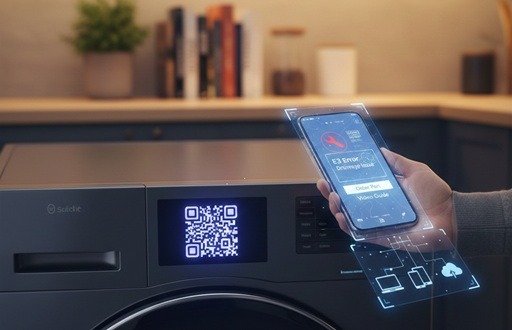
Now imagine instead that appliance has a small QR code on it—maybe dynamic, maybe printed, doesn't really matter. When my dishwasher starts flashing "E3" at me, I scan that code. And because the QR can encode the exact model, serial number, maybe even my registration details if I've set it up before, it takes me directly to a troubleshooting page specifically for my device, showing error code E3, with options to order the replacement part I need, or book an engineer, or watch a video showing me how to clear the filter that's probably causing the problem.
That's not a traditional search—I haven't typed anything into a search box—but it absolutely is search behaviour. It's intent-driven discovery. And from a brand or retailer perspective, it's incredibly high-intent. Someone scanning that code has a problem right now that they need solving. The commercial opportunity is obvious: sell them the part, sell them the service call, sell them the extended warranty they should have bought in the first place.
From an SEO angle, it gets interesting when you realise that these QR-enabled support pages still need to rank in traditional search too. Someone who's lost their manual might still Google the error code. So you're optimising the same content for two different entry points: one where someone's typing keywords, one where they're scanning from the physical device. The content needs work for both, but the scanning route lets you be much more specific about context.
Smart Packaging and In-Store Experiences
Extend this same thinking to product packaging. You're standing in a shop looking at two similar products. One has a QR code that says "Scan for full specs and reviews." You scan it, and instead of just hitting the manufacturer's marketing page, you get routed to a genuinely useful comparison view—maybe even including competitor products—because the brand is confident enough in their offering to be transparent.
Or you're watching TV and an ad shows a QR code. Rather than expecting you to remember a URL or search for the product later, scanning it drops you straight into a mobile-optimised product page, maybe with a discount code applied because you scanned from the ad, maybe with your location detected so it can show you local stockists.
Again, this is search behaviour, just initiated physically rather than textually. And again, the SXO opportunity is in making that transition seamless. The brands that get this right—fast loading, clear next steps, mobile-optimised—will likely see better engagement metrics that feed into their organic search visibility for related queries. For businesses operating across multiple locations or markets, this approach pairs particularly well with SEO localisation strategies to ensure the right language and regional content is served based on scan location.
The Optimisation Opportunity (This Is Where SEO Geeks Get Excited)
Right, so if we accept that QR codes could become legitimate entry points into search experiences, how do we optimise for them? Because that's the practical question, isn't it?
Treat QR Scans as High-Intent Search Queries
First principle: every QR code you deploy should be thought of as a search query with its own keyword strategy, content plan, and analytics setup.
If you're putting a QR code on a washing machine to help with troubleshooting, map out what people are likely trying to accomplish when they scan it. They're not browsing; they're problem-solving. The content behind that code should answer "Why isn't this working?" not "Here's our full product range."
You can even parameterise QR codes to track context. A code on packaging might tag the landing page differently than a code in a manual or on the device itself, letting you understand which entry points lead to the most valuable engagement. This kind of strategic thinking is particularly valuable for enterprise SEO implementations where you're managing hundreds or thousands of products and support resources.
Align with SXO Best Practices
This should go without saying, but I'll say it anyway: QR-driven landing pages need to be fast, mobile-first, and immediately useful. Someone who's scanned a code has demonstrated clear intent; rewarding that with a slow-loading page or a desktop-optimised experience that's unusable on mobile is committing SXO suicide.
Load time matters even more here than in traditional search, because the expectation is instant gratification. Someone typing a search query is somewhat conditioned to wait a second or two for results. Someone who's scanned a physical code expects an immediate response.
You also want clear information architecture and structured data, because these same pages still need to perform in traditional search contexts. Your QR-optimised troubleshooting page for dishwasher error E3 should also rank well when someone Googles "Bosch dishwasher E3 error"—and structured data helps search engines understand that it's a how-to guide, that it's specific to certain models, that it's up to date.
Leverage Cross-Device Tracking (Carefully)
Here's where it gets technically interesting and ethically complex. If you can connect someone's QR scan to their broader browsing behaviour—their earlier desktop searches, their app usage, their purchase history—you can start to understand complete user journeys in a way that's currently quite fragmented.
Did people who scanned the QR code from the TV ad later complete purchases? Did scanning a troubleshooting code on an appliance lead to parts purchases, or did they abandon? If they abandoned, where and why? These insights can feed directly back into how you optimise both the QR experience and your traditional search presence.
But—and this is crucial—this stuff is rightly under heavy regulatory scrutiny. GDPR, evolving privacy regulations, browser restrictions on third-party cookies... you can't just connect someone's physical QR scan to their digital profile without explicit consent and transparency about how that data's being used.
Done ethically, cross-device attribution can make experiences better. Done poorly, it's creepy and probably illegal. The brands that figure out the right balance—useful personalisation with clear consent and control—will have an advantage.
The Bits That Could Go Wrong
I'd be remiss if I didn't talk about the risks, because there are proper pitfalls here that could turn this from "clever SXO play" to "expensive failure."
Privacy and Trust Issues
I mentioned this already, but it's worth emphasising. If someone scans a QR code on their toaster and suddenly starts seeing weirdly specific ads for replacement toasters following them around the internet, that's going to freak them out. The "magic" of seamless experiences can quickly feel like surveillance.
Transparency is everything. If scanning a code is going to link their device to your systems, tell them. If it's going to personalise their experience based on previous interactions, get consent. If you're tracking cross-device behaviour, make it opt-in and give people control.
This is especially critical in regulated sectors. Healthcare devices, financial products, children's toys—there are additional compliance layers that make QR-based cross-device tracking significantly more complex.
Usability Failures
QR codes are only useful when scanning is genuinely easier than the alternative. A QR code that's too small to scan reliably, or placed where it's awkward to get your phone camera lined up, or that requires downloading a special app first, or that loads a page that doesn't work properly on mobile... all of these things actively harm the user experience rather than improving it.
I've seen QR codes on bus shelter ads that are completely unreadable if you're actually waiting for the bus because of the angle. I've seen codes on packaging that redirect to generic homepages rather than product-specific content. I've seen codes that work fine on iOS but break on Android. Every single one of these implementations is worse than just printing a short URL.
And here's the SXO kicker: these failures don't just waste the user's time. They send negative behavioural signals back to search systems. If lots of people scan your QR code, land on your site, and immediately bounce because the experience is broken, that's going to show up as poor engagement metrics that could affect your organic rankings for related queries.
The Complexity Tax
Building robust QR-to-digital experiences requires proper infrastructure. You need multi-link routing that detects device types. You need analytics that can track QR scans as a distinct traffic source and connect them to downstream behaviour. You need content management systems that can serve different experiences based on how someone arrived. You need quality assurance processes that test QR journeys separately from traditional web journeys.
That's all doable, but it's not trivial. Smaller brands or teams without significant technical resources might struggle to implement this well. And half-implemented is often worse than not bothering—it raises expectations and then fails to meet them. For SMEs looking to implement these kinds of advanced strategies, it's worth considering whether to build this capability in-house or partner with specialists who already have the infrastructure sorted.
So Where Does This Leave Us?
Look, I don't think QR codes are going to replace traditional search. I'm not suggesting Google results should just be a page of QR codes. That would be absurd.
What I am suggesting is that we're at an inflection point where physical and digital search behaviours are starting to merge, particularly around IoT devices, and QR codes are a pragmatic, already-familiar mechanism for bridging that gap.
The opportunity is for brands, SEOs, and UX teams to start thinking about QR codes not as novelty add-ons, but as genuine entry points into search experiences that deserve the same strategic attention as keyword optimisation or site speed. Treat them as intent signals. Optimise the experiences behind them using SXO principles. Measure their impact on broader search performance.
The brands that get this right will be the ones that recognise a fundamental truth: people don't care about whether they're doing "traditional search" or "QR-based discovery" or "voice search" or whatever. They just want to solve their problem with minimum friction. If scanning a QR code on my broken dishwasher gets me to a solution faster than Googling error codes, I'll do that every single time.
And from a search perspective, that's not a threat to traditional SEO. It's an expansion of it. It's recognising that the journey to finding information starts in more places than just a search box, and that our job is to optimise all of those entry points to create better experiences.
The future of search might not look like a list of blue links. It might look like a QR code on your fridge that knows exactly what you need when you scan it. And honestly? I think that could be rather brilliant.
Related blog posts:
Mastering AIO with 6 Free AI Tools for SEO Success
The Complete Guide to Schema Markup for UK SMEs: Boost Rankings & Dominate AI Search Results
The Future of Search is Everywhere: Why UK Small Businesses Need Multichannel SEO
Technical Hreflang Implementation Guide: English to Spanish (2026)
Expertise
Senior technical SEO for SMEs in regulated, automotive, funeral and multilingual markets.
Mail to: jj@jjseo.co.uk
© 2026 JJSEO | Jorge Jaroslavsky, Senior SEO Consultant, Leeds
Free SEO Toolsour text here...