
Writing for Two Masters: SEO Content Strategy in Regulated Industries
As a freelance SEO consultant, I work with regulated firms where standard content tactics create real legal risk. This guide covers how to balance Google's E-E-A-T requirements with regulators like the FCA, ASA and SRA.
SMESSEO CONTENTINSURANCE SEOLOCAL SEOESTATE AGENT SEO
Jorge Jaroslavsky
4/7/202612 min read
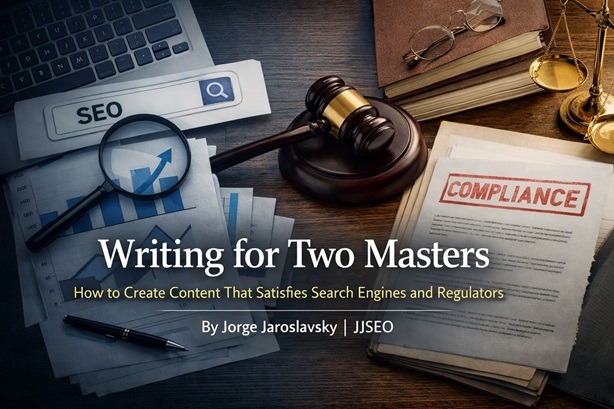

Writing for Two Masters: How to Create Content That Satisfies Search Engines and Regulators
By Jorge Jaroslavsky | JJSEO | Last reviewed: April 2026
There is a tension at the heart of content marketing in regulated industries that most agencies never talk about plainly. On one side, you have Google — an algorithm that rewards confidence, clarity, and authority. On the other, you have financial, legal, and health regulators who are deeply suspicious of exactly that kind of confident, persuasive language. Getting this balance wrong costs you in one of two ways: either your content is so hedged and cautious that it never ranks, or it ranks brilliantly until a regulator comes knocking.
I work exclusively as an Independent SEO consultant across several regulated sectors, and I see this problem repeatedly. Firms arrive with content that reads like it was written by an enthusiastic sales team with no compliance oversight — or the opposite, content so legally sanitised that no human being would voluntarily read it, let alone share it. Neither approach serves you well. This article sets out how I think about the intersection of search performance and regulatory compliance, and why the two are far less at odds than most people assume.
Understanding Who You Are Actually Writing For
Before you write a single word, you need to accept that your content has at least three audiences: the human reader, the search engine crawler, and the regulator. Most content training focuses exclusively on the first two. The third is treated as an afterthought — until it isn't.
Google wants to know whether your content is genuinely useful, written by someone with real expertise, and trustworthy enough to send users to. Its E-E-A-T framework — Experience, Expertise, Authoritativeness, Trustworthiness — has made this increasingly explicit. For topics that affect people's finances, health, or legal standing (what Google calls YMYL, or "Your Money or Your Life" content), the bar is substantially higher than for, say, a recipe blog. Google's quality raters are human beings instructed to ask: would a real expert stand behind this?
Regulators want to know something remarkably similar, but from a legal rather than algorithmic perspective. Whether you are dealing with the UK's Financial Conduct Authority (FCA), the Advertising Standards Authority (ASA), the Medicines and Healthcare products Regulatory Agency (MHRA), the Solicitors Regulation Authority (SRA), or another body entirely, the core question is consistent: could a reasonable person be misled, harmed, or manipulated by this content?
Here is the insight that changes everything about how I approach this work: Google and regulators are essentially trying to solve the same problem. They both want content that genuinely helps people, written by people who know what they are talking about, without tricks or pressure tactics. Truly compliance-first content is not the enemy of good SEO — it is the foundation of it.
Why Standard SEO Techniques Break Down in Regulated Sectors
The typical conversion-rate playbook was not built with regulators in mind. Several standard practices that a general-purpose copywriter might reach for without thinking can create serious problems the moment a regulated firm is involved.
Urgency and scarcity language — "limited time offer," "don't miss out," "last chance" — is considered a dark pattern by financial and consumer regulators. It pressures people into decisions without giving them adequate time to consider their options. The FCA's Consumer Duty rules explicitly identify "foreseeable harm" as something regulated firms must prevent, and time-pressure tactics are a textbook example of exactly that.
Absolute and superlative claims — "the best," "the cheapest," "fully covered," "guaranteed" — are beloved by copywriters because they are punchy. They are also almost always either unverifiable or demonstrably false when applied universally. The regulator's test is straightforward: can you prove this is true for every single person who reads it? If not, you cannot say it.
Oversimplification creates a subtler problem. Writing accessibly is excellent practice, and regulators actively encourage plain English. But there is a difference between clear writing and misleading simplification. Saying a process is "instant" when there is underwriting involved, or that something provides "total protection" when every policy has exclusions, is not plain English — it is inaccuracy dressed up as readability.
Hidden or de-emphasised disclaimers are a particular frustration I encounter frequently. SEO professionals sometimes treat compliance text as a design problem — something to shrink, grey out, or fold into an accordion so it does not disrupt the page layout. Regulators take the opposite view. The FCA, for instance, requires that status disclosures and risk warnings are "clear and prominent," meaning readable font size, strong contrast, and not buried behind a "Read more" toggle.
The Language of Risk: A Practical Substitution Guide
One of the most practical things I do when auditing content for regulated clients is run a simple word search before anything else. The following categories of language are the ones most likely to attract regulatory scrutiny, and for each I will suggest a compliant alternative that still serves your SEO goals.
Absolutes are the highest-risk category. Words and phrases like "cheapest," "best," "guaranteed," "instant," "fully covered," and "no strings attached" all make claims that are almost never universally true. The SEO instinct is to use them because they match search queries — people do search for "cheapest business insurance" — but the solution is not to use the phrase in your body copy; it is to target the keyword whilst using compliant language in the content itself. "Cheapest" in a title tag or H1 is a different conversation to "cheapest" in a promise to the reader.
The substitutions I use most regularly:
"The cheapest option" → "Competitive options from a panel of providers"
"Guaranteed cover" → "Subject to underwriting and policy terms"
"Get covered instantly" → "Start your application online today"
"Best policy for your needs" → "Tailored to your specific circumstances"
"Fully protected" → "Wide-ranging cover — exclusions apply"
"No-hassle claims" → "Dedicated claims support team"
"Stress-free process" → "A straightforward application process"
Urgency triggers such as "offer ends today," "last chance," and "don't miss out" should only appear if there is a genuine, verifiable deadline. Using them as conversion tactics without factual basis is, in the FCA's view, exploiting consumer psychology — and increasingly, the ASA takes a similar position on urgency claims in digital advertising more broadly.
Testimonials and social proof require care in regulated contexts. Claims like "five-star service" must cite the source, platform, and date. "UK's favourite" or "number one broker" require independent substantiation — not an internal survey, but a recognised third-party study. "100% claims payout rate" is almost never accurate and is the kind of claim that tends to appear in enforcement actions.
Jargon presents a different kind of risk. Technical terminology is not necessarily non-compliant, but unexplained jargon fails the "consumer understanding" test that sits at the heart of the FCA's Consumer Duty. If you use a technical term for SEO purposes — because people search for it — you must define it immediately in plain English within the same passage. The term earns you the ranking; the definition earns you the regulator's approval.
The 1:1 Principle: Balancing Benefits and Limitations
One structural framework I apply consistently to product pages in regulated sectors is what I think of as the 1:1 principle. For every benefit or positive feature you describe, a corresponding limitation or exclusion must appear with equal prominence and in close proximity.
This is not just a regulatory requirement — it is also genuinely good content. A reader who understands exactly what a product does and does not cover is a better-qualified lead. They are less likely to make a complaint, less likely to feel misled, and more likely to convert because they have made an informed decision. Balanced content, paradoxically, converts better in regulated sectors because it builds the kind of trust that genuinely drives purchase decisions.
In practice this means that a section titled "What this covers" should be immediately followed by — or paired alongside — "What is not included." These sections should use the same font size, the same visual weight, and ideally the same formatting. Putting benefits in a prominent bulleted list and exclusions in a small-print paragraph at the bottom of the page is exactly what regulators mean when they talk about prominence failures.
From an SEO perspective, this balanced structure also happens to be ideal for featured snippets. Google tends to favour content that answers questions comprehensively, and a well-structured "what's covered / what's not covered" section is precisely the kind of content that earns position zero for product-related queries.
Credentialing and Author Authority
Google's E-E-A-T framework places significant weight on who wrote the content and what qualifies them to write it. For YMYL topics, anonymous content published under a generic "admin" account is treated with suspicion by quality raters. This is an SEO problem, but it is also — almost by coincidence — a regulatory best practice.
In financial services, the FCA's approach to financial promotions requires that content be approved by an authorised person. In legal services, the SRA expects that marketing accurately represents the qualifications and authorisations of the firm. In healthcare, the MHRA and ASA both scrutinise whether health claims are made or endorsed by appropriately qualified individuals.
What this means practically is that blog posts and guides should carry real author bylines, linked to author biography pages that clearly state professional qualifications, relevant experience, and any regulatory registrations. In financial services, this means CII qualifications. In law, SRA registration. In healthcare, GMC, NMC, or relevant professional body registration. The biography page should also link to the relevant regulatory register where the individual or firm can be independently verified.
This serves three purposes simultaneously: it satisfies Google's E-E-A-T requirements, it meets the regulatory expectation of transparency, and it builds genuine trust with the reader. It is one of those relatively rare cases in SEO where doing the right thing and the smart thing are exactly the same action.
Schema Markup as a Compliance and SEO Tool
Structured data — specifically JSON-LD schema markup — is underused in regulated sectors, partly because most SEO practitioners do not think about it in compliance terms. I think about it as both.
For regulated entities, schema markup allows you to formally declare your regulatory status to Google in a machine-readable format. A financial services firm can use the FinancialService schema type and include their firm reference number, regulated status, and links to the relevant regulatory register. A healthcare provider can declare their registrations. A law firm can declare their SRA number.
From a purely SEO perspective, this creates a knowledge graph connection between a relatively small organisation and a highly authoritative government or regulatory body. Google understands that connection. It signals legitimacy. For YMYL queries, that signal matters considerably more than it does for low-stakes content.
There is also a local SEO benefit. A properly structured schema including address, telephone, and service area helps regulated firms appear in Google's local pack — the map results that appear for queries like "financial adviser near me" or "solicitor in Manchester." For a local regulated firm, this is frequently where the most commercially valuable searches resolve.
Date stamps deserve mention here too. Any page containing regulatory, financial, or legal information should include a clearly visible "last reviewed" or "last updated" date. This matters for SEO because Google's quality raters downgrade evergreen content that appears stale. It matters for compliance because advice that was accurate twelve months ago may no longer reflect current rules, rates, or legislation. A date stamp combined with a realistic review schedule is both a search quality signal and a basic duty of care.
Mapping Keywords by Regulatory Risk
One of the most useful things I do at the start of any regulated-sector content engagement is produce what I call a compliant keyword map. Rather than a flat list of target terms grouped by volume and difficulty, this adds a third dimension: regulatory risk level.
Not all keywords carry the same compliance burden. A query like "what is professional indemnity insurance" is low risk. The reader is at the research stage, the content required is primarily educational, and the compliance requirement is essentially to define terms clearly and avoid making unsupported claims. A query like "compare professional indemnity insurance quotes" is high risk. The reader is at the decision stage, the content is directly connected to a commercial transaction, and the regulatory requirements around balance, disclosures, and prohibitions on absolute claims apply in full.
I use a rough three-tier framework:
Low risk — informational queries. "What is," "how does," "do I need," "guide to" queries. The content priority is consumer education. The compliance requirement is plain English, accurate definitions, and a date stamp. These pieces build E-E-A-T authority over time and are relatively straightforward to produce compliantly.
Medium risk — product and service pages. These target keywords with commercial intent — someone looking for a specific type of cover, service, or professional. The 1:1 balance principle applies in full. Required disclosures, risk warnings, and target market statements must be built into the page structure. The compliance review requirement is higher, and these pages should carry the regulated firm's authorisation number and a clear link to the relevant regulatory register.
High risk — comparison, advice, and pricing content. Any content that directly compares providers, makes pricing claims, or answers an "advice-seeking" query ("should I get," "is it worth," "which is better") carries the highest regulatory exposure. These pages require the most careful drafting. Absolute claims are entirely off the table. All pricing references must be qualified. Any advice-type framing must be immediately clarified as information rather than regulated advice, with a clear signpost to seek professional guidance for individual circumstances.
Understanding this map before commissioning any content means you can allocate compliance resource proportionately rather than applying the same level of scrutiny to a definitional blog post as to a comparison landing page. It also helps you have honest conversations with clients about where the greatest risk lies in their existing content estate.
Building a Compliance-Ready Content Process
The compliance and SEO problems I have described above are fundamentally process problems. They arise because content is produced by people focused on rankings and conversion, reviewed (if at all) by compliance professionals who are not embedded in the content workflow, and published before the two perspectives have been properly reconciled.
The solution is not to slow everything down — it is to front-load the compliance thinking so that it shapes the content from the brief stage, not the sign-off stage.
When I work with regulated clients, the workflow looks roughly like this. Before any writing begins, I categorise target keywords by regulatory risk using the framework above. The content brief for a high-risk keyword includes not just the SEO parameters — target keyword, user intent, subheadings, internal links — but also the required disclosures, the specific benefits and exclusions to balance, any sector-specific risk warnings, and the plain-English definitions needed for any technical terms that must be included for search purposes.
Writers working from this kind of brief produce first drafts that are already structurally compliant. The compliance review then becomes a quality check rather than a rewrite — which is both faster and considerably less contentious. Every piece of content that goes through this process generates a sign-off record: who approved it, when, and under what regulatory framework. That record is archived, because financial promotion records typically need to be retained for between three and six years depending on the product and regulator.
There is also value in a regular "regulatory drift" check — a scan of live content for prohibited language that may have crept in through subsequent edits by internal staff who were not part of the original compliance process. This is more common than firms realise. A page that was signed off as compliant in January can be non-compliant by March if someone has tweaked the headline or added a promotional banner without going back through the approval process. Building this check into the ongoing SEO reporting cycle — rather than treating compliance as a one-time event — is what separates a mature regulated-sector content programme from one that is simply hoping for the best.
This is not complexity for its own sake. It is the minimum viable process for a regulated firm that wants to do content marketing without accumulating regulatory risk. And from my experience, it is also the process that produces the best content — because the discipline of explaining things clearly, balancing claims fairly, and citing evidence precisely is, at its core, simply good writing.
The Regulator Is Not Your Enemy Here
I want to close with something that I think is genuinely underappreciated in conversations about regulated-sector SEO. The consumer protection instincts of bodies like the FCA, the ASA, and the SRA are not arbitrary bureaucratic obstacles. They exist because people have been harmed by misleading financial promotions, by health claims that were not substantiated, and by legal services that overpromised. The rules were written in response to real harm.
When I advise clients to replace "guaranteed cover" with "subject to policy terms," I am not just keeping them out of trouble. I am helping them say something true. When I recommend balancing a list of benefits with a matching list of exclusions, the result is not just a more compliant page — it is a more honest one. And in regulated sectors, where trust is the single most important factor in purchase decisions, honesty is the most durable competitive advantage available.
The firms that will rank consistently well in regulated sectors over the next five years are not those that find the cleverest workarounds for compliance requirements. They are the ones that build content programmes serious enough that their compliance becomes a genuine differentiator — something visible to both Google's quality raters and their prospective clients.
That is the case I make to every new client I work with. Not because I am a regulator, but because I have seen enough of how this plays out to know which approach produces better results, and which produces better clients.
If you are looking for specialist SEO support in a regulated sector, I work with a small number of clients at any one time. You can find out more about my compliance-first SEO approach, review my SEO audit process, explore how I handle content strategy for regulated firms, or get in touch directly to discuss whether I can help with your specific situation.
About the author: Jorge Jaroslavsky (JJSEO) is an independent SEO consultant, specialising in regulated industries including financial services, legal, and healthcare. He works directly with clients — no account managers, no juniors — on search strategy, content frameworks, and technical SEO.
Expertise
Driving organic traffic and qualified leads with tailored SEO solutions.
Growth
Results
Mail to: jj@jjseo.co.uk
© 2025 JJSEO. All rights reserved. | Expert SEO Consultant in Leeds
Free SEO Toolsour text here...