
SEO Playbook for B&B Direct Bookings
Practical SEO steps to help your B&B get recommended by AI, build trust online, and win more direct bookings without relying on OTAs.
SMESSEO CONTENTLOCAL SEOB&B SEO
4/27/202610 min read
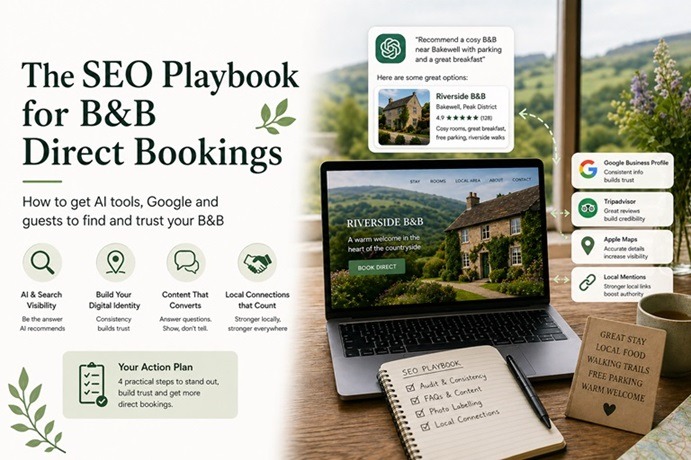
Shortlisted by AI: The 2026 SEO Playbook for B&B Direct Bookings
By Jorge Jaroslavsky | JJSEO.co.uk | 2026
This playbook is written for independent B&B and small guesthouse owners in the UK who want more direct bookings without playing Google's game full-time.
Key Takeaways
AI tools now shortlist B&Bs before many guests open a search results page — consistency and specificity are your main levers.
Your digital identity (name, address, local connections, photos) matters as much as your website content.
Four practical actions — auditing listings, writing FAQs, labelling photos, and one local connection — will put you ahead of most competitors.
A couple planning a weekend break in the Peak District open ChatGPT and type: "Find me a cosy B&B near Bakewell, ideally with parking and a good breakfast." Within seconds, they have a shortlist of three properties. They never see a traditional search results page. They never type anything into Google. If your B&B is not on that shortlist, you do not exist for them.
This is not a hypothetical. It is happening right now in 2026. AI tools like ChatGPT, Google's Gemini, and Perplexity are becoming a first port of call for a growing share of travellers planning short breaks — and that share is growing month on month. Google and OTAs such as Booking.com remain important front doors for guests, but a new one has opened alongside them.
The question is no longer just "Can guests find me on Google?" It is: "Does the AI trust me enough to recommend me?" These are two very different things, and they require two very different strategies.
This article explains exactly what AI systems look for when shortlisting accommodation, and what you can do — practically, without spending a fortune — to become one of the properties they trust.
Why AI Travel Recommendations Have Changed the Game
Until recently, SEO for B&Bs was primarily about Google. You needed a well-built website, a solid Google Business Profile, a handful of good reviews, and ideally a few links from local tourism boards. That still matters. But something significant has shifted alongside it.
AI assistants do not "rank" websites the way Google does. They build a picture of your property from multiple sources — your website, Google Maps, Tripadvisor, booking platforms, local news coverage, social media, review sites — and then decide whether they trust you enough to recommend you. They are looking for consistency, depth, and what is sometimes called "entity strength."
An entity is simply how the internet as a whole "knows" your business. Is your address the same on Google as it is on Apple Maps? Does your Tripadvisor listing describe the same experience as your website? Are there local organisations, businesses, or attractions that mention you by name? The more consistently and richly your property is represented across these sources, the more confident an AI becomes that you are a real, reliable, recommendable place to stay.
Think of it this way: if you were a stranger in a town and asked three different locals for a B&B recommendation, and all three independently mentioned the same place, you would trust that recommendation immediately. AI works similarly — it is looking for corroboration from multiple sources, not just claims from your own website.
Building Your Digital Identity
You do not need to understand how large language models work to benefit from this shift. You need to understand what makes an AI trust a business — and then work through a fairly straightforward checklist.
Get your basics consistent
This is the single most important thing you can do. Your trading name, address, phone number, and website URL must be identical across every platform where your B&B appears. Not similar — identical.
If Apple Maps has your old phone number and Booking.com still shows your previous address, an AI system trying to join the dots has to guess which version is true. Guesswork is the enemy of trust. Keep a simple master document — even a text file — with your official business name, address, phone number, and website URL written out exactly as they should appear everywhere, and copy-paste from that whenever you update a listing.
This means checking and correcting your presence on:
Google Business Profile
Apple Maps (often forgotten, increasingly important as iPhone users ask Siri for recommendations)
Bing Places for Business
Tripadvisor
Booking.com and any other OTAs you use
Your local tourism board directory
VisitEngland, VisitScotland, or VisitWales if applicable
Any local directories, village websites, or walking route guides that mention you
Even small discrepancies create confusion. "The Old Rectory B&B" and "Old Rectory Bed and Breakfast" look similar to a human, but to an AI building a picture of your business, they can appear as two different establishments. Inconsistency erodes trust. Consistency builds it.
Show you are part of a place
One of the most powerful things you can do for your visibility is to become genuinely embedded in your local area — and then make sure that is reflected online.
When you describe your B&B on your website, name your local partners specifically. Not "locally sourced breakfast" but "breakfast featuring sausages from Thornton's Farm in the village and bread from Hawthorn Bakery two streets away." Not "close to local attractions" but "a ten-minute walk from Chatsworth House along the riverside path."
When you name real farms, cafés, walking routes, and attractions, you give AI systems concrete place names they can cross-reference against maps, guides, and other websites. If Thornton's Farm has its own web presence and mentions supplying local accommodation, that cross-reference strengthens your credibility. If the Chatsworth House visitor guide references nearby places to stay, even better.
Contact your local coffee shop, farm shop, or cycle hire company and suggest a simple mutual mention on each other's websites. It costs nothing, benefits both businesses, and is exactly the kind of local connection AI systems use to assess whether a property is genuinely part of a community.
You can take this further with short, specific pages on your website. A page titled "Staying near Chatsworth House without a car" that mentions your B&B, the bus route number, and approximate walk times gives an AI assistant a perfect ready-made answer to a question many guests actually ask.
Answer the questions guests actually ask
A large proportion of AI travel recommendations are triggered by very specific questions. "Is there a B&B near the South Downs Way with secure storage for bikes?" "Where can I stay in the Yorkshire Dales that accepts dogs and has a drying room?" "Is there anywhere near the Cotswold Way with early breakfast for walkers?"
Your website needs to answer these questions explicitly — not hint at them, not bury the answer in a paragraph, but answer them directly. A dedicated FAQ section is the most effective format. Keep each answer to two to five short paragraphs or a clear bullet list; long, meandering answers are harder for both guests and AI systems to parse.
Think about the questions your guests ask before they arrive. If the same enquiry comes in ten times a year, that question deserves a clear, written answer on your website. For example:
"Do you have secure, undercover storage for bicycles?"
"Can you accommodate guests arriving after 9pm?"
"Is the breakfast suitable for coeliac guests?"
"How far is the nearest railway station, and is there a taxi service?"
"Is there parking for vehicles with bikes on the roof or a trailer?"
When an AI assistant is asked a specific question by a traveller, it looks for a source that answers that question directly. If your website has the answer and no one else's does, you have a meaningful advantage in being recommended.
Making Structured Data Work for You
Structured data — sometimes called schema markup — is a way of adding hidden labels to your website so that search engines and AI systems can understand what they are reading. You do not see it as a visitor, but it tells the machine: "This is a bed and breakfast. It has eight rooms. Check-in is from 3pm. Breakfast is included. It accepts dogs."
If your website was built on WordPress, plugins such as Rank Math or Yoast handle much of this without any coding. If you use another platform, your web developer can add it relatively quickly. Ask them to use JSON-LD — the format Google recommends — rather than older methods buried inside the page HTML. The key types of structured data for a B&B are:
LodgingBusiness or BedAndBreakfast — the core business type, confirming what you are
amenityFeature — listing specific features such as parking, dog-friendly, Wi-Fi, drying room
Offer — highlighting direct-booking-only rates or room-specific inclusions
FAQPage — marking up your FAQ section to help AI systems identify specific question-and-answer pairs
FAQPage schema helps Google and AI systems understand that your page is directly answering specific guest questions — and in some cases it can still surface those answers directly in search results without the guest needing to click through to your website at all. You become the authoritative answer.
You can also use structured data to highlight what you offer exclusively to direct bookers — a welcome bottle of wine, a later checkout, a discount on stays of three nights or more. OTAs cannot replicate this information in their listings, which means guests looking for the best overall deal are guided towards booking directly with you.
Your Photos Are Working Against You (And How to Fix It)
Why most B&B photos fail
Most B&B photos are technically fine and commercially useless. A crisp image of a bed against a white wall tells a guest almost nothing that helps them decide. It tells an AI even less.
Guests in 2026 are increasingly searching by feel — they want the cosy reading room with the wood-burning stove, the garden table with the countryside view, the bathroom with the freestanding bath. Tools like Google Lens and built-in visual search on smartphones let travellers point at a photo and ask "where can I stay that looks like this?" If your photos are not labelled, you will never be in the running.
How to make your photos AI-friendly
The fix is not necessarily to hire a more expensive photographer. It is to be deliberate about how you label and describe your images.
Rename every image file with a descriptive name before uploading it. "IMG_4832.jpg" is meaningless. "garden-view-breakfast-table-derbyshire-bb.jpg" tells a search engine exactly what it is looking at.
Write alt text for every image that describes the experience, not just the object. Not "bedroom" but "Double room with countryside views and king-size bed, Hathersage B&B." Keep it natural — one or two descriptive phrases is enough; avoid stuffing in extra keywords.
Add captions beneath key images on your website that describe what guests will experience, not just what they are looking at. "This is where guests have breakfast — eggs from our neighbour's hens, views across the valley towards Mam Tor."
These descriptions give AI systems the vocabulary they need to match your property to the way guests are searching. When someone asks "find me somewhere cosy with a garden and countryside views in Derbyshire," correctly labelled photos and descriptions make you findable in ways a generic gallery never will.
The Direct Booking Opportunity: What OTAs Cannot Copy
Industry data consistently shows that a significant proportion of travellers — studies suggest anywhere between 15% and 25% depending on the segment and channel — research accommodation on an OTA but then visit the property's own website before deciding where to book. They are using the OTA as a discovery tool, not as their booking platform.
Your job is to make sure that when they find you — whether through an OTA, a Google search, or an AI recommendation — your own website is clearly the better place to complete the booking. This is not about undercutting OTA pricing; many platform agreements have rate parity clauses that require your base room price to match (check your agreement, as some do allow value-adds as long as the room rate itself is the same). It is about offering genuine value that no OTA listing can provide.
This might include:
A flexible cancellation policy for direct bookers that is more generous than your OTA terms
Room upgrades when available for guests who book directly
Early check-in or late checkout without additional charge
A local guide, a pre-arrival message from you personally, or a welcome bottle of something local
The ability to make special requests directly — a birthday cake, a specific pillow preference, travel advice from someone who actually lives there
Use your structured data to highlight these direct-booking benefits so that AI systems can present your property as the more complete option, even when a guest first encounters you on a third-party platform.
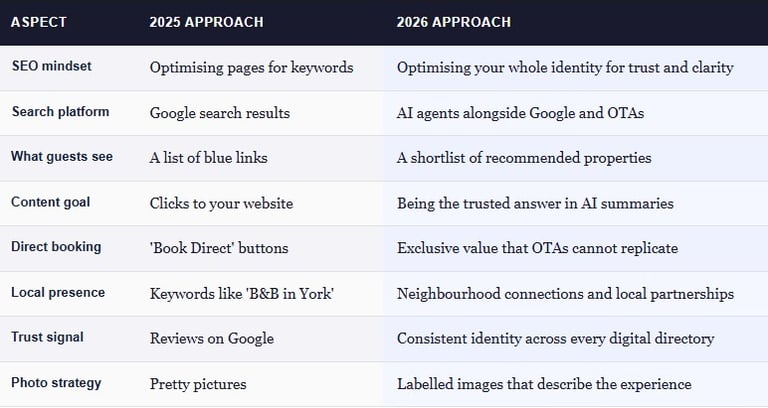
2025 vs 2026: What Has Changed
Here is a straightforward comparison of how the approach to B&B SEO needs to shift. If you are still focusing entirely on the left-hand column, you are working hard for diminishing returns.
A Practical Starting Point: What to Do This Month
If you take nothing else from this article, take these four actions. They do not require a large budget. They do require a few hours of honest, methodical work.
1. Audit your listings (1–2 hours). Search for your B&B on Google, Apple Maps, Bing, Tripadvisor, and any OTAs you use. Write down your business name, address, and phone number from each source. If anything differs, correct it. Keep a master copy somewhere safe so it never drifts again.
2. Write ten FAQ answers (2–3 hours). Think of the ten questions guests ask you most often before arrival. Write a clear, specific answer to each one — two to five short paragraphs or a bullet list per question — and publish them as a dedicated FAQ page on your website. Then ask your web developer to add FAQPage schema markup in JSON-LD format.
3. Rename and describe your photos (1–2 hours). Go through your website images. Rename the files descriptively, write alt text that describes the experience, and add a caption beneath any image that does not already have one.
4. Make one local connection (1 hour). Contact one nearby business — a farm, a café, a cycle hire, a local producer — and suggest a mutual mention on each other's websites. One genuine local connection is a start. Build from there, one conversation at a time.
If you would like help implementing these four actions, that is exactly the kind of project I take on for independent B&Bs — Services and Pricing.
The Bigger Picture
None of this is about gaming an algorithm. It is about making sure that what is genuinely good about your property is clearly, consistently, and specifically communicated across the internet in a way that both human guests and AI systems can understand.
The B&Bs that will do well in 2026 and beyond are not necessarily the ones with the biggest marketing budget. They are the ones with the strongest sense of identity — who they are, where they are, what they offer, and why a guest would be better off booking directly with them than through a platform that takes 15–20% of every booking.
AI has not made that harder to communicate. If anything, it has created a new opening for independent operators who know their story and can tell it clearly. The OTAs have scale. You have specificity. That is your competitive advantage — and it is exactly what AI systems are designed to surface.
If you would like a free audit of how your B&B currently appears across search engines and AI platforms — and a shortlist of the three to five fixes that would make the biggest difference — get in touch at jjseo.co.uk. No jargon, no hard sell, just a clear picture of where you stand.
About the author
Jorge Jaroslavsky is an independent SEO consultant specialising in hospitality and small businesses in the UK. I work directly with B&B owners — no account managers, no junior staff.
Expertise
Senior technical SEO for SMEs in regulated, automotive, funeral and multilingual markets.
Mail to: jj@jjseo.co.uk
© 2026 JJSEO | Jorge Jaroslavsky, Senior SEO Consultant, Leeds