
How to Fix Duplicate Content on Your Campervan Dealer Stock Listings
How to fix duplicate content on campervan dealer stock listings, write unique vehicle descriptions, and stay visible in Google's AI Overviews.
AUTOMOTIVE SEOTECHNICAL SEOSMESLOCAL SEO
Jorge Jaroslavsky
6/18/202611 min read
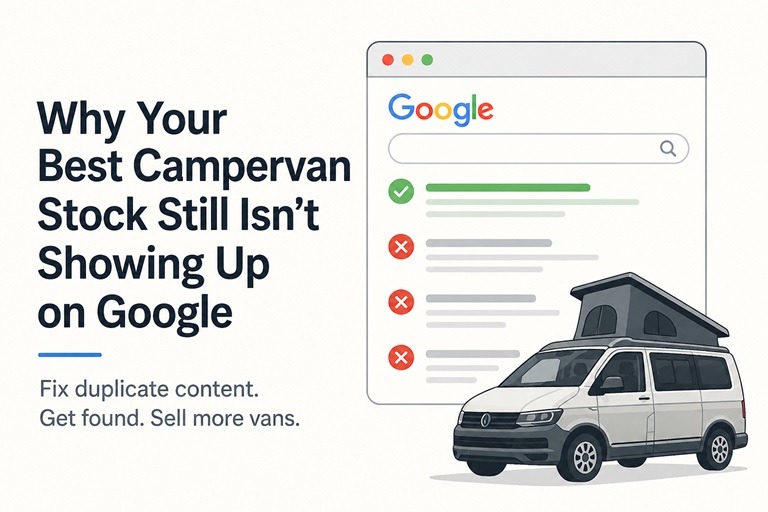
Why Your Best Campervan Stock Still Isn't Showing Up on Google
If you run an independent campervan dealership, I'd put money on this being one of the most frustrating problems you've faced with your website. You've got a forecourt full of brilliant stock — pop-top conversions, fixed-roof California-style builds, the odd RIB or Wellhouse gem — and yet your listings barely show up on Google, even for the exact model and conversion someone's searching for.
In nearly every case I investigate, the root cause is the same: duplicate content. It's quietly strangling the visibility of your stock pages, and most dealers have no idea it's happening. You can read more about my background and experience on the About Me page.
I've written this guide specifically for owners of independent campervan dealerships — not the high-volume car supermarkets, not the big motorhome chains, but the dealers who genuinely know every van on their forecourt by name. Your website deserves to compete on the strength of that knowledge, and fixing duplicate content is the single biggest lever you have to make that happen.
Why Campervan Dealers Get Hit Harder Than Most
Here's something I've noticed repeatedly: campervan dealers suffer from duplicate content more severely than almost any other vehicle sector, and there's a simple reason for it.
A campervan isn't one product — it's two layered on top of each other. You're selling a base vehicle (a VW Transporter, a Ford Transit Custom, a Mercedes Sprinter, a Vauxhall Vivaro) and a conversion (pop-top or fixed roof, RIB, Wellhouse, Danbury, a bespoke self-build, or your own in-house conversion). Your stock management system, however, was almost certainly built for a standard car dealer who just needs "Make, Model, Year, Mileage, Price." It has no real concept of "conversion brand," "berth layout," or "roof type" as differentiating fields.
The result is that your stock platform generates near-identical templated pages for vans that are, in reality, completely different propositions. A 2018 VW T6 with a pop-top and a swivel seat is a different buying decision to a 2018 VW T6 panel van with a fixed high-top and rock-and-roll bed — but if your website describes both with the same boilerplate paragraph, Google can't tell them apart either. Add in stock feed integrations, filter pages, and sold vehicles left lingering in the index, and you've got a website fighting itself for rankings.
The good news is that every one of these problems is fixable, and none of them require a website rebuild. Let's go through them properly.
1. Canonical URLs: Your First Line of Defence
Every campervan in your stock should have exactly one clean, indexable URL. In practice, most dealer platforms generate several variants of the same listing without you ever asking for them:
/stock/vw-t6-california/?colour=white
/stock/vw-t6-california/?sort=price
/stock/vw-t6-california/?utm_source=facebook
/stock/vw-t6-california/?ref=homepage-feature
To Google, these aren't four views of one van. They're four separate, near-identical pages competing against each other — and competing against you.
The fix: add a self-referencing canonical tag to every stock page, pointing at the clean version of the URL:
<link rel="canonical" href="https://yourdealership.co.uk/stock/vw-t6-california-2018/">
This tells Google exactly which version to index and consolidates all the ranking signals — links, engagement, relevance — onto that single page rather than splitting them across four. If your stock system is built on a common platform like AutoTrader Dealer Sites, BigWave, Carworld, or a bespoke WordPress build, this is usually a five-minute job for a developer. It's also one of the highest-leverage fixes on this entire list, so if you only do one thing after reading this article, do this.
2. Stop Filter and Faceted Pages From Being Indexed
Filter pages are genuinely useful to a customer browsing your site. They are far less useful to Google, and when they get indexed, they actively work against you.
On a campervan dealer site, these typically look like:
/stock/?conversion=pop-top
/stock/?berths=4
/stock/?base-vehicle=vw-transporter
/stock/?transmission=manual&fuel=diesel&berths=2
Each combination of filters can generate its own URL, and a site with even a modest stock list can spin off hundreds, sometimes thousands, of these thin, overlapping pages. None of them offer anything genuinely unique — they're just different slices of the same underlying stock list — so Google treats them as duplicate or near-duplicate content.
Your fix options:
Add noindex, follow to all filter and faceted URLs — my preferred approach, as it keeps the crawl paths open (so Google can still discover your actual stock pages through them) without polluting the index with junk.
Block them in robots.txt if there's no need for them to be crawled at all.
Canonicalise them back to the main stock page, if you'd rather keep things simple.
For most independent dealers, noindex, follow is the sensible default. It lets customers keep filtering by berths, conversion type, or base vehicle without any SEO downside.
3. Write a Genuinely Unique Description for Every Van
This is the one I see neglected most often, and it's the one that costs dealers the most in lost visibility. Most stock management systems ship with a templated description, and most dealers — understandably, given how busy a forecourt gets — leave it largely as-is and just swap out the registration and price.
Google sees straight through this. If forty of your listings share the same 150-word paragraph with only the mileage and price changed, Google doesn't see forty unique products. It sees one piece of content copied forty times, and it will only bother to properly index a handful of them.
For a campervan specifically, you have far more genuinely distinguishing detail available than a standard car dealer ever would. Use it. A strong listing description should include:
Conversion specifics — pop-top or fixed roof, RIB, Wellhouse, Danbury, in-house build, swivel seats, rock-and-roll bed, pull-out kitchen, awning
Layout and berths — two-berth or four-berth, side or rear kitchen, fixed bed versus convertible
Service and ownership history — main dealer history, number of previous owners, recent work carried out
Condition notes specific to that van — tyre condition, habitation check date, damp report results, gas safety certificate
Dealer-specific extras — your own warranty terms, finance options, part-exchange welcome, delivery available
Even 100–150 words of genuinely unique content per listing is usually enough to lift a page out of "duplicate" territory in Google's eyes. You don't need an essay — you need specificity. "Recent habitation check passed, no damp readings, awning and bike rack included, two owners from new" tells Google (and your buyer) far more than "Lovely example of this popular conversion, ready to go."
If writing forty unique descriptions feels daunting, prioritise: do it for your higher-value stock first, and build it into your process for every new arrival going forward rather than trying to retrofit your whole forecourt in one sitting.
4. Handle Sold Vans Properly
This is where I see otherwise well-run dealer websites lose the most SEO value, almost always without realising it.
The three common mistakes:
Deleting the listing the moment it sells, which throws a 404 error at anyone who finds it via a saved link, an old search result, or a bookmark.
Leaving it live and indexable indefinitely, which builds up duplicate and outdated content over time as your "Sold" section grows.
Redirecting every sold listing straight to /stock/, which Google increasingly treats as a soft-404 signal — it knows you're masking a missing page rather than genuinely redirecting to an equivalent one.
Fix Option A — keep the page live (my preferred approach for most dealers): Add a clear "Sold" badge, remove the enquiry and finance calculator CTAs, keep the written content indexable, and link out to similar current stock ("Looking for something similar? See our current VW T6 conversions"). This preserves the page's accumulated link equity and search visibility, and it genuinely helps buyers — a sold listing for "2017 VW T6 pop-top, Wellhouse conversion" is exactly the kind of page that can keep attracting relevant traffic for years, even with nothing to sell.
Fix Option B — redirect to a near-identical replacement: Only use this when you have a genuinely comparable van in stock — same base vehicle, same conversion type, similar spec. Never redirect every sold van to your generic stock page; that's the soft-404 problem in disguise, just one step removed.
5. Use Structured Data to Differentiate Listings
Structured data (schema markup) is how you explicitly tell Google "this is a distinct product, here are its attributes" rather than hoping it works that out from your page layout.
The fix:
Use Product schema on every stock listing, with unique attributes filled in — make, model, conversion, mileage, price, condition.
Mark sold vehicles correctly with "availability": "https://schema.org/SoldOut" rather than leaving stale "in stock" signals in place.
Avoid copying the exact same dealer-level schema block across every single listing without adjusting the vehicle-specific fields — that's just duplication wearing a different hat.
Google's own published guidance is clear that structured data isn't a strict requirement for visibility, including in AI-powered search features, but it remains a genuinely useful way to remove ambiguity about what a page represents — and ambiguity is exactly what causes duplicate content problems in the first place.
6. Fix Pagination Duplication
A healthy stock list creates paginated browsing pages — /stock/page/2/, /stock/page/3/, and so on. These pages are mostly the same template repeated with a different slice of vans, and left unmanaged, they can get indexed as near-duplicates of your main stock page.
The fix: canonicalise paginated pages back to the primary stock listing page:
<link rel="canonical" href="https://yourdealership.co.uk/stock/">
This keeps pagination fully crawlable — so Google can still discover every individual van listing by following the pagination trail — while preventing the paginated shells themselves from cluttering the index.
7. Stop Reusing One Template Across Every Example of a Model
If every VW T6 California you've ever listed uses the same template, the same stock photography angles, and the same three sentences of copy with only the registration changed, Google will quite reasonably conclude these are low-value, repetitive pages — even though to you, each one is a completely different van with its own history.
The fix: build in points of genuine differentiation for every listing, even within the same base model and conversion:
Exact mileage and age
Specific conversion extras (solar panel, leisure battery upgrade, drive-away awning)
Condition and cosmetic notes
Your own commentary — why this particular van stands out, who it would suit, what you'd say to a customer walking onto the forecourt and pointing at it
That last point matters more than it might seem. A line or two of genuine, first-hand dealer opinion — "This is one of the tidiest low-mileage T6 conversions we've had through in a while" — is exactly the kind of distinctive, experience-based content that both Google's classic ranking systems and its newer AI-driven search features are designed to reward over generic, interchangeable copy.
8. Don't Let Third-Party Platforms Outrank Your Own Listings
Most campervan dealers syndicate stock to platforms like Auto Trader, eBay, Gumtree, Facebook Marketplace, and campervan-specific marketplaces. There's nothing wrong with that — it's good practice for visibility and lead volume. The problem arises when your own website's version of the listing is thinner or less complete than the version sitting on a third-party platform, because Google will then quite happily index and rank the third party's page in place of yours for that exact van.
The fix:
Publish on your own site first, before or at the same time as syndicating elsewhere.
Make your own version the richest version — more photos, fuller description, your dealer-specific extras and warranty terms.
Keep page speed and image quality strong; third-party platforms are often faster and more mobile-optimised than ageing dealer websites, and that counts against you.
Strengthen internal linking into and around your stock pages (more on this below).
The aim is straightforward: you want to be the canonical, most complete, most useful source for every van you sell — not Auto Trader's mirror of your own stock.
9. Use Internal Linking to Reinforce Each Listing's Uniqueness
Internal linking gives Google context about how a page fits into your wider site, and it's a genuinely underused tool for combating duplicate content signals on dealer websites.
The fix: link each stock listing out to genuinely relevant supporting content, such as:
A buyer's guide to that base vehicle ("What to look for when buying a used VW T6")
Your finance and part-exchange pages
A guide to that specific conversion brand, if you stock it regularly
Model-specific blog content — maintenance tips, common faults, conversion comparisons
Each of these links builds a slightly different web of context around each listing, which helps Google see every page as occupying its own distinct place in your site rather than as one of forty interchangeable stock pages.
10. Duplicate Content, AI Overviews, and Why This Matters More Than Ever
It's worth being upfront about something that's changed the SEO landscape since the basics of this guide were first written: Google increasingly answers searches directly on the results page itself, through AI Overviews, rather than sending people straight to a list of ten blue links. For searches like "best VW T6 campervan conversions for sale near me" or "is a pop-top or fixed roof better for a campervan," there's a real chance the searcher sees an AI-generated summary before they see your listing at all.
Google has been explicit that the foundational SEO practices in this guide — clean indexable pages, reducing duplicate content, and genuinely helpful, original content — remain exactly what determines whether a page is eligible to be pulled into these AI-generated summaries as a cited source. There's no special extra technical trick; a page still has to be properly indexed and free of the duplication and thin-content issues we've covered above before it even gets considered.
What's changed is the bar for what gets selected once a page is eligible. Generic, templated descriptions are exactly the kind of "commodity content" that AI systems tend to skip over in favour of pages that demonstrate first-hand knowledge and a distinct point of view — which, conveniently, is exactly what fixing your duplicate content problem naturally produces. A dealer who writes "recent habitation check passed, no damp, two owners, drove this one myself before listing it" is giving Google something specific and credible to draw on. A dealer who's left the default template in place across forty listings is giving it nothing to differentiate on at all.
For an independent campervan dealer, the practical takeaway is this: fixing duplicate content isn't just about getting your existing rankings back. It's increasingly the baseline requirement for being visible at all in a search results page that's leaning more heavily on AI-generated summaries every year. The dealers investing in unique, specific, well-structured listings now are the ones who'll still be visible when more of their competitors' generic stock pages quietly disappear from view.
11. Keep Monitoring — This Isn't a One-Off Job
Duplicate content has a habit of creeping back in. New filter combinations get added when you tweak your stock search. A developer makes a change to the URL structure and forgets the canonical tags. A sold van gets deleted by someone covering for you on a Saturday afternoon. None of this is anyone's fault — it's just the nature of running a live, regularly updated stock website.
A simple quarterly check is usually enough for most independent dealers:
Search site:yourdealership.co.uk to see what Google currently has indexed, and look for filter URLs or obvious duplicates that shouldn't be there.
Check Google Search Console's "Pages" report for anything flagged as "Duplicate, Google chose different canonical than user" — this tells you exactly where your canonical tags aren't being respected.
Spot-check a handful of sold listings to make sure they're either properly indexed with a "Sold" badge or correctly redirected, not sitting as 404s or soft-404s.
Read through a sample of your live listings and ask yourself honestly: could a customer tell these apart from the text alone?
Quick Reference Checklist
Canonical tag on every stock page, pointing to the clean URL
Filter and faceted pages set to noindex, follow
Every listing has a genuinely unique 100–150 word description
Sold vans handled with a "Sold" badge and kept indexable, not deleted or mass-redirected
Product schema in place, with SoldOut availability used correctly
Paginated stock pages canonicalised to the main stock page
No two listings of the same model/conversion read identically
Your own website's listing is the richest version available anywhere
Stock pages link out to relevant guides, finance pages, and model content
A quarterly check in Search Console to catch new duplication before it spreads
Final Thoughts
Duplicate content is, in some sense, inevitable on a dealer website — the platforms and feed integrations most of us rely on simply weren't built with campervans in mind. But it's entirely fixable, and the dealers who fix it properly tend to see the difference within a matter of weeks rather than months: more impressions, more of the right enquiries, and stock that actually gets found by the people searching for exactly that van.
For an independent campervan dealership, that's not a marginal gain. It's the difference between your forecourt's best vans being found by a genuinely interested buyer, or quietly losing that buyer to a third-party listing — or to an AI-generated summary that never mentions you at all.
If you're unsure whether duplicate content is affecting your campervan stock pages, get in touch and I'll be happy to take a look.
Expertise
Driving organic traffic and qualified leads with tailored SEO solutions.
Growth
Results
Mail to: jj@jjseo.co.uk
© 2025 JJSEO. All rights reserved. | Expert SEO Consultant in Leeds
Free SEO Toolsour text here...