
Hreflang for Spanish: ES vs Latin America Guide 2026
Master hreflang implementation for Spanish markets. Learn when to use es-es, es-419, or country codes like es-mx. Practical guide from a Leeds SEO consultant with real examples and decision frameworks for 2026
TECHNICAL SEOMULTILINGUAL SEO
Jorge Jaroslavsky
12/10/202514 min read
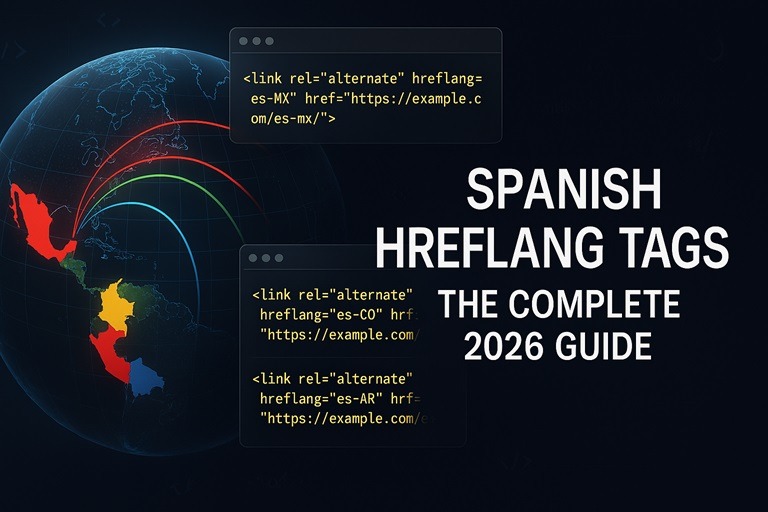
Hreflang Tags for Spanish (ES) vs. Latin American Spanish Variants: The Ultimate 2026 Guide
Hreflang tags are still the core signal for telling Google which Spanish version to show in each market, and the key decision for 2026 sites targeting Spanish is whether to use a single global es, a country code like es-es, or regional variants such as es-mx or es-419 for Latin America. As a multilingual freelance SEO consultant in Leeds, I find that the right choice depends less on theory and more on how different your Spanish variants really are, how your URL structure looks, and what your analytics are telling you.
What Hreflang Actually Does
Hreflang is an attribute that signals the language (and optionally region) of a URL so that Google can swap in the most suitable version in the search results without treating them as duplicate content. In practice, it lets me say "this URL is in Spanish for Spain, and this other one is in Spanish for Mexico" whilst keeping them both indexable and mapped as alternates.
The attribute always follows the pattern language-REGION, using ISO 639-1 language codes (like es, en) and ISO 3166-1 country codes (like ES, MX). If I only specify es, Google reads that as "for Spanish speakers globally", whereas es-es narrows the intent down to Spanish speakers in Spain.
It's important to understand that hreflang functions as a hint rather than a directive. As Google reminded the SEO community in May 2025, these tags are suggestions that work alongside other signals like canonical tags, site structure, and content similarity. Even with perfect implementation, Google may still choose to show a different variant based on user context, which is why monitoring performance across regions remains essential throughout 2026.
Spain vs Latin America in Hreflang
For Spanish in Spain, the standard hreflang code is es-es, which explicitly targets users in Spain using European Spanish conventions. When a site has clearly local content for Spain (currency in euros, "código postal", "móvil", legal notices for Spanish law), I almost always map that content to es-es rather than a generic es.
For Latin America, there are two main approaches. One is using country-level codes like es-mx (Mexico), es-ar (Argentina) or es-cl (Chile) when content, currency and legal details differ by country. The other is the regional code es-419, which denotes "Spanish for Latin America and the Caribbean" and can be useful when there is a single pan-LatAm version that's different from Spain but not deeply localised to each country.
The es-419 code is an IETF language tag where "419" comes from the UN M.49 regional code representing Latin America and the Caribbean. It was specifically registered to identify a neutral variant of Latin American Spanish that distinguishes it from Castilian Spanish found in Europe. This makes it particularly valuable for businesses that want to serve the Latin American market with content that uses regional terminology like "celular" instead of "móvil" or "computadora" instead of "ordenador", without maintaining separate versions for each country.
When to Use Just "es"
Google accepts a bare language code like es as "Spanish language, no specific country targeting", and will serve it to Spanish speakers in any market where no more specific match exists. On smaller or resource-constrained projects, I often start with a single high-quality Spanish version using es and only split into es-es or es-mx once traffic and leads justify extra maintenance.
Using es as a catch-all works best when the content is relatively neutral: no country-specific slang, generic currency references ("prices on request"), and contact details that make sense from any Spanish-speaking country (e.g. an online SaaS rather than a local plumber in Málaga). If your wording, pricing, or regulations depend heavily on Spain or a given Latin American country, moving beyond a single es version usually improves both conversion and click-through rates.
From what I've seen in client analytics, a generic es version typically performs adequately when you're just testing the Spanish market, but conversion rates can improve by 15-30% once you properly segment Spain from Latin America with appropriate localisation. This isn't just about language differences—it's about trust signals like local payment methods, shipping information, and legal compliance indicators that reassure users they're in the right place.
How es-ES vs es-419 Works in Practice
The locale es-es indicates Spanish for Spain; this is what I use for content written with Iberian Spanish spelling, "usted/tú" choices tailored to Spain, and references to Spanish geography, currencies and law. It aligns with how many CMSs label Spanish (Spain) and avoids ambiguity when you are also targeting Latin America with different content.
The locale es-419 is a special IETF language tag where "419" is a UN regional code representing Latin America and the Caribbean, and it is recognised by Google for hreflang. I reserve es-419 for situations where there is a distinct LatAm variant (e.g. "celular", "código ZIP", regional payment methods) but I do not yet have the capacity to maintain 10–15 separate es-XX country sites.
When deciding between these two approaches, I typically ask clients about their customer service capabilities. If you can only handle enquiries in one Spanish variant and your team isn't familiar with Latin American terminology or payment systems, starting with es-es for Spain and adding es-419 later makes more sense than spreading resources too thin. However, if you're seeing significant organic traffic from Mexico, Argentina, and Colombia in Search Console, the business case for es-419 becomes compelling quickly.
One practical consideration I've encountered: es-419 content needs careful copywriting. It's not simply "Mexican Spanish" or "Argentine Spanish"—it's a neutral variant that avoids region-specific slang whilst incorporating terminology that feels natural across Latin America. I often work specifically in this neutral LatAm Spanish, and the extra investment in getting the tone right pays dividends in engagement metrics.
Country-Level Latin American Variants
When a business has a strong presence in specific Latin American markets, deeper localisation with country-level hreflang is more accurate than a single regional es-419. For instance, using es-mx for Mexico, es-ar for Argentina and es-co for Colombia ensures that Google can pick the most precise match for each user's market. This becomes particularly important when each country page has its own pricing in local currency, local phone numbers, and different legal or delivery conditions.
From a technical angle, country-level hreflang also aligns better with geo-targeted Search Console properties, country-specific ccTLDs, and separate subfolders like /mx/, /ar/, and /co/ under a gTLD. In my consulting work, I usually suggest starting with your top two or three revenue markets and only later expanding to secondary countries once those are consistently performing.
Mexico deserves special mention because it represents roughly 30% of the Latin American Spanish-speaking market and has distinct consumer behaviour patterns. I've seen e-commerce clients achieve 40% higher conversion rates on es-mx pages compared to generic es-419, particularly when they integrate local payment methods like Oxxo and Mercado Pago. Argentina and Colombia similarly benefit from country-specific targeting when businesses can support local fulfilment and customer service.
The challenge with country-level variants is maintenance overhead. Each additional country multiplies your content management burden: you need to update promotions, check legal compliance, and ensure currency converters work correctly. For B2B SaaS clients in the UK targeting Latin America, I typically recommend starting with es-419, monitoring performance by country in Google Search Console, and splitting off es-mx when Mexican traffic justifies the investment. Then es-ar and es-co follow based on commercial priorities rather than trying to launch 15 countries simultaneously.
Recommended URL Structures for Spanish Variants
Hreflang annotations work best when the URL structure clearly reflects language and region choices. Typical patterns that integrate well with multilingual SEO are example.com/es-es/ and example.com/es-419/ under a .com domain, or completely separate ccTLDs such as example.es for Spain and example.com.mx for Mexico. Search engines do not require the region code in the path, but keeping it consistent with hreflang values simplifies audits and CMS configuration.
For many small and medium projects, a pragmatic structure is:
example.com/es/ for Spain, tagged es-es
example.com/es-419/ (or /latam/) for Latin America, tagged es-419
Additional country folders (like /mx/) only where there is a clear commercial case
This gives room to grow from a simple Spain vs LatAm split into a more granular setup without rewriting the whole URL hierarchy later.
I've seen clients struggle when they start with example.com/es/ tagged as just "es" and then try to add Spain-specific content later. The migration to example.com/es-es/ and example.com/es-419/ requires careful 301 redirects, updated hreflang, and communication with users. Starting with a forward-looking structure—even if you only have one Spanish variant initially—saves considerable technical debt.
Country-code top-level domains (ccTLDs) like .es for Spain or .com.mx for Mexico provide strong geographic signals to Google, but they also limit flexibility. If your Spanish site is on example.es, expanding to Latin America means either buying example.com.mx or creating a subdomain structure, both of which fragment authority. For clients with global ambitions, I typically recommend a .com with subfolder structure, reserving ccTLDs for markets where local trust signals justify the investment.
Basic Hreflang Implementation Patterns
There are three main methods for implementing hreflang that are still valid going into 2026: HTML <link> tags, XML sitemaps, and HTTP headers for non-HTML resources. For most Spanish SEO projects I handle, XML sitemaps scale better, whilst inline tags in the <head> are convenient for one-off landing pages or where dev resources are limited.
The core rules remain: every language version must list all alternates (including itself), all URLs referenced must return a 200 status and be indexable, and there must be reciprocal linking—if page A points to page B via hreflang, page B must also point back to page A. Missing reciprocals, canonical conflicts, and pointing hreflang at redirected or non-indexable URLs are still the main reasons why hreflang fails silently.
Recent studies show that 67% of websites have issues with their hreflang implementation, with the most common problems being missing return links and incorrect ISO codes. I audit hreflang setups using tools like Screaming Frog and Semrush's Site Audit, and these errors appear consistently even on large enterprise sites. The good news is that once you establish a solid pattern, maintaining it becomes straightforward.
Example Setup: ES vs LatAm in HTML
On a simple two-version setup with one page for Spain and one for Latin America, I would annotate the head of each HTML document with a small set of <link rel="alternate"> tags. Here's what that looks like in practice:
On the Spain page (example.com/es-es/page):
<link rel="alternate" hreflang="es-es" href="https://example.com/es-es/page" />
<link rel="alternate" hreflang="es-419" href="https://example.com/es-419/page" />
<link rel="alternate" hreflang="x-default" href="https://example.com/" />
The Spain page declares itself as es-es and the LatAm page as es-419, with both also optionally sharing an x-default pointing to a language selector or the safest general version for users whose language or region is unknown.
On the Latin American page (example.com/es-419/page):
<link rel="alternate" hreflang="es-419" href="https://example.com/es-419/page" />
<link rel="alternate" hreflang="es-es" href="https://example.com/es-es/page" />
<link rel="alternate" hreflang="x-default" href="https://example.com/" />
This symmetry is what allows Google to reliably swap between the right versions whilst treating them as alternates rather than duplicates. Note that each page includes a self-referencing tag—this confirms the page's intended audience and is essential for proper function.
Example Setup: Using Sitemaps for Scale
Once a site has many Spanish variants and hundreds or thousands of URLs, putting hreflang in XML sitemaps is usually easier to maintain than editing HTML templates or plugins. Each URL entry in the sitemap can include alternate versions for Spain (es-es), Latin America (es-419), and any country-level variants.
Here's an example of how this looks in an XML sitemap:
<url>
<loc>https://example.com/es-es/page</loc>
<xhtml:link rel="alternate" hreflang="es-es" href="https://example.com/es-es/page"/>
<xhtml:link rel="alternate" hreflang="es-419" href="https://example.com/es-419/page"/>
<xhtml:link rel="alternate" hreflang="x-default" href="https://example.com/"/>
</url>
<url>
<loc>https://example.com/es-419/page</loc>
<xhtml:link rel="alternate" hreflang="es-419" href="https://example.com/es-419/page"/>
<xhtml:link rel="alternate" hreflang="es-es" href="https://example.com/es-es/page"/>
<xhtml:link rel="alternate" hreflang="x-default" href="https://example.com/"/>
</url>
This is also less error-prone when multiple dev teams or CMSs are involved because all mapping is centralised in one or a few files.
Search Console continues to support hreflang via sitemaps, and it's a good practice to create separate properties for key subdomains or subfolders (for example, /es-es/ and /es-419/) so that you can monitor indexing and geographical performance per version. Being able to see impressions and clicks by hreflang region is essential when deciding whether to split a LatAm version into individual es-mx or es-ar sites later.
How Google Chooses the Right Spanish Version
Google uses a combination of hreflang, geolocation signals (such as ccTLDs and server location), content language detection and user settings (like interface language and search location) to choose the best match. Hreflang does not override country targeting completely, but it has a strong influence, particularly when you have a generic TLD (like .com) serving multiple countries.
If a user in Mexico searches in Spanish and both es-mx and es-es versions are available and properly annotated, Google will almost always choose es-mx because it is a closer geographic match. If only es and es-es exist, and the content is relevant, it can still show es or es-es depending on other signals; this is one reason why having a good LatAm variant often improves behaviour metrics and, indirectly, SEO.
What's changed heading into 2026 is Google's increased sophistication in understanding when hreflang signals conflict with other indicators. If your es-419 page is on a .es domain, or if your canonical tags point to a different variant than your hreflang suggests, Google may ignore the hreflang entirely. This is why holistic technical SEO—ensuring all signals align—matters more than perfect hreflang syntax alone.
I've also noticed that Google has become better at detecting when content marked for a specific region doesn't actually match that region's conventions. If your es-mx page uses "ordenador" instead of "computadora" or prices in euros instead of Mexican pesos, Google may deprioritise it for Mexican users even with correct hreflang. The technical implementation must match the content strategy.
Handling Canonical Tags, Duplicates and x-Default
Canonical tags and hreflang must not contradict each other. The canonical on each Spanish variant should normally be self-referential, pointing to that same URL, whilst hreflang handles the relationship between equivalents in Spain and Latin America. Pointing all Spanish versions canonically to a single URL whilst also using hreflang can cause Google to ignore the alternates, because the canonical says "this is the only one you should index".
This is a common mistake I see when auditing sites: a well-meaning developer implements canonical tags to "consolidate authority" without realising it conflicts with the hreflang strategy. The result is that Google indexes only one Spanish variant and ignores the others, defeating the entire purpose of localisation.
The optional x-default hreflang value can be used for a neutral page such as a language selector, or a global Spanish page that you want to show when no language or region match exists. For bilingual sites aimed at UK expats in Spain, I often use x-default for a simple language chooser that links to both the English UK and Spanish ES or LatAm versions, instead of auto-redirecting by IP, which Google discourages.
The x-default fallback is particularly useful for international businesses where users might be travelling or using VPNs. I've implemented x-default pages that detect the user's browser language preferences and suggest appropriate versions without forcing automatic redirects. This respects user agency whilst still providing clear navigation to regional content.
Common Pitfalls with ES vs LatAm Hreflang
The most frequent problems I see when auditing Spain and Latin America implementations are incomplete reciprocal tags, mixing up codes (for example using es-la, which is not a valid IETF language tag), and pointing hreflang at redirected or noindex URLs. Another typical mistake is using Spain-centred content (EU law, "IVA", euros) on a supposed LatAm URL tagged as es-419, which confuses users even if the hreflang itself is syntactically valid.
I once audited a UK e-commerce site expanding to Spain and Mexico. They had implemented hreflang correctly from a syntax perspective, but their es-419 content was essentially a machine translation of their Spanish Spain content, complete with references to "envío gratuito en la península" (free shipping on the peninsula—referring to mainland Spain). Mexican users were arriving on the page but bouncing immediately because the content made no sense for them. Technical correctness without content alignment achieves nothing.
There is also the risk of over-fragmentation: splitting early into many tiny es-XX sites that never build enough authority or content depth, especially for small businesses and niche projects. From Leeds, when working with UK-based clients expanding into Spanish-speaking markets, I tend to recommend starting with strong es-es vs es-419 variants and only then testing full country splits where search demand and conversion justify it.
Another pitfall is incorrect ISO codes. Using "en-UK" instead of "en-GB" is enough to invalidate your entire hreflang setup, and I've seen similar mistakes with Spanish codes. Some developers use "es-LA" thinking it means Latin America, but LA is actually the ISO code for Laos. Always double-check codes against official ISO 639-1 language codes and ISO 3166-1 Alpha-2 country codes.
Technical Validation and Monitoring for 2026
Heading into 2026, validation and ongoing monitoring remain critical because hreflang errors often fail silently—pages still rank, but in the wrong markets, and you only notice when conversion rates don't match expectations.
Google Search Console remains the official validation tool, though the International Targeting country targeting report was deprecated in 2022. Instead, you'll need to review the Coverage report and use filters to check indexed status by language variant. I typically set up separate Search Console properties for each major language/region folder to get clearer insights into how each variant performs.
Third-party tools like Screaming Frog, Semrush's Site Audit, and Ahrefs can identify syntax errors, missing return tags, and broken reciprocal relationships efficiently. I run these audits quarterly for clients with complex multilingual setups, or immediately after any major site migration or CMS change.
Real-world testing remains essential. I use VPNs to simulate searches from Spain, Mexico, and Argentina to verify that Google displays the correct pages. This catches issues that purely technical validation might miss, like when hreflang is technically correct but content language detection overrides it. Setting up alerts for unexpected traffic pattern changes—such as sudden drops in Mexican organic traffic—can flag problems before they significantly impact revenue.
A Practical Decision Framework for 2026
For 2026 projects, my decision tree for Spanish hreflang usually looks like this:
Stage 1 - Single Spanish Version: If you only have one Spanish version, use es but write content as neutral as possible and plan for future splits. Monitor Search Console by country to identify when Spain or specific LatAm markets generate sufficient traffic to justify localisation.
Stage 2 - Spain Focus: If Spain is your main market and Latin America is secondary, start with es-es and a generic es or es-419 variant, tracking performance by country in analytics and Search Console. Ensure the es-419 content uses appropriate LatAm terminology and addresses regional needs, not just a duplicate of es-es.
Stage 3 - Strategic LatAm Markets: If Latin America is strategically important and you already adapt pricing, payments and customer service per country, move straight to country-level codes like es-mx, es-ar and es-cl, keeping es-es for Spain and using consistent URL structures and sitemaps to make maintenance manageable.
This kind of phased, evidence-driven approach lets you respect linguistic reality, avoid duplicate content issues, and keep your technical setup stable whilst still giving Spanish speakers—whether in Madrid, Mexico City or Buenos Aires—a version that feels written directly for them.
The key insight from my consulting work in 2026 is that hreflang success depends on alignment across three layers: technical implementation (correct syntax, reciprocal links, no canonical conflicts), content strategy (appropriate terminology, currency, legal information for each market), and business readiness (customer service, fulfilment, payment methods). Get one layer right but neglect another, and the entire strategy underperforms.
Looking Ahead: Spanish SEO in 2026 and Beyond
As we move through 2026, several trends are shaping how I approach Spanish hreflang for clients. First, Google's algorithms have become more sophisticated at detecting content-market misalignment. Perfect hreflang syntax won't save you if your es-mx page feels like it was written for Spain. Quality localisation—not just translation—is now a ranking factor in its own right.
Second, the rise of AI-generated content means more sites are attempting multilingual expansions without proper localisation expertise. This creates both opportunity and risk: opportunity because well-localised content stands out more than ever, and risk because low-quality machine translations undermine trust in the Spanish-language web generally.
Third, user expectations around personalisation have increased. Spanish speakers in the US (who might have es-US browser settings) expect different content than users in Spain or Mexico, and hreflang allows you to serve these audiences appropriately. Ignoring the US Spanish-speaking market—roughly 42 million people—is a missed opportunity for many businesses.
Finally, the technical implementation options continue to evolve. Whilst HTML tags, XML sitemaps, and HTTP headers remain the core methods, CMS platforms and CDNs are offering better native support for hreflang automation. However, automation only works if your underlying strategy—which markets to target, which content to localise, how to structure URLs—is sound. Technology amplifies strategy; it doesn't replace it.
For freelance SEO consultants like me working from Leeds with international clients, the Spanish market represents one of the highest-value opportunities in multilingual SEO. The language covers 20+ countries, over 500 million speakers, and wildly different economic and cultural contexts. Getting hreflang right for Spanish variants is complex, but it's also one of the most rewarding technical SEO challenges because the impact on traffic, engagement and conversions is immediate and measurable.
Whether you're just starting to explore Spanish-language SEO or optimising an existing multi-country setup, contact me, and remember that hreflang is a means to an end: connecting your content with the right audience in the right context. Focus on that goal, ensure your technical implementation supports it, and you'll build a foundation for sustainable international growth throughout 2026 and beyond.
Related blog posts:
SEO Localisation: A Guide for Leeds Businesses and British Expats in Spain
Best Spanish Cities for UK Expats: 2025 Business Guide with Bilingual SEO Tips
Spanish SEO for British Expats: Meta Tags & Local Tips
The Complete Guide to Schema Markup for UK SMEs: Boost Rankings & Dominate AI Search Results
AI SEO in 2026: How Different Models Rank Content
Technical Hreflang Implementation Guide: English to Spanish (2026)
Expertise
Driving organic traffic and qualified leads with tailored SEO solutions.
Growth
Results
Mail to: jj@jjseo.co.uk
© 2025 JJSEO. All rights reserved. | Expert SEO Consultant in Leeds
Free SEO Toolsour text here...