
TikTok SEO for UK SMEs: A Practical Guide from a Leeds Consultant
TikTok is now a search channel, not just an entertainment app. Here's how I help UK SMEs use it to get found — without big budgets or video production teams.
SMESSEO CONTENTLOCAL SEO
Jorge Jaroslavsky
5/6/202611 min read
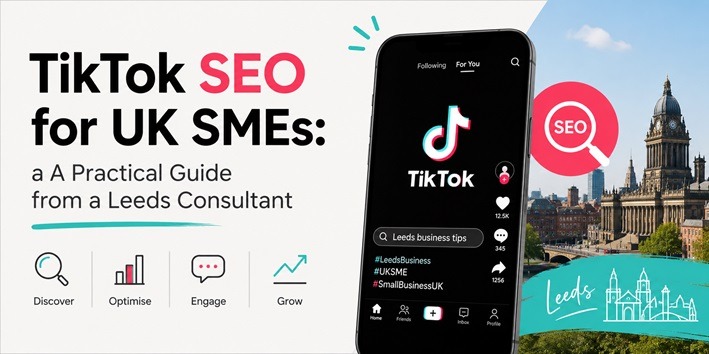
TikTok Search Is One of the Few Places UK SMEs Can Still Compete Without a Big Budget
If someone told you three years ago that TikTok would become a serious search tool for small businesses, you would probably have smiled politely and moved on. But here we are. A growing number of people — including your potential customers — now go to TikTok the same way they go to Google: to find answers, compare options, look up local services and decide who to trust.
That is worth paying attention to, especially if you run a small or medium-sized business and you are already stretched thin on time and budget. The good news is that TikTok's search behaviour actually favours businesses that are clear and helpful over those with the biggest marketing spend. You do not need a production team or a social media manager. You need to be findable, and you need to make sense quickly.
I am a freelance SEO consultant based in Leeds. I help small and medium-sized businesses get found online, and I look at TikTok the same way I look at any other search channel: who is searching, what are they looking for, and how do we make sure they can find you?
This article sets out what I have learned working with UK SMEs on TikTok SEO. It is written for business owners and marketing managers, not for people who already know what a canonical tag is.
Why TikTok now matters — even if you are not on it yet
People use TikTok to search for things now. That might sound odd if you still think of it as a platform for dance videos, but the reality has shifted. Users type queries like "best accountant for sole traders UK", "public liability insurance explained" or "Leeds plumber reviews" directly into TikTok's search bar, and they expect to find useful, trustworthy content.
For a small business, this creates a practical opportunity: if someone in your area searches for what you do, could they find you? Right now, the honest answer for most UK SMEs is no — not because TikTok is too hard, but because most small businesses have not thought about it in these terms yet.
You do not need a big following to appear in TikTok search results. You do not need to go viral. You just need to produce content that clearly answers the right questions, consistently enough that TikTok understands what you are about.
Start with what your customers actually ask you
The simplest place to start is the question you answered last week. Every business owner has a mental list of things they explain constantly — the calls that begin "I just want to quickly ask…", the emails that say "before we go ahead, can you just clarify…". That list is your TikTok content plan.
Think about the questions your ideal customer asks before they decide to buy from you. For example:
A sole trader asking an accountant: "Do I need to register for VAT straight away?" A homeowner asking a local builder: "How long does a loft conversion actually take?" A small retailer asking an SEO consultant: "Why can't I find my business when I search on Google?"
Each of those is a short video waiting to happen. Not a sales pitch — an honest answer to a real question, in plain English. That is exactly the kind of content TikTok surfaces when someone searches.
This is also where TikTok and SEO for SMEs overlap more than people expect. The questions your customers ask before buying are the same phrases they type into search engines. Answering them on TikTok reinforces the same themes across multiple channels.
Being clear beats being clever
One thing I notice when I look at TikTok accounts for small businesses is that the ones that perform best are not necessarily the most polished or the most entertaining. They are the most obvious. You watch the first three seconds and you immediately know: who this is for, what problem it addresses, and whether it applies to you.
That clarity is harder to achieve than it sounds, because the instinct is often to lead with your brand or your credentials. But on TikTok, the viewer's first question is not "who are you?" — it is "is this for me?"
So instead of opening with "Hi, I'm Sarah, and I'm a Leeds-based accountant with fifteen years of experience", try: "If you're a UK sole trader and you've just gone over £50,000 in turnover, this affects your VAT registration." Now the right person immediately knows to keep watching.
The same logic applies to the rest of the video. Say what you mean, say it simply, and finish with one clear takeaway or action. Most business owners are better at this than they think — it is basically what you do in every sales conversation.
How TikTok decides what to show people
You do not need to understand the TikTok algorithm in technical detail, but it helps to understand the basic idea: TikTok tries to show each person content that is relevant to their interests and their searches. When someone types a query, TikTok looks at the words in your caption, the text on screen, what you say out loud, and what your account generally covers.
That means a few practical habits make a real difference:
When someone would search for your video using a specific phrase — say, "public liability insurance for UK tradespeople" — that phrase should appear somewhere in your caption, somewhere on screen, and ideally in what you say in the first fifteen seconds. Not forced or repeated awkwardly — just naturally present. You are giving TikTok the same signals you would give Google.
A simple trick worth doing this week: open TikTok and type the start of a question your customers ask you. Watch what the autocomplete suggests. Those suggestions are real searches, and each one is a potential video.
Staying in one lane is not boring — it is smart
A common concern I hear from business owners is: "But I need to keep posting, and I don't want to repeat myself." This usually comes from thinking about content like social media entertainment, where novelty matters. But when you are using TikTok for search visibility, repetition is less of a problem than inconsistency.
TikTok (like Google) builds up a picture of what your account is about over time. An account that consistently covers insurance for UK tradespeople will, over time, be associated with that topic. An account that mixes insurance advice, funny office videos, trending sounds and random motivational quotes will be associated with nothing in particular.
For a small business owner, this is actually a relief. You do not need to be creative in new directions every week. You just need to keep answering questions in your area, in a format people can follow.
This is the same principle behind niche SEO — building clear, consistent authority in a specific subject area rather than trying to rank for everything at once. It works on Google, and it works on TikTok too.
The first few seconds are everything
TikTok moves fast and people scroll without guilt. If your video does not give someone a reason to keep watching in the first two or three seconds, they are gone — and that is not a personal rejection, it is just how the platform works.
The best opening is usually the most direct one. Something like:
"Here's what your business insurance probably doesn't cover — and it catches a lot of UK small business owners out."
"If your website isn't showing up in local searches, here are the two most common reasons I see with Leeds businesses."
"Three things to check before you sign a commercial lease — number two surprises most people."
What these have in common: they name a specific situation, they suggest a useful outcome, and they do not waste time. You do not need a flashy intro or a jingle. You need the viewer to think "that sounds like it's about me" within the first couple of seconds.
On-screen text: use it to clarify, not decorate
A lot of TikTok videos use on-screen text as a style choice — big animated letters, captions that fly in dramatically. That is fine aesthetically, but from a search perspective, on-screen text is most valuable when it simply states what the video is about.
Think of it like the headline on a webpage. "VAT registration for UK sole traders — when it's required" tells both the viewer and TikTok exactly what this content covers. Keep it readable, keep it uncluttered, and make sure it is not hidden behind TikTok's own interface buttons. A significant number of people watch with the sound off — your on-screen text may be the only thing they read before deciding whether to stay.
What to measure — and what not to worry about
Likes are visible and satisfying, but they are not the most useful measure of whether your TikTok content is working for your business. The signals that matter more are:
Saves
When someone saves a video, they found it useful enough to come back to. That is a strong indicator that the content answered a genuine question.
Shares
When someone sends your video to a colleague, client or friend, that is word-of-mouth at scale.
Watch time
If people watch most or all of your video, TikTok treats that as a quality signal. It also usually means your content was clear enough to hold attention.
An educational video that gets 400 views, 60 saves and three enquiries is doing its job. A trend video that gets 10,000 views from people who will never need what you offer is not. For a business owner, the question is always: is this reaching the right people and moving them closer to getting in touch?
Local signals matter, especially for service businesses
If your business serves a specific area — a town, a city, a region — say so. Not just in your profile, but in the content itself.
"If you run a small business in West Yorkshire…" or "this applies to most UK tradespeople, especially outside London where rates are very different" — these small signals do two things. They tell TikTok where your content is relevant, and they tell the viewer immediately whether it applies to them. A business owner in Sheffield is much more likely to keep watching if you mention Yorkshire than if the content feels like it was made for a generic global audience.
Mistakes that are easy to avoid
The most common TikTok mistakes I see from small businesses are all variations on the same underlying issue: creating content for the platform rather than for the person watching.
Joining a trending audio because your competitor did. Making videos that could apply to any business in any country. Posting sporadically because you ran out of ideas. Leading with your company name and logo for ten seconds before getting to the point. Treating every video as an opportunity to push people to "book now" or "get in touch today."
None of these are catastrophic, but they collectively make it harder for the right person to find you and trust you quickly. The fix is always the same: start with a real question your customer would ask, give an honest and useful answer, and make it obvious from the first few seconds who it is for.
A practical starting point for the next two weeks
If you want to start without overcomplicating it, here is what I would suggest:
Write down ten questions your customers ask before they buy from you. Open TikTok and type the start of each question into the search bar — see how the platform phrases them. Pick the one where you have the clearest, most useful answer. Film a 45–60 second video: name the problem in the first few seconds, give your answer in plain English, finish with one practical takeaway. Write a caption that includes the key phrase from your TikTok search. Add on-screen text that states the topic clearly. Post it, then do the same with the next question next week.
That is it. You are not trying to build a media brand. You are trying to be the most useful, clearest result when your ideal customer types their question into TikTok.
If you would like to understand how this fits alongside your existing search presence, take a look at what I do for UK SMEs or visit the SEO services and pricing page for more detail.
If you would rather talk through how this fits your specific business before diving in, feel free to get in touch — no obligation, just a straightforward conversation.
Final thought
TikTok is not going to replace Google for most UK small businesses, and that is not the point. The point is that it is another place where your customers are already searching — and right now, most of your competitors are not showing up there in any meaningful way.
You do not need to become a content creator. You just need to be findable. If you are clear, consistent and genuinely helpful, that is more than enough.
If you want to know a bit more about how I work before getting in touch, the about page is a good place to start.
Frequently Asked Questions
What is TikTok SEO for UK small businesses?
TikTok SEO is the practice of making your videos easy to find when someone searches on TikTok. Just like on Google, TikTok uses the words in your captions, your on-screen text and what you say out loud to decide what your content is about and who to show it to. For a UK small business, that means creating short videos that answer the questions your customers are already searching for — so you can be discovered without paying for advertising.
Is TikTok really useful for SMEs in the UK, or is it just for big brands?
TikTok's search function actually tends to favour relevance over reach, which means a small business with a clear, focused answer to a specific question can outperform a big brand with a generic one. You do not need a large following or a big budget. What matters is whether your content clearly addresses what someone is searching for. For local and niche service businesses in particular, the competition on TikTok is still relatively low compared to Google.
How do I find TikTok keywords for my business?
The simplest method is to use TikTok's own search bar. Type the beginning of a question your customers commonly ask — for example, "public liability insurance for UK…" — and watch what the autocomplete suggests. Those suggestions reflect real searches happening on the platform. You can also look at what phrases appear in the captions and on-screen text of videos that already perform well in your sector.
Do I need professional video equipment to do TikTok SEO well?
No. Most of the TikTok content that performs well for small businesses is filmed on a smartphone in a reasonably well-lit room. What matters far more than production quality is whether the content is clear, relevant and easy to follow. A video that directly answers a question your customer is searching for, filmed at your desk, will consistently outperform a polished video that is vague about who it is for.
How often should a UK SME post on TikTok for SEO benefits?
Consistency matters more than frequency. One well-focused video per week, maintained over several months, will do more for your search visibility than posting daily for a fortnight and then stopping. Start with a pace you can genuinely sustain. For most small business owners, that is somewhere between one and three videos per week. The goal is for TikTok to build a clear picture of what your account covers — and that requires regular, topically consistent content over time.
Does TikTok help my Google SEO, or is it completely separate?
They are separate ranking systems, but they are not entirely unconnected. TikTok videos can appear in Google search results, particularly for certain types of queries. More importantly, the content strategy that works on TikTok — answering specific questions clearly, staying consistent within a topic area — reinforces the same authority signals that matter for Google. The questions your customers search for on TikTok are often the same ones they search for on Google.
What should I talk about in my TikTok videos as a local service business?
Start with the questions you answer every week. Every phone call, email or conversation where a customer says "can you just quickly explain…" is a video. Beyond that, anything that helps a potential customer make a better decision — what to look for when hiring someone in your trade, common mistakes to avoid, how a process works, what a realistic cost or timeframe looks like — tends to perform well. The more specific you are about who the content is for (e.g. "for UK sole traders" or "for small garages in Yorkshire"), the more useful it is to the right viewer.
How can a solo business owner manage TikTok content without it taking over their week?
The most practical approach is to batch your content. Set aside an hour or two once a week and film three or four short videos back to back, then post them over the coming days. You can also repurpose content you have already created — a question you answered in an email, a point you made on a client call, a paragraph from something you have written — rather than starting from scratch every time. The aim is not to become a full-time content creator. It is to be consistently present and useful in a small, focused way.
Expertise
Driving organic traffic and qualified leads with tailored SEO solutions.
Growth
Results
Mail to: jj@jjseo.co.uk
© 2025 JJSEO. All rights reserved. | Expert SEO Consultant in Leeds
Free SEO Toolsour text here...