
Fleet Insurance SEO: How Independent UK Brokers Can Capture High‑Value Leads
Independent UK brokers have a genuine edge in fleet insurance SEO. Here's how to make your expertise visible to the buyers who are already looking for it.
INSURANCE SEOSMESAUTOMOTIVE SEOSEO CONTENT
Jorge Jaroslavsky
5/19/202612 min read
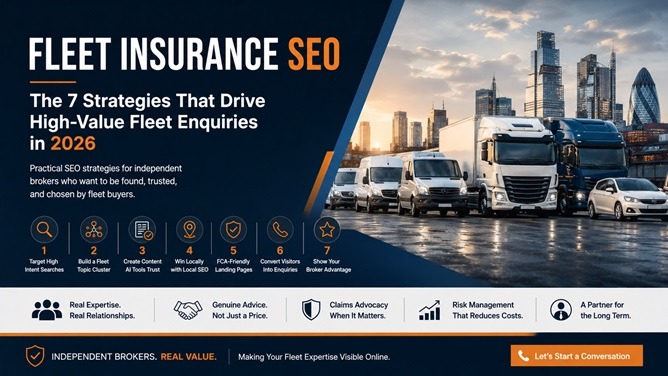

Fleet Insurance SEO
Fleet insurance sits in one of the most competitive and misunderstood corners of the UK insurance market. Every broker wants fleet clients — and for good reason. They're high‑value, high‑retention, and often multi‑policy. Yet most independent brokers struggle to generate consistent fleet enquiries online, because the search landscape is dominated by aggregators, national insurers, and generic content mills that don't understand the nuances of UK fleet risk.
I've worked with enough brokers to know that the frustration is real. You have the expertise, the insurer relationships, and the ability to genuinely add value — but the phone isn't ringing the way it should. Often, the gap isn't the product or the service. It's visibility. And visibility, in 2026, means being found, trusted, and chosen before a conversation has even started.
The reality is simple: fleet insurance SEO isn't about keywords or hacks — it's about trust, clarity, and authority. If you're an independent broker weighing up your SEO options, fleet needs its own thinking — it doesn't respond to the same approach as general commercial lines.
Why Fleet Insurance Requires a Different SEO Approach
It's worth being clear about who actually searches for fleet insurance, because this shapes everything that follows.
Fleet buyers aren't browsing comparison sites in the evening or shopping on price alone. The person conducting the search is typically a transport director, a fleet manager, a finance director, or the owner of a growing SME who's just realised their current personal lines setup won't cut it any more. They've often got a renewal coming up, a claims issue that's unsettled them, or a business that's expanding faster than their current cover can keep pace with.
What they're looking for isn't a quote widget. They're looking for:
A broker who genuinely understands their industry and the risks specific to it. A haulage firm has very different exposures to a care provider operating a fleet of support vehicles. The best fleet brokers know this instinctively, and the best SEO communicates it.
Someone who can negotiate with underwriters rather than simply presenting a computer-generated price. Fleet buyers with complex risks — mixed fleets, poor claims histories, specialist vehicles — have often been burned by brokers who couldn't get the terms they needed.
Support with claims, not just placement. Fleet claims can be operationally disruptive and financially significant. Buyers want to know there's someone in their corner when things go wrong, not just when the renewal comes around.
Stability in premiums and a partner who can help them manage their risk profile over time, rather than someone who places the business and moves on.
Guidance on telematics, driver behaviour programmes, and risk management tools that can actually reduce their exposure and, ultimately, their premium.
This means the SEO strategy must reflect the real buying psychology of these people — not the assumed behaviour of a consumer buying home insurance. The two are entirely different, and treating them the same is one of the most common mistakes I see. It's a pattern I come across equally when working with SME businesses in other regulated sectors — generic SEO thinking consistently underperforms when the buyer is sophisticated and the product is complex.
1. Where Fleet Enquiries Actually Come From
Most agencies and in‑house marketing teams chase broad, low‑value terms like "fleet insurance" or "business vehicle insurance." These terms are dominated by national brands with domain authority built over decades and marketing budgets that most independent brokers can't realistically compete with on a pure volume basis.
High‑value intent lives somewhere else entirely. It lives in the specific, operational queries that signal a buyer who knows what they need and is looking for someone who knows how to provide it.
Searches like "fleet insurance for courier businesses," "fleet insurance for small fleets UK," "mixed fleet insurance UK," or "fleet insurance with telematics" aren't just more niche — they're more valuable. They signal urgency, complexity, and genuine commercial intent. The person conducting that search isn't browsing; they're looking for a solution.
There's also a category of query that often gets overlooked: problem‑led searches. Things like "fleet insurance claim rejected what can I do," "why has my fleet premium increased," or "how to reduce fleet insurance costs UK" — these aren't direct buying signals, but they represent a fleet decision‑maker who is actively engaged with the subject and is a prime candidate for conversion if you can provide genuinely useful content at that moment.
The broader point is this: intent‑led SEO requires you to think like the buyer, not like a marketer trying to rank for high‑volume terms. What questions are your existing fleet clients asking you? Start there.
2. Building a Fleet Insurance Topic Cluster
A single "Fleet Insurance" landing page is no longer sufficient — both for search engines and, increasingly, for AI‑powered search tools that synthesise information before a user even clicks through to a website.
The concept of a topic cluster is straightforward: rather than having one page trying to do everything, you build a network of interlinked content that covers the subject with genuine depth. Each page addresses a specific aspect of fleet insurance, and together they signal to search engines that your site is an authoritative source — not a thin, keyword‑stuffed afterthought.
In practice, a well‑structured fleet cluster looks something like this:
/fleet-insurance — the pillar page: what it is, who it's for, why an independent broker matters
/fleet-insurance/courier — dedicated to courier and last‑mile delivery operators
/fleet-insurance/mixed-fleet — covering businesses running cars, vans, and HGVs under one policy
/fleet-insurance/trades — trades and contractors with tool cover considerations
/fleet-insurance/telematics — how telematics affects risk, pricing, and driver management
/fleet-insurance/claims — what happens when something goes wrong and why broker support matters
Each of these pages links naturally to the others, and back to the pillar. That internal linking logic is what turns a collection of pages into a coherent resource — and what Google's quality evaluators, and AI search tools, recognise as genuine topical authority.
One broker I worked with moved from a single fleet page to a structured cluster of eleven pages over the course of a few months. The immediate impact wasn't volume — it was quality. The enquiries that started coming through were more specific, more commercially advanced, and considerably easier to convert. The buyers had already self-selected based on their industry and situation before they picked up the phone.
A topic cluster also needs to be maintained. The fleet insurance market moves — underwriting appetites shift, telematics technology evolves, the FCA updates its guidance. Content that is reviewed and refreshed regularly signals to search engines that the site is actively managed and genuinely current. That freshness matters, particularly for buyers making significant financial decisions who want to know the information they're reading reflects the market as it actually stands.
3. Creating Content That AI Tools Trust and Cite
This is where fleet insurance SEO is evolving most rapidly right now, and it's something independent brokers should pay close attention to.
AI‑powered search — whether that's Google's AI overviews, tools like Perplexity, or the growing number of buyers who use ChatGPT as a starting point for research — doesn't just index content. It evaluates it, summarises it, and decides whether it's credible enough to cite or recommend.
To be cited or surfaced by these tools, content needs to be clear, structured, factual, and verifiable. It needs to demonstrate that the author understands the subject in a practical, real‑world sense — not just that they've assembled a page around the right keywords.
In practice, this means short, purposeful paragraphs that get to the point without padding. It means precise definitions — what actually constitutes a "fleet" for insurance purposes, for instance, and how that threshold affects policy structure and pricing.
It means FCA‑friendly language that is clear and fair without being watered down into meaninglessness. And it means practical examples that ground abstract concepts in recognisable scenarios — the kind of thing a broker explains naturally in a client meeting, but rarely commits to writing.
The brokers I've seen do this well write content that reads as though it was written by someone who has actually sat across the table from a fleet manager and had the conversation. Because it was. That authenticity is increasingly detectable — by human readers and, increasingly, by AI systems too. I cover the regulated content dimension in more depth in my broader SEO guide for insurance brokers, which is worth reading alongside this.
4. Local SEO for Fleet Insurance
There's a persistent myth in insurance marketing that fleet insurance is a national game and that local SEO doesn't apply. In my experience, the opposite is often true.
Fleet buyers — particularly SMEs and owner‑managed businesses — frequently prefer to work with a broker who understands their region, their local industries, and ideally has a physical presence or at least a meaningful connection to the area. The relationship matters. Trust matters. And trust is often built, at least initially, on perceived proximity and shared context.
High‑intent local queries like "fleet insurance broker Leeds," "fleet insurance broker West Midlands," or "fleet insurance for haulage companies Yorkshire" carry several practical advantages over national terms:
Competition is meaningfully lower
The leads that come through are warmer, because the buyer has already filtered by geography
Conversion rates tend to be higher
Google Business Profile optimisation — something many brokers still treat as an afterthought — can produce a disproportionate return for relatively modest effort
The key is specificity. A Google Business Profile that simply says "insurance broker" is a missed opportunity. One that references fleet specialism, lists relevant industries, and includes reviews from fleet clients tells a very different story. The same principle applies to local landing pages: a page built around "fleet insurance for manufacturing businesses in the East Midlands" will never drive enormous volume, but the traffic it does drive is highly qualified.
It's also worth thinking beyond the obvious cities. Most brokers with local SEO ambitions target their nearest major conurbation — Manchester, Birmingham, Leeds, Bristol — and leave it there. But the businesses with the most complex and valuable fleet risks are often not in city centres. They're on industrial estates in Stoke, distribution hubs in Northampton, agricultural suppliers in Lincolnshire, or civil engineering contractors in County Durham. Building content that speaks to those regional industries and search patterns can open up territory that your national competitors aren't even looking at.
Local PR and community presence support this too. Sponsoring a regional industry event, being quoted in a trade publication that covers your area's dominant sector, or partnering with a local fleet management consultancy all generate the kind of regional signals — links, mentions, citations — that reinforce your local authority in search. SEO and reputation-building are not separate activities for a regional broker; they feed each other.
5. FCA‑Friendly Fleet Landing Pages
This point is worth dwelling on, because it shapes how every piece of fleet content should be written.
Fleet insurance is a regulated product. The Financial Conduct Authority's rules around financial promotions are clear: content must be fair, clear, and not misleading. This isn't just a compliance obligation — it's also, in my view, good SEO practice. Content that makes extravagant claims, implies guaranteed savings, or uses vague superlatives doesn't just risk FCA scrutiny; it also erodes the trust that fleet buyers are actively seeking.
The brokers who do this well don't try to over‑sell. They explain. They set out what fleet insurance is, what it covers, what it doesn't, how pricing works, and what the buyer should consider when evaluating their options. That kind of honest, informative content performs better in search, converts better with sophisticated buyers, and is far less likely to create problems down the line.
Clarity and genuine usefulness consistently outperform hype — in search rankings and in client relationships.
6. Turning Fleet Visitors Into Enquiries
Generating traffic is only half the challenge. Converting that traffic into enquiries requires equal thought — and this is often where the real losses happen, not on the page itself but in what comes after the click.
Fleet buyers, in my experience, have clear preferences when it comes to how they want to make contact. Most prefer to speak to someone directly, which means a prominent, easy‑to‑find phone number is non‑negotiable. But not everyone is ready to call immediately, which is why a well‑designed "Request a Callback" option — with a clear promise of a prompt, expert response — can capture buyers who are interested but not quite ready to have the conversation.
Enquiry forms should be short. Three to five fields is typically the right balance: enough to give the broker useful context before the call, but not so much that the form itself becomes a barrier. Fleet managers are busy people. Every additional field you ask them to complete is a reason to close the tab. Adding a simple expectation-setter — "We'll be in touch within two hours during business hours" — reduces friction further and signals that a real person is on the other end.
Call handling matters more than most brokers realise. A landing page can do everything right — clear proposition, relevant trust signals, frictionless form — and still lose the lead if the phone isn't answered promptly, or if the person who answers doesn't immediately demonstrate fleet knowledge. The SEO investment and the operational investment need to be aligned. There's little point driving qualified fleet traffic to a number that goes to a generalist call handler who has to transfer the enquiry twice.
Beyond the mechanics, the most effective fleet landing pages build trust in a logical sequence. That sequence typically runs: clear statement of fleet specialism → industries and vehicle types covered → insurer panel or market access → client testimonials or case studies → straightforward next step. Each element earns the right to the next. Missing one — particularly the social proof layer — often explains why a page with decent traffic isn't converting.
This is typically where independent brokers need the most support — not in creating the content, but in structuring the page so that trust builds in the right order. If you'd like to explore how that applies to your own site, feel free to get in touch.
7. The Independent Broker Advantage
I want to finish on this point, because I think it's the most important one, and it's often the one that brokers are least confident about articulating.
Aggregators, comparison platforms, and direct insurers have significant advantages in terms of brand recognition, marketing budgets, and digital infrastructure. But there is something they fundamentally cannot do, and it's the thing that fleet buyers — particularly those with complex, high‑value fleets — value most.
They cannot give advice. They cannot sit down with a transport director and work through the implications of a mixed fleet, a telematics rollout, or a series of at‑fault claims.
They cannot negotiate with an underwriter to secure terms that reflect a client's genuine risk profile rather than a computer‑generated assessment. They cannot support a client through a significant claim, advocate on their behalf, or help them understand why their premium has moved and what practical steps might stabilise it.
Independent brokers can do all of these things. This is the competitive moat — and the task of SEO is to make it visible.
One of the most underused tools in an independent broker's content arsenal is the case study. Not a vague, anonymised paragraph about "a logistics client in the Midlands," but a properly told story: the challenge the client faced, why their previous arrangements were falling short, how you approached the market on their behalf, and what the outcome was. Fleet buyers read these and recognise their own situation. That recognition is enormously powerful, and it's something a comparison site or direct insurer simply cannot replicate.
The same applies to thought leadership content. If you've spent years placing courier fleets, you have genuine insight into how that market has shifted — how the rise of gig economy platforms has complicated driver classification, how claims frequency has changed, how underwriters are approaching the sector now versus five years ago. Writing about that — plainly, honestly, without dressing it up — positions you as someone worth calling. Not because you've optimised for a keyword, but because you demonstrably know what you're talking about. You can read more about how I approach this kind of work on the about page.
The content strategy should return to this theme consistently, not in a way that attacks competitors, but in a way that clearly articulates value. Human expertise. Real‑world experience across specific industries. Genuine claims advocacy. Risk management guidance that goes beyond the policy schedule. These are not small differentiators. For the right fleet buyer, they're the difference between a broker relationship that lasts a year and one that lasts a decade.
What Actually Wins in Fleet Insurance SEO
Fleet insurance SEO, done well, is a long‑term investment in visibility, credibility, and trust. It isn't about chasing short‑term rankings or gaming algorithms. It's about building a body of content and a digital presence that accurately reflects the genuine expertise your business holds — and making sure that the fleet buyers who need that expertise can find you when it matters.
The brokers who invest in this properly — structured clusters, intent-led content, local depth, and conversion pages that build trust in the right order — consistently pull away from those who treat their website as a digital brochure. The gap is widening, and AI‑powered search is accelerating it, because the bar for what counts as authoritative content is rising every month.
Independent brokers have something that aggregators will never have: credibility built on real relationships, real outcomes, and real expertise. The goal is to make that credibility visible — before the renewal lands, before the competitor gets the call, and before the buyer decides a comparison site is good enough. If you're ready to work on that, I'd be glad to help.
Related blog posts:
Protection Broker SEO: YMYL Authority Strategy
Local SEO vs Enterprise Keywords and why Leeds SMEs need long tail precision
SEO for Insurance Brokers UK: Guide from Leeds Consultant
Modern Local SEO Strategy for Yorkshire Businesses
SEO Blueprint Report: The Foundation of a Successful SEO Strategy
TikTok SEO for UK SMEs: A Practical Guide from a Leeds Consultant
PI Insurance SEO: 31% More Leads for a Birmingham Broker
Why Backlinks and Schema Markup Are Overrated — And What Actually Matters in SEO for Regulated Industries
Expertise
Driving organic traffic and qualified leads with tailored SEO solutions.
Growth
Results
Mail to: jj@jjseo.co.uk
© 2025 JJSEO. All rights reserved. | Expert SEO Consultant in Leeds
Free SEO Toolsour text here...