
Modern Local SEO Strategy for Yorkshire Businesses
Stop following outdated SEO checklists. Discover the 2026 framework for local search success in the UK, focusing on AI overviews, entity trust, and lead intent over vanity rankings.
SMESSEO CONTENTTECHNICAL SEOLOCAL SEO
Jorge Jaroslavsky
3/31/20268 min read
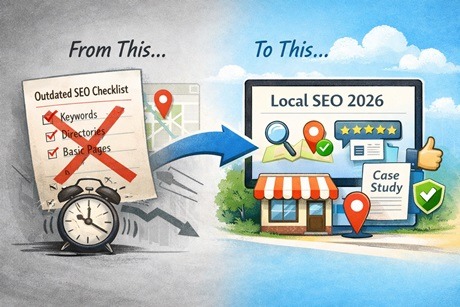
The Problem: Outdated Local SEO Advice
Let’s start with a hard truth: most local SEO advice you’ll find online today is dangerously outdated. You will still find blog posts, YouTube videos, and “ultimate checklists” promising to get your business ranking on Google Maps in a few weeks—but they were written for a very different digital world.
By 2026, Google’s local ranking algorithms do not behave like they did even two years ago. The days of climbing the local Map Pack simply by claiming your Google Business Profile (GBP), adding a few geotags, and stuffing city names across your site are over.
The game has changed.
In the UK, and especially across competitive regions like Yorkshire—Leeds, York, Sheffield, and Bradford—local businesses have started to notice something worrying. Despite doing everything they were told by "SEO gurus," their rankings and local visibility have plateaued. The phone isn’t ringing more. The form fills aren’t increasing.
That is because the algorithm has moved on—but most strategies haven't. Google no longer rewards the quantity of listings or cloned local pages. It has learned to reward the signal behind the signal: relevance, credibility, and trust.
Why Generic Checklists are a Strategic Trap
The fundamental flaw with SEO checklists is that they are designed to be universal. But local SEO is not universal. It is deeply influenced by geography, demography, competition density, and whether your brand feels "real" to a local audience.
A generic “Top 10 Steps” guide cannot account for the difference between a Leeds auto garage, a York law firm, and a Sheffield roofing company. The intent, conversion path, and audience expectations are entirely different. This is the trap many SMEs fall into: following steps A through Z because it worked for a business in Miami or Melbourne, forgetting that Google’s local algorithms now lean heavily on regional behavioural data.
If your SEO strategy feels like a tick-box exercise, it might get you listed, but it won’t help you grow. To understand why, we must look at the specific strategic failures currently plagueing UK local sites.
The Four Strategic Killers of Local Growth
1. Chasing Rankings Instead of Lead Intent
Business owners fixate on being "Spot One" for keywords like “plumber Leeds.” While visibility is good, being first on the map doesn’t always equate to revenue. In 2026, local searches are layered. A user looking for “emergency boiler repair Leeds” has a different intent than someone searching for “boiler service costs.”
A smart strategy focuses on profitable intent. If you rank first for a broad term but the traffic doesn't convert, you have a vanity metric, not a business asset. To measure if your SEO is actually working, ignore vanity rankings and track:
Direct phone calls and WhatsApp enquiries.
Direction requests on Google Maps (a high-intent signal).
Branded search growth (people looking for you by name).
2. The Plague of Thin Location Pages
This is the most common "SEO killer" I audit in Yorkshire. Agencies often spin up 20 near-identical pages, swapping only the town name:
"We are the leading electricians in Bradford. Our Bradford team is ready to help..."
In 2026, Google’s AI language models spot this "mass templating" instantly. It doesn't trust these pages because they offer no unique value. To Google, these aren't service pages; they are spam. Authentic local content requires more than a Find-and-Replace command; it requires actual local knowledge.
3. Over-Reliance on Third-Party Directories
Directories like Yell, Checkatrade, or TrustATrader have their place, but they should not be your engine. Google’s AI systems are now entity-driven. This means your brand’s identity—verified across the web via your own site and structured data—carries more weight than a paid listing on a directory that hosts 500 of your competitors. Directories should confirm your details, not define your reputation.
4. Ignoring the "Satisfaction" Signal
Google uses post-click interactions as a quality signal. If users click your result but immediately bounce because your site looks untrustworthy or is difficult to navigate on a mobile, Google learns that your page didn't satisfy the user. In the age of AI search, "Satisfaction" is a core ranking factor. Poor satisfaction leads to a quiet, gradual slide down the rankings that no amount of backlinking can fix.
The 2026 Shift: AI Overviews and the "Reputation Era"
The biggest change to local search is the integration of AI Overviews (SGE). These summaries appear above everything else, including the map pack, aggregating reviews, snippets, and authority context to generate a direct answer.
Fewer Clicks, More Decisions
In competitive Leeds industries like roofing, estate agency, or legal services, only 2–3 results now appear before the AI section on mobile. Where before users might scroll through listings, many now get their answer at the AI layer. To survive this, you must be the business the AI trusts enough to summarise. This requires moving from "Keyword SEO" to "Entity SEO."
Reputation is No Longer Contained to Your Website
In 2026, Google’s Large Language Models (LLMs) look far beyond your own site. They are now scanning for unlinked brand mentions. We have officially entered the Reputation Era. The AI cross-references what you say about yourself with what the wider web says about you. It looks for your brand name appearing in:
Local Reddit threads or community forums (e.g., r/Leeds or r/Sheffield).
Regional news coverage (The Yorkshire Post, York Press).
Local event sponsorships or community group mentions.
When Google sees your brand mentioned consistently across the local web—even without a direct link—it validates your business as a high-trust entity. This "off-site proof" is often the deciding factor in whether the AI includes you in a summary or ignores you entirely.
The Framework for Modern Local Success
To build a system that lasts, you need to focus on four core pillars: Structure, Context, Authority, and Conversion.
Pillar 1: Technical Site Architecture and "Topical Silos"
Your website must be machine-readable. This means a clean, hierarchical URL structure that mimics a well-organised building. Avoid "flat" structures where every page is just one click from the homepage. Instead, use topical silos:
Root: yoursite.co.uk
Service Parent: /services/commercial-cleaning/
Location Child: /services/commercial-cleaning/leeds/
This hierarchy tells Google exactly how your expertise relates to your geography. It builds "Topical Authority" by grouping related concepts together as demonstrated in this B2B SEO Case Study, where a structural overhaul contributed to a 50% increase in organic traffic for a technical niche.
Pillar 2: Deep Local Context (The Anti-Template)
To rank in 2026, a location page must prove you were actually there.
Hyper-Local Landmarks: Don't just say "Leeds." Mention being "based near the White Rose Centre" or "serving clients from Headingley to Rothwell."
Project Proof: Describe a real job. "Last week, our team assisted a homeowner in Chapel Allerton with a burst pipe..."
Sub-Region Specifics: Reference local road names (e.g., the A61 or A64) or specific challenges found in local architecture (e.g., "common roofing issues in York's Victorian terraces").
Pillar 3: Advanced Schema Markup and "Entity Bridging"
Standard "LocalBusiness" schema is no longer the "secret weapon" it was in 2020. In 2026, you should be using Schema Stacking to define your entity:
areaServed: Specifically define the UK counties and postcodes (e.g., LS, YO, S, BD).
knowsAbout: Link your services to established Wikipedia or Wikidata entities to help the AI understand your niche.
sameAs: Link to your social profiles and verified directory listings to "bridge" your digital identity.
Pillar 4: Conversion-First Design (CRO)
If your site doesn't convert, the SEO effort is wasted. Moreover, high bounce rates signal to Google that your site is irrelevant.
Click-to-Call: Ensure your phone number is prominent and functional on mobile.
Trust Elements: Display Gas Safe logos, FCA accreditations, or local chamber of commerce badges.
Mobile Speed: In 2026, "fast" is the baseline. If your site takes more than 2 seconds to load on a 4G connection in Bradford, you’ve already lost the lead.
The "Cluster Strategy": Building Authority Through Connection
Google doesn't rank isolated pages; it ranks authoritative domains. To win in 2026, you must link your content in a way that shows topical depth. This is called a Topical Cluster.
Imagine you are a York-based law firm. Your main "Family Law York" page is the "Pillar." To support it, you need "Cluster" content:
Blog Post: "A Guide to Divorce Proceedings in York Courts."
Case Study: "How We Helped a York Resident with Property Disputing."
FAQ Page: "Common Questions about Child Custody in North Yorkshire."
By linking these internally, you create a "web of expertise." Google sees that you don't just want to rank for a keyword—you actually own the subject in that region.
The "Google Business Profile" (GBP) Evolution
Your GBP is the digital storefront of your business. In 2026, "set and forget" is a recipe for failure.
Semantic Reviews: Encourage customers to be specific. A review saying "Great job on my kitchen extension in Harrogate" is worth ten reviews saying "Good service." The AI reads the keywords inside the review.
GBP Posts: Use these as a local micro-blog. Post photos of your team on-site in Leeds or York. Use the "Update" feature to announce local community involvement.
Q&A Section: Don't wait for customers to ask questions. Populate this section yourself with the most common enquiries you receive from local clients.
Why "Real World" Activity Now Impacts SEO
Google’s AI is increasingly capable of verifying real-world activity. If your business is mentioned in a local news story about a charity event in Sheffield, or if your vans are frequently photographed at local landmarks, these signals are processed.
In Yorkshire, this means:
Local PR: Aim for mentions in regional publications.
Community Engagement: Sponsoring a local football team in Wakefield isn't just "goodwill"—it's a high-level local SEO signal when that team links to you from their "Sponsors" page.
Digital Footprint: Ensure your business is active where your customers are. If Leeds residents are talking about you on a local Facebook group, Google’s "Reputation Era" algorithms will eventually take note.
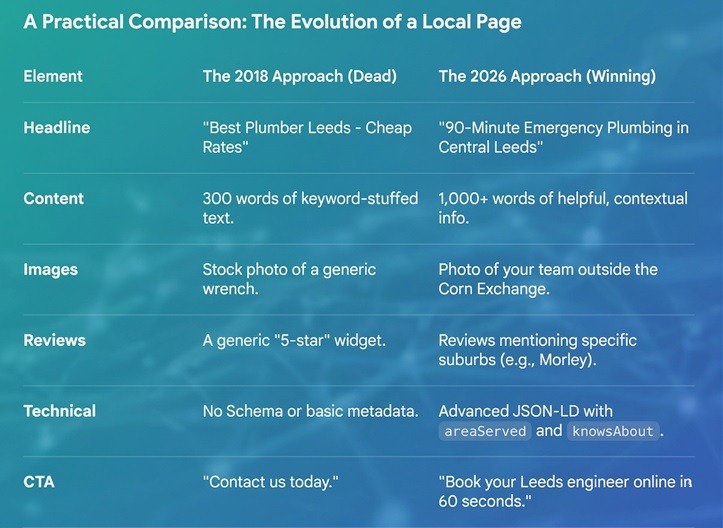
A Practical Comparison: The Evolution of a Local Page
How to Audit Your Own Local Presence
If you are based in Yorkshire and your growth has stalled, perform this quick 3-step audit:
The "Template" Test: Open your Leeds and York location pages side-by-side. If more than 50% of the text is identical, you are being penalised for thin content.
The "Entity" Test: Search your business name on Google. Does the "Knowledge Panel" on the right show accurate info? Does the AI Overview correctly summarise your services?
The "Mobile" Test: Open your site on your phone while walking through a high-traffic area like Briggate. Is the "Call" button the first thing you see? Does the site load instantly?
The Future of Search in Yorkshire
The digital landscape in cities like Leeds, York, and Sheffield is becoming more crowded every day. As AI becomes the primary way users find local services, the "smoke and mirrors" of old-school SEO will continue to fail.
Success in 2026 belongs to the businesses that focus on authenticity. By building a website that is technically sound, contextually rich, and conversion-focused, you move beyond "chasing the algorithm." You start building a brand that Google—and more importantly, your local customers—can actually trust.
If your current local SEO has plateaued, it is likely because you are still playing by the rules of a game that no longer exists. It is time to hit the reset button and build a strategy that works for the way people search today.
Next Steps:
Phase 1 (Week 1): Clean your site structure. Ensure your /services/ and /locations/ folders are logical.
Phase 2 (Week 2): Rewrite your core location pages. Add real stories, real photos, and real local landmarks.
Phase 3 (Week 3): Implement Advanced Schema. Tell the AI exactly who you are and where you operate.
Phase 4 (Ongoing): Build your reputation. Focus on high-quality, semantic reviews and local brand mentions.
If your current results have plateaued, view my SEO services and pricing to see how a 2026-ready framework can be applied to your business.
This guide is part of a series on Local Search Evolution. For more specialised insights into how AI is changing the UK business landscape, see my upcoming deep dive on AI & Search Behaviour or contact me directly for a regional audit in the Yorkshire area.
Related blog posts:
Google Business Profile: What Local Businesses Need to Know
Local SEO vs Enterprise Keywords and why Leeds SMEs need long tail precision
SEO For Eco-Friendly Pet Products Shops In The UK
SEO for Insurance Brokers UK: Guide from Leeds Consultant
SEO Blueprint Report: The Foundation of a Successful SEO Strategy
What CEOs in Regulated SMEs Should Expect From an SEO Consultant
Expertise
Driving organic traffic and qualified leads with tailored SEO solutions.
Growth
Results
Mail to: jj@jjseo.co.uk
© 2025 JJSEO. All rights reserved. | Expert SEO Consultant in Leeds
Free SEO Toolsour text here...