
Google Business Profile: What Local Businesses Need to Know
Google Business Profile has quietly shifted. This guide explains what's changed with local search, AI overviews, and review signals — and what Leeds small businesses can do about it this week.
SMESLOCAL SEO
Jorge Jaroslavsky
3/24/202611 min read
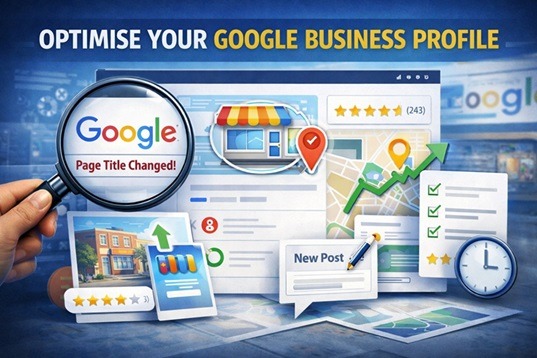
What's actually changed on Google Business Profile — and what to do about it
By Jorge Jaroslavsky — Freelance SEO Consultant, Leeds | jjseo.co.uk
There's a version of this article that opens with a dramatic claim about Google rewriting the rules of local search overnight. This isn't that article.
What's actually happened over the past year is quieter, more gradual, and — for most small businesses — considerably more consequential than any single algorithm update. Google has been steadily, methodically getting better at understanding context. Not just what your business does, but whether your entire online presence reflects that in a consistent, believable, location-specific way.
For businesses in Leeds, Bradford, Harrogate, and across West Yorkshire, that shift matters more than it might in a sprawling city where competition is diluted across millions of results. In local search, you're not competing with the whole internet. You're competing with the business a few streets away. The margins are smaller, the signals matter more, and the gaps are harder to hide.
This is a practical look at what's changed on Google Business Profile, why it matters to local businesses specifically, and what you can realistically do about it — without needing a digital marketing degree or a consultancy retainer just to get started.
How local search actually works — a plain English version
When someone types "accountant near me" or "plumber in Headingley" into Google, what comes back isn't a lucky dip. Google is trying to answer three questions at once: is this business relevant to the search, is it close enough to be useful, and is it prominent enough to be worth recommending?
That last one — prominence — is where most small businesses fall short, and it's the part that's changed most noticeably over the past twelve months or so.
Prominence used to be fairly straightforward to measure. How many reviews do you have? How many other websites reference you? Are you listed in the right directories? All of that still counts. But Google has added something more nuanced on top of it: it now pays closer attention to whether the content associated with your business — your reviews, your replies, your photos, your posts — actually reflects an active, locally-rooted operation. Not just a profile that was set up once and left to fend for itself.
The practical effect is that doing nothing on your Google Business Profile is now more costly than it used to be. Businesses that maintain their profile thoughtfully are pulling ahead of those that don't. And the gap is widening.
What Google's AI is doing to local results
You may have noticed something different in Google search over the past year. Before you reach the traditional list of results, there's often a generated answer at the top — a paragraph or two that Google has assembled from various sources to address your question directly.
For local searches, this is happening more and more. Someone asking "which accountants in Leeds handle sole trader tax returns" might see a generated response naming two or three businesses before they ever scroll to the map pack.
How does a local business end up in that generated answer? Nobody can give you a definitive rulebook — Google hasn't published one. But the pattern that's emerging is fairly consistent, based on early testing and case studies from local SEO practitioners, even though Google hasn't published an official rulebook: businesses with clear, specific, up-to-date information across their Google Business Profile, their website, and their reviews are the ones being surfaced. The AI is essentially drawing a line between what you claim to do and what the evidence actually supports.
If your profile says you're a commercial cleaning company in Leeds but your reviews are vague, your photos are generic, and your website talks in woolly terms about "delivering excellence in cleaning solutions," Google has very little to work with. It can't confidently recommend you for a specific search because nothing about your presence is actually specific.
Contrast that with a business whose profile is kept current, whose photos show real jobs in recognisable locations, whose review replies mention neighbourhoods and services by name, and whose website describes what they do in plain English. That business is giving Google something to hold onto. It's citable. It's trustworthy. It's the kind of business Google feels comfortable putting its name to.
This is the shift worth paying attention to in 2026.
The four things Google Business Profile is paying close attention to right now
1. Whether your information is current and genuinely accurate
This sounds obvious. In practice, it rarely is.
The most common issue I come across with local business profiles — and I see a fair few of them — isn't missing information, it's stale information. Business hours that haven't been updated since well before the pandemic. A phone number that redirects to a mobile that isn't always answered. A website link pointing to a homepage that's been redesigned and no longer loads the right page.
Google cross-references what's on your profile with what it finds elsewhere — your website, directories, data aggregators. When things don't match, it downgrades its confidence in your listing. It's not a formal penalty in the traditional sense; it's more that Google simply trusts you less. And a business it trusts less is a business it shows less.
The fix is straightforward: audit your profile properly at least twice a year, and update it immediately whenever anything changes. Even small things — correcting your holiday hours, adding a new service, confirming your address is still right — matter. They tell Google the profile is being looked after by someone paying attention.
2. What your photos actually show
Google's Visual AI has become noticeably more sophisticated over the past couple of years, and can now recognise far more about what's in an image and how it relates to a place. It's not just checking whether you have photos; it's attempting to understand what those photos depict, where they were taken, and whether they reflect a genuine, active business.
Photos of your team at work. Photos of your premises, inside and out. Photos of completed jobs, with enough context that Google — and a potential customer — can understand what they're looking at. These are the images that contribute meaningfully to your local visibility now.
A dozen shots of your logo and a couple of stock images of a handshake won't do much. Neither will blurry phone snaps taken in poor lighting at the end of a long day.
This doesn't mean you need a professional photographer on retainer. It means being consistent and intentional. If you're a joiner who's just finished a kitchen installation in Chapel Allerton, take three or four decent photos before you pack up. If you run a café in Roundhay, photograph your space on a good morning when the light's right. The cumulative effect of regularly adding genuine, location-relevant imagery is more significant than most business owners realise — and it compounds over time.
3. The signals buried in your reviews — and your replies
Reviews have always mattered for local SEO. What's changed is which part of the review matters most.
Google is increasingly reading reviews for contextual content. A review that says "great service, really happy" tells it almost nothing useful. A review that says "really pleased with the new bathroom they fitted in our Burley terrace — finished on time and the tiling was immaculate" is rich with local and service-specific data that Google can actually extract and use.
You can't write your customers' reviews for them, and you shouldn't try. But you can influence the kind of reviews you tend to receive by being slightly more specific when you ask for them. Instead of a generic "please leave us a Google review if you get a chance," try: "It really helps us if you mention what we did and roughly where in Leeds you are." Most people are happy to oblige when you ask thoughtfully. The ones who weren't going to review you anyway still won't — but the ones already inclined to say something positive will often write something considerably more useful.
The reply, though, is entirely within your control. And this is where the majority of local businesses are leaving the most value on the table.
When you reply to a review with "Thanks so much for the kind words, we really appreciate your support!" you've used the one part of the exchange you could actually shape — and given it nothing. That reply is indexed. Google reads it. It contributes to the contextual picture of your business.
A reply that says "Really glad we could get the rewire sorted at your Woodhouse property — it was a big job, but the team were chuffed with how it came out" does something meaningfully different. It confirms your service area. It names your trade. It reads like a real person who remembers the customer. And it feeds Google exactly the kind of specific, local, relevant signal it's looking for.
The formula is simple: service + location + a human touch. It takes an extra thirty seconds. Over the course of a year, the cumulative SEO effect of doing this consistently is something I'd put money on.
4. Whether your profile is actively maintained — not just existing
Google Business Profile has a handful of features that most local businesses set up once and never revisit: the Q&A section, Google Posts, the products and services tab, the business description.
Each of these is an opportunity to reinforce what you do, where you do it, and who you do it for — in your own words, with your own local context.
Google Posts are worth a particular mention. They're short updates that appear directly on your Business Profile in search results. Most businesses either don't use them at all or abandon them after a few half-hearted attempts. Used consistently, they're a low-effort way of signalling to Google that someone is actively managing this listing — and they give you a controlled space to use service-specific and location-specific language that you know is being read.
You don't need to post daily. Once a week, or even twice a month, is enough to keep the profile looking current. A short post about a recently completed job, a seasonal offer, a useful tip for local customers — anything genuine and locally relevant will do more good than nothing.
A note on consistency across the web
Your Google Business Profile doesn't exist in isolation. Google compares what's on it against your website, against your listings on other directories, against what it finds when it crawls mentions of your business name across the internet.
If your address is formatted slightly differently across three directories. If your business name on Yell doesn't quite match what's on your profile. If your website says you cover "the Leeds area" but your profile lists a different service radius. All of these small inconsistencies erode Google's confidence in your listing.
This is sometimes called NAP consistency — Name, Address, Phone number — and it sounds like the kind of technical detail only an SEO consultant would lose sleep over. In practice, getting it right is one of the highest-return, lowest-effort things a small business can do. It's not glamorous work, but it reliably moves the needle. Worth noting: Google can usually cope with minor formatting differences — "St" versus "Street," for instance — but outright inaccuracies, or conflicting versions of your details across multiple sources, are where real problems start.
If you're running a local business and haven't checked your listings across the major directories recently, it's worth an hour of your time. You may be surprised how many small discrepancies have crept in without you noticing.
What AI-generated answers mean for local businesses specifically
Earlier I mentioned that Google is producing AI-generated answers for more and more local searches. It's worth dwelling on that a moment longer, because the implications are significant.
The traditional goal of local SEO has been to appear in the "Local Pack" — the map with three business listings near the top of Google for location-based searches. That's still valuable. But the AI overview that now appears above it, for an increasing number of searches, is drawing attention before anyone reaches the map.
Getting featured in those AI overviews isn't a guaranteed science. But the businesses that appear in them tend to share common characteristics: they have detailed, well-maintained profiles; their reviews contain specific, relevant language; their websites are clear about what they do and who they serve; and their online presence is consistent across platforms.
In other words — all the things that good local SEO has always required, done more thoroughly and with more attention to the specifics of language and place.
This is actually good news for small local businesses, if you're willing to engage with it. Large national companies struggle to compete on hyper-local specificity. A plumber who genuinely serves Meanwood, Horsforth, and Adel, and whose online presence consistently reflects that, can outrank a national comparison site for searches in those areas — because the national site cannot replicate that authentic local depth. That local specificity is your competitive edge. It's not available for money. It has to be earned.
The practical checklist: where to start this week
Rather than leave you with a vague sense that you should "do more" with your Google Business Profile, here's what I'd actually suggest working through, in rough order of priority:
Audit what's already there. Log into your Google Business Profile and go through every section. Is everything accurate? Is your website link working? Are your hours correct, including any special hours for bank holidays? Is your business description specific about what you do and where?
Sort your photos. Check what's currently showing. Remove anything that's poor quality or no longer relevant. Add at least three to five recent, genuine photos of your work, your space, or your team. Make a habit of adding a few more every couple of months.
Read your last ten review replies honestly. Are they specific? Do they mention your services and your area? Or are they polite but generic acknowledgements? If they're generic, changing that habit is the single most impactful thing you can do this week — starting with your next reply.
Check your listings elsewhere. Look at Yell, Bing Places, Apple Maps, and any industry directories relevant to your trade. Make sure your name, address, and phone number are consistent across all of them.
Write one Google Post this week. Three or four sentences about something you've recently completed, or something genuinely useful for local customers, is enough. Then do it again in a fortnight. The habit is the thing.
None of this is complicated. The businesses that are pulling ahead in local search right now aren't doing anything extraordinary — they're just doing the basics more consistently and more specifically than the businesses next to them.
This sits within a bigger picture
Google Business Profile is one piece of a broader local SEO strategy. It works best when it's supported by a website that's structured clearly, content that speaks to your specific local audience, and a broader online presence that consistently reinforces what you do and where you do it.
If you're weighing up whether investing in local SEO is worth it compared to paid advertising, I've written about that directly — including why the long-term return tends to favour organic visibility for most small businesses: Beyond Paid Media: The Enduring Value of SEO for Leeds SMEs.
For small and medium-sized businesses, the SEO picture is different from that facing larger organisations. The budgets are tighter, the teams are leaner, and the results need to be tangible rather than theoretical. The work I do with SMEs is built around that reality — practical, specific, and focused on what actually moves things forward. You can find out more on the SEO for Small & Medium Enterprises page.
A final thought
Local search in 2026 is not fundamentally more complicated than it was five years ago. What's changed is the bar. Google has become better at spotting the difference between a business that's genuinely embedded in its local community and one that's simply ticking boxes.
The businesses that treat their Google Business Profile as a living part of their operation — something that's maintained, updated, and used with a bit of thought — are the ones that will keep showing up when local customers are looking for exactly what they offer.
It takes some effort to establish the habits. Once they're in place, it becomes routine. And routine, done consistently over months and years, is what separates the businesses that own their local search results from the ones that wonder why they can't get found.
If you're not sure where your profile currently stands, or you'd like someone to look at your local search presence with fresh eyes, I'm happy to have a conversation about it. You can find out a bit more about how I work on the About Me page — or if you'd rather just cut to it, get in touch directly. No hard sell, no obligation.
Expertise
Driving organic traffic and qualified leads with tailored SEO solutions.
Growth
Results
Mail to: jj@jjseo.co.uk
© 2025 JJSEO. All rights reserved. | Expert SEO Consultant in Leeds
Free SEO Toolsour text here...