
SEO for independent estate agents: the real pain points it can solve
If your website is not generating valuation leads, SEO may be the missing piece. Here is what actually works for independent estate agents — and what to stop wasting time on.
SMESESTATE AGENT SEOSEO CONTENT
Jorge Jaroslavsky
4/20/202611 min read
The Panorama:
There is a quiet frustration I hear from a lot of independent estate agents. The website is live. The listings are on Rightmove. Someone set up a Google Business Profile a few years back. And yet the phone is not ringing the way it should. Valuations are coming in, but too many of them arrive via paid leads or portal enquiries — sources that cost money every single time.
When I sit down with an independent agency owner, that frustration often gets described as a marketing problem. In most cases, what I am actually looking at is a local visibility problem. The agency is simply not showing up at the right moment — when a homeowner in a specific street types “estate agent in [area]” into Google at nine o’clock on a Tuesday evening and starts comparing their options.
That is the kind of gap SEO can help close. Not as a long-term vanity exercise or a way to generate impressions on a dashboard, but as a practical tool for getting your agency in front of people who are already in your patch, already thinking about selling or letting, and already looking for someone to call.
The good news is that SEO, done properly and focused in the right places, can be one of the most cost-effective ways for an independent agency to build that kind of local visibility. This article walks through the pain points I see most often, what SEO can realistically do about them, and a few areas where, in my view, most independent agents can safely stop spending time.
What this article covers
This is a longer read, so here is a quick map of what is coming:
The problems I see most often
Six business frustrations, from portal dependence to websites that generate nothing.What SEO can actually do
Practical responses to each pain point, in plain language.What good SEO looks like
A realistic picture of what you are aiming for as a small agency.Where you may be wasting time
Activities that look like SEO but rarely move the needle for independents.90‑day practical steps
Actions worth doing, in a sensible order.Quick Q&A
Straightforward answers to questions I hear regularly.
The problems I see most often
I like to start with the business problems rather than the technical ones, because that is usually where the real conversation belongs.
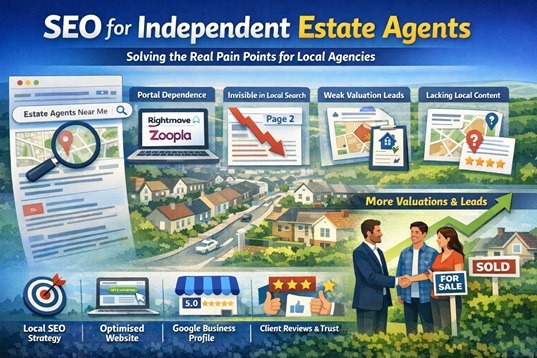
You are heavily dependent on portals for enquiries
Rightmove and Zoopla are not going anywhere, and I am not suggesting you abandon them. For many agencies, they are still an important source of visibility. The issue appears when your primary source of vendor leads comes from a platform you pay to appear on.
In that situation, you do not really own your visibility. The moment a competitor outbids you or a portal changes its algorithm or packages, your enquiry flow can change overnight. For an independent agency, that can feel uncomfortable.
Your website exists, but it is not doing much work
Quite a few agencies I speak to have a perfectly decent-looking website — maybe built three or four years ago, with an About page, a listings feed, and a contact form. It looks fine, but it is not generating many enquiries on its own.
In that case, the website is acting more like a digital brochure than a working part of the sales process. A brochure is better than nothing, but it does not usually bring in instructions by itself.
You are largely invisible in local search results
A simple but revealing question is: when someone types “estate agents in [your town]” into Google, where do you appear? On the first page? In the map results? Or do they mostly see portals and competitors?
Most independent agents I speak to have never really audited how they show up in local searches. Many are surprised to find that other, very similar agencies are outranking them simply because some of the SEO basics are in better shape.
You are not getting enough valuation leads from your website
On a lot of websites, the valuation page feels like an afterthought — a form tucked away in a corner, with very little copy and no real attempt to explain why a homeowner should choose your agency over the competition.
If someone lands on that page, is clearly thinking about a valuation, and still does not feel confident enough to make contact, that is a missed opportunity. It is quite common and often fixable.
Your content does not reflect your local knowledge
You may know the streets, the schools, the transport links, and the price trends in particular roads extremely well. In many cases, the website does not say much about any of that. It uses broad phrases like “we cover the local area” without showing what that really means.
Generic content does not help Google understand where you operate or who you are for, and it does not help a homeowner feel that you know their specific patch. That local detail is often where independent agents are strongest.
Your trust signals are weak or out of date
Most people choosing an agent will at least glance at Google reviews before they make contact. If your profile has fourteen reviews from five years ago, that is not particularly reassuring. If your website has no testimonials, no case studies, no recognisable faces, and no evidence of work done in real streets, that gap in trust can quietly cost you enquiries.
None of this is unusual. It is simply what tends to happen when everyone is busy running the agency and “the website” is left to tick along in the background.
What SEO can actually do about these issues
SEO is not a magic switch, but there are practical ways it can help with each of those problems.
Reducing portal dependence
Reducing portal dependence usually starts with owning more of your local search presence. That often means building properly developed location pages that:
Rank for local searches.
Talk clearly about the areas you cover.
Give homeowners a reason to choose you.
When those pages appear in organic results, you are building visibility you own rather than visibility you rent. Portals can still play a role, but they are not the only tap you can turn on.
Turning your website into an enquiry generator
Turning the website into something that actively supports your sales process is not just about design. It is about what happens after someone arrives.
A few simple questions help:
Is the valuation call to action visible on every key page?
Does the homepage tell a homeowner clearly what you do and where you do it?
Is there a straightforward path from reading about an area or service to getting in touch?
Small improvements to the way a site guides visitors can make a noticeable difference to how many end up calling, enquiring, or booking a valuation.
Improving local search visibility
For independent estate agents, local visibility is often closely tied to Google Business Profile (GBP). It appears in map results, in the local “3-pack”, and whenever someone searches directly for your agency name.
Keeping GBP complete, accurate, and regularly updated sends stronger signals to Google that you are an active, relevant business in that location. It also gives homeowners and landlords a quick way to:
See your reviews.
Check your contact details.
Click through to your website.
It is not the whole of local SEO, but it is a core part of it.
Getting more valuation leads
If valuation enquiries are particularly valuable to you (and for most agencies they are), then it is worth building pages around what vendors actually care about and search for.
A well-thought-out valuation page can:
Explain briefly how your valuation process works.
Address common concerns (pricing strategy, timescales, what happens next).
Show some evidence of your track record in the area.
Make it very easy to request a valuation or call.
The key is to write that page for the homeowner first, and for Google second. If a real person would feel reassured by it, you are on the right track.
Making better use of your local knowledge
Building pages around your local knowledge is one of the most useful things an independent agency can do. A strong area page usually goes beyond “we cover [postcode]” and includes:
Your perspective on the local market.
The types of buyers or tenants you typically see.
What tends to sell quickly and why.
What makes that area distinctive or attractive.
That is the kind of content a national chain or generic portal finds harder to replicate, and it is exactly the kind of local signal that both people and search engines tend to respond well to.
Strengthening trust through reviews and evidence
A steady flow of recent, genuine reviews helps in several ways:
It improves how you appear in map results.
It increases click-through from search results.
It does some of your persuasion work before anyone lands on your site.
On the website itself, things like testimonials, photos of sold boards, short case studies, and team photos all contribute to a sense of “this is a real, active agency doing work in my area”. Many independent agents already have this evidence offline; SEO and good content simply bring it into view.
What good SEO looks like for a small agency
It is probably worth saying that good SEO for an independent estate agent does not mean “being top of Google for ‘estate agents UK’.” That space is dominated by portals and national brands, and chasing it is unlikely to be a good use of time or budget.
What I am usually focused on is something more achievable and more useful:
When someone in your area searches for the kind of service you actually offer.
When they look for an estate agent in a specific town or neighbourhood.
When they search for your agency name to check you out.
In those moments, the aim is for your agency to appear clearly and to look like a sensible, trustworthy choice.
For a smaller agency, good SEO tends to be:
Local rather than national – focused on your patch, not the whole country.
Centred on a handful of key pages – homepage, valuation page, area pages, vendor and landlord services.
Measured by enquiries and instructions – not just by traffic curves on a chart.
If those pages are visible, relevant, and easy to act on, you are a long way towards where you need to be.
Where I usually suggest agents spend less time
There are a few patterns I see quite often where time and money get used without much return. None of these are “wrong” in themselves, but they are rarely the best starting point for an independent agency.
Publishing content just to “do content”
Blog posts can be useful, but generic articles that could apply to any market in the country tend not to help much with either rankings or reputation.
If a piece of content does not:
Help you show local expertise.
Support an important service.
Or answer a real question your clients ask, then it may not need to be written at all.
Chasing very broad, non-local keywords
If your agency is in Harrogate, focusing on “estate agents in Harrogate” or related local phrases is usually realistic. Trying to rank for “estate agents” on its own is extremely competitive and, for most independents, not a sensible goal.
It usually makes more sense to be very visible in your own patch than to try to look big everywhere.
Treating SEO as a one-off project
A common pattern is: invest in an audit or a burst of activity, see some improvement, and then leave everything untouched for a couple of years.
You do not need constant major changes, but a small amount of ongoing attention — especially around content, reviews, and GBP — tends to produce much steadier results than a single push followed by silence.
Ignoring what happens after someone arrives
Bringing the right people to your website is important, but it is only half of the story. If the pages they land on are confusing, feel thin, or do not give a clear reason to get in touch, some of that effort is lost.
A little time spent on clarity and calls to action can often pay off just as much as time spent climbing a ranking.
Practical steps for the next 90 days
If you want to make progress without over complicating things, a simple 90‑day plan can help. You do not have to do all of this at once, but these are usually good places to start.
Step 1: Audit your key pages
Look at your homepage, valuation page, and any existing area pages. For each one, ask:
Does it explain clearly what you do?
Is it obvious which areas you cover?
Is there a clear next step for someone who is interested?
If the answers are not clear to you, they probably will not be clear to a visitor either.
Step 2: Build or improve area pages
Each important town, village, or postcode area you genuinely serve deserves its own page with:
Some genuine local insight.
A sense of the properties you deal with there.
A clear route to enquiry or valuation.
One strong page for your main patch is often more valuable than five thin pages that all say the same thing.
Step 3: Sort out your Google Business Profile
Make sure your GBP is:
Accurate (address, phone number, opening hours).
Complete (categories, services, photos).
Active (the occasional post, responses to reviews).
This is free to do and has a direct impact on how you appear in local searches.
Step 4: Start collecting reviews consistently
After every sale or let, consider sending a simple, friendly message with a direct link to your review page. If you make it part of your standard process, the review count builds over time without needing big campaigns.
Recent reviews matter at least as much as old ones.
Step 5: Improve your valuation page
Treat the valuation page as one of your most important assets. You might:
Explain briefly how valuations work with your agency.
Address a few common worries.
Show a little evidence of your local track record.
Make it straightforward to request a valuation or call.
If it feels like a real conversation starter rather than just a form, it is usually on the right lines.
Step 6: Check mobile experience and speed
Most property-related searches now happen on a phone. It is worth checking:
How quickly your pages load on mobile.
Whether key buttons and forms are easy to use on a small screen.
If the main messages are visible without lots of scrolling.
If the mobile experience is awkward, some visitors will leave before they ever reach your good content.
Step 7: Measure what actually matters
If possible, keep an eye on:
How many enquiries you receive from the website.
Which pages those enquiries tend to come from.
How your local visibility in Google and GBP changes over time.
Traffic numbers have their place, but for most independent agencies, a small rise in the right kind of enquiry is more important than a big rise in visits.
Quick questions I am often asked
Do I need to be on the first page of Google to get enquiries?
For local, area-specific searches, first page visibility generally makes a noticeable difference. The good news is that “first page for ‘estate agents in [your town]’” is a more realistic goal than trying to rank for broad national terms.
How long does SEO take to show results?
It varies, but as a rough guide:
Improvements to Google Business Profile can sometimes show within weeks.
Meaningful movement for organic page rankings is more often measured in months.
Sex to eight months is a common range for focused work on the fundamentals. It is not instant, but it is also not as slow as it can sometimes appear when efforts are scattered.
Can I do any of this myself?
Quite a bit, yes. Things like:
Updating your GBP.
Encouraging reviews.
Improving your valuation page copy.
Writing a genuinely useful area page for your main patch.
These do not require technical knowledge, just time and a clear view of your audience. More technical elements can be handed off if and when they become relevant.
Is SEO worth it if we are already on Rightmove and getting enquiries?
If portals are working for you, that is positive. The question is more about balance and risk. If most of your leads come from a channel you pay for and do not control, any change in cost or visibility can have an immediate impact.
SEO allows you to build some visibility that is not tied to a monthly invoice, which many agencies find reassuring over the longer term.
What is the single most useful thing I can do right now?
For many independent agencies, a sensible first move is to:
Bring Google Business Profile fully up to date.
Start asking consistently for reviews.
It is free, it is manageable, and it has a direct effect on how you appear when local people search.
A closing thought
Independent estate agents do not need “more SEO” in the abstract. In my experience, what tends to help most is SEO that is pointed at a clear target: better local visibility, more vendor leads, stronger valuation enquiries, and less dependence on portals and paid traffic.
Once that target is clear, the actions become clearer too. You do not need a national marketing budget or a large team to make progress — just a focus on the pages, messages, and channels that matter most for the kind of clients you want to attract.
If you recognise some of the situations I have described here, it may be a sign that your website and local presence could be working a little harder for you. Contact me, even a few small changes, made in the right places, can start to shift things in a more sustainable direction.
Related blog posts:
Beyond Paid Media, The Enduring Value of SEO For Leeds SMEs
Local SEO vs Enterprise Keywords and why Leeds SMEs need long tail precision
SEO For Eco-Friendly Pet Products Shops In The UK
Estate Agent SEO Strategy 2026: The New Rules for UK & Spain
TikTok SEO for UK SMEs: A Practical Guide from a Leeds Consultant
Expertise
Senior technical SEO for SMEs in regulated, automotive, funeral and multilingual markets.
Mail to: jj@jjseo.co.uk
© 2026 JJSEO | Jorge Jaroslavsky, Senior SEO Consultant, Leeds
Free SEO Toolsour text here...