
SEO Strategies for Independent Car Dealers in Leeds and Beyond
Practical, no-nonsense SEO advice for independent car dealers in Leeds and the UK — covering used car sourcing, AI search and answer engines.
AUTOMOTIVE SEOSMESLOCAL SEO
Jorge Jaroslavsky
7/7/202610 min read
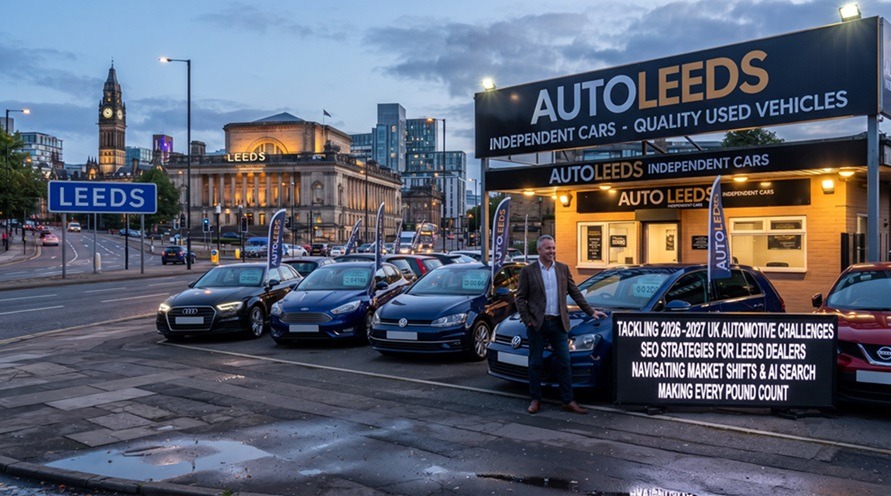
Tackling 2026-2027 UK Automotive Challenges: SEO Strategies for Independent Car Dealers
I wrote the original version of this post back in May 2025, when the UK automotive industry was in the middle of what turned out to be its toughest manufacturing year in over seventy years. A lot has shifted since then, some of it for the better, and I think it's worth an honest, updated look rather than just tinkering round the edges.
As an Independent SEO consultant based here in Leeds, I work mostly with independent dealers, family-run forecourts and small dealer groups, the MDs and owner-operators who don't have a marketing department to fall back on and need to make every pound of spend count. This update is for you, not for the national franchise groups with in-house agencies. I want to walk through where the market genuinely stands going into 2026 and 2027, and then get practical about what's changed in SEO itself, because the AI search shift happening right now is arguably a bigger deal for your website than anything the manufacturing figures throw at you.
Manufacturing: A Cautious Recovery, Not a Rebound
2025 was brutal for UK car makers. Total vehicle production fell 15.5% across the year, with just 764,715 cars and commercial vehicles built, the lowest figure since the early 1950s. SMMT chief executive Mike Hawes called it "the toughest year in a generation," and he wasn't exaggerating. Trade barriers with the US, a cyber attack that halted production at Jaguar Land Rover for months, and the ongoing cost of retooling factories for electrification all landed at once.
The good news, such as it is, is that 2026 looks like the year the industry starts climbing back. SMMT is forecasting car production to rise over 10%, to roughly 790,000 units, with the possibility of reaching one million vehicles by 2027 if a planned wave of seven new EV models makes it into production on schedule. May 2026 gave us the first monthly rise of the year, production up 2.7% on the same month in 2025, helped along by a new UK-US trade arrangement that's eased some of the tariff pressure on exports. It's genuinely encouraging, but the year-to-date numbers are still down on 2025, so I'd treat this as the start of a recovery rather than a return to normal.
There's also a cloud on the horizon worth knowing about if you're advising customers on what to buy: the EU is proposing new "Made in Europe" rules of origin from 2027, which could restrict UK-built vehicles and components from counting as domestic content across the Channel. That's a manufacturing and trade story more than a forecourt one, but it feeds into the same theme running through every part of this market right now, new car supply remains tight, uncertain, and skewed toward whichever manufacturer has the right EV model ready at the right time. One genuine bright spot: EV and hybrid production hit a record 41.7% share of everything built in the UK last year, so the electrification story, unlike the trade story, is actually running ahead of schedule.
The Used Car Market: Your Real Opportunity, With a Catch
This is where it gets interesting for independent dealers, and where I'd focus most of your attention and budget. Autotrader is forecasting the UK car market will reach 10 million total transactions in 2026, matching the scale we last saw before the pandemic, with used sales growing roughly 3% to around 8 million while new registrations stay largely flat. Independent retailers have been the standout performers through this recovery: independent used car sales grew 4.3% year-on-year in 2025, against a 0.7% decline for franchise dealers. That's not a coincidence. Independents have generally been quicker to adapt sourcing and pricing to a changing market than the bigger groups.
But there's a structural squeeze coming that every independent dealer needs to plan around, not just react to. Roughly two million new cars weren't sold during the pandemic years, and that gap has been working its way through the used market ever since, first hitting the youngest stock, and now maturing into the 5-7 year old bracket. Autotrader's own analysis points to a 25-30% drop in available 5-6 year old cars in 2026 compared with 2024, worsening to as much as 35% for 5-7 year old cars in 2027. If your sourcing and your website content are still built entirely around that classic "nearly new" age bracket, you're going to be fighting harder and harder for a shrinking pool of stock.
The upside is that demand hasn't gone anywhere, it's just spreading out. Older cars, the 10-15 year old bracket, saw prices rise around 8.5% year-on-year through late 2025, the ninth straight period of growth for that segment, while nearly-new stock actually softened. Petrol and diesel values are holding up well too, with plenty of buyers happy to sit out the EV transition a little longer in a well-maintained three-to-five-year-old family car. Meanwhile, used EVs are having a genuinely strong run: demand is up around 30% year-on-year, independent retailers are shifting used EVs in an average of 20 days, and January 2026 was the second-best month on record for used EV sales in the UK. Overall used car prices have stayed broadly flat, averaging around £17,000, with supply improving and buyers becoming more selective and better informed than they were a couple of years ago.
What this all means practically: 2026 and 2027 reward the dealers who diversify their forecourt story rather than assume the market will keep handing them the same age and fuel mix they've always sold. Your website and your content need to reflect that shift, because customers are increasingly searching for options outside the narrow band they'd have considered two years ago.
Consumer Sentiment: Confident, But Doing More Homework
Buyer confidence has actually held up better than a lot of people expected. Autotrader recorded close to a billion visits to its platform over the past twelve months, and more than eight in ten car buyers say they feel as confident, or more confident, about affording their next car as they did the year before. That's a genuinely useful data point to share with anxious customers.
That said, affordability hasn't disappeared as an issue. List prices, finance costs and insurance premiums are all still pinching, particularly for private buyers rather than fleet or business purchasers. What's changed since I wrote the original post is how buyers are behaving with that pressure: they're negotiating harder, cross-checking provenance more carefully (HPI checks are now considered basic due diligence rather than an optional extra), and increasingly comparing online-only platforms like Cinch against a good independent dealer before deciding where to buy. This is good news if you can demonstrate transparency and trust clearly on your site, because independents who do that convert that research-heavy buyer far more easily than a platform that's all self-service and no relationship.
The Bigger Shift: AI Has Changed How People Find You
Here's the part I think matters most for this update, and it's the part most dealer websites in Yorkshire simply haven't caught up with yet.
Search itself has fundamentally changed shape since I wrote the 2025 version of this post. Google's AI Overviews, those AI-generated summaries that now appear above the traditional results, are showing up on a huge and growing share of searches, and current research suggests they now appear in the vast majority of brand-related searches. On top of that, Google's newer AI Mode conducts what's called a "query fan-out," running dozens of sub-searches behind a single question and stitching the results into one conversational answer, in an experience that behaves much more like ChatGPT than a traditional search results page. Roughly six in ten Google searches now end without the person clicking through to any website at all.
For an independent dealer, this isn't an abstract industry trend, it changes what a "good" search result actually looks like. Someone researching "best used family car under £15,000 Leeds" or "is now a good time to buy a used EV" might get a synthesised answer with no clicks involved. The businesses that get named inside that answer, and the sources that AI systems trust enough to quote or summarise, are the ones who benefit even without a click, through brand recall and trust before the customer ever reaches a site. This has given rise to a genuine new discipline sitting alongside classic SEO, usually called Answer Engine Optimisation (AEO) or Generative Engine Optimisation (GEO): structuring your content so that clear facts, direct answers and well-organised FAQs can be lifted cleanly by an AI system, rather than being buried in marketing copy.
A few things are worth knowing if you want to take this seriously rather than just chase the buzzword:
Google Business Profile matters more than ever, not less. It's one of the primary data sources AI systems draw on for local business information, so accurate categories, regularly updated photos and stock, and prompt responses to reviews all feed directly into how confidently an AI system will recommend you.
Third-party trust signals outweigh your own website copy. Independent research shows brands are considerably more likely to be cited via reviews, press coverage or other people's sites than through their own domain. That means your Google reviews, local press mentions and genuine customer testimonials carry real weight in how AI systems perceive your dealership, not just how humans do.
Clear, well-structured content still wins. Direct answers, honest comparisons, and content organised in a Q&A format tend to get pulled into AI summaries far more reliably than dense sales copy. This is good news for smaller dealers: you don't need a huge content budget, you need clarity and honesty.
These results are genuinely inconsistent from one query to the next. Nobody, including large agencies, has this fully cracked yet, which is exactly why building a solid foundation now, rather than waiting for the picture to settle, puts you ahead of dealers who assume this doesn't apply to a local forecourt.
None of this replaces traditional SEO, it sits on top of it. You still need the fundamentals right: fast pages, clean structure, decent backlinks, genuine local relevance. But treating AI visibility as an afterthought in 2026 is a bit like ignoring mobile-friendliness was in 2015.
SEO Strategies to Drive Traffic and Sales in 2026 and 2027
Here's how I'd actually put all of this into practice for an independent dealer in Leeds or anywhere else in the UK.
1. Build Your Stock Story Around What's Actually Available
With the 5-7 year old bracket tightening through 2026 and 2027, your website needs to actively guide customers toward the stock you can genuinely source, rather than hoping they'll adjust their expectations once they arrive. I'd recommend content and landing pages built around:
Older, well-documented vehicles: "Reliable used cars over 10 years old in Leeds" performs well right now, because demand and prices in that bracket are both climbing.
Used EV content that speaks to real buyer questions: battery health, charging in West Yorkshire, and realistic running costs, since demand here remains strong and the buyers are typically well-informed and ready to move quickly.
Honest fuel-type comparison content: "Petrol, hybrid or used EV: what's right for a Leeds commute in 2026" tends to earn trust precisely because it isn't just a sales pitch for one option.
2. Structure Content So AI Systems Can Actually Use It
This is the newest and, I'd argue, the most overlooked opportunity for independent dealers right now. Rather than long, unstructured blog posts, I build pages with:
Clear, direct answers near the top of the page, followed by supporting detail, since AI systems disproportionately pull from the opening section of a page.
Genuine FAQ sections addressing the exact questions your customers ask on the forecourt: "Is it worth buying a used EV in 2026?", "How do I check a used car's finance history?", "What's changed with car tax on EVs?"
Basic schema markup on inventory, reviews and business information, so your site is easier for both Google and AI crawlers to parse accurately.
Consistent, accurate business details across your website, Google Business Profile and any directory listings, since inconsistency is one of the fastest ways to undermine the trust signals AI systems are looking for.
3. Earn Trust Beyond Your Own Website
Because third-party mentions carry real weight in how AI systems and human buyers both judge your dealership, I put real effort into:
Encouraging and responding to Google reviews consistently, not just when things go well.
Building genuine local press and community mentions where possible, a feature in a local paper or an industry directory listing does more for your AI visibility than another page on your own site.
Making sure your reputation is consistent wherever it appears, since AI systems tend to lean on consensus across multiple sources rather than trusting a single glowing claim.
4. Keep Local SEO as Your Foundation
None of the AI shift changes the basics of good local SEO, it just raises the stakes. I focus on:
Accurate, complete Google Business Profile details, including up-to-date stock categories and opening hours.
Local keyword targeting: "used car dealer Leeds," "independent EV dealer West Yorkshire," and similar terms specific to your actual catchment area rather than generic national phrases.
A steady flow of genuine reviews, since these remain one of the strongest ranking and trust signals available to a small local business.
5. Address Real Buyer Concerns With Honest Content
Buyers doing more homework than ever respond well to dealers who get ahead of their concerns rather than waiting to be asked. Content that continues to perform well includes guides on car finance in the current interest rate environment, honest explainers on EV battery health and realistic running costs, and straightforward advice on checking a used car's provenance before buying. The tone that works best here isn't a sales pitch, it's the kind of advice a trusted local garage owner would give a friend.
Why Work With Me
The market heading into 2026 and 2027 is more hopeful than it was when I wrote the original version of this post, but it's also more complicated. Manufacturing is recovering, the used market is genuinely strong for independents, and stock dynamics are shifting in ways that reward dealers who plan ahead rather than dealers who wait and react. On top of all that, the way people actually search for a car dealer has changed more in the last year than in the previous five, and most small dealer websites simply haven't kept pace.
As a solo, Leeds-based SEO consultant, I don't run a big agency and I don't oversell what SEO can do. What I offer is straightforward: an honest look at where your site stands today, a plan built around what's realistically achievable for a business your size, and the ongoing work to get you there, whether that's classic local SEO, structuring your content properly for AI search, or both. If you're an MD, owner or decision-maker at an independent dealership and want a second opinion on where you're leaving visibility, and sales, on the table, get in touch and I'll take an honest look at your site.
Contact me for a straightforward conversation about where your dealership stands, and where it could be.
Related blog posts:
How Schema Makes Your Car Dealership Visible in Google’s AI Results
How Independent Car Dealers Can Actually Win More Customers With Voice Search in 2025
The Complete SEO Guide for Campervan & Caravan Dealers
SEO for Insurance Brokers UK: Guide from Leeds Consultant
How to Fix Duplicate Content on Your Campervan Dealer Stock Listings
Expertise
Driving organic traffic and qualified leads with tailored SEO solutions.
Growth
Results
Mail to: jj@jjseo.co.uk
© 2025 JJSEO. All rights reserved. | Expert SEO Consultant in Leeds
Free SEO Toolsour text here...