
The Client Intent Map: SEO for Regulated Firms
How AI search is changing client decisions, and the Client Intent Map framework I use to help regulated and niche firms adapt and win better clients.
SMESSEO CONTENTLOCAL SEOINSURANCE SEO
Jorge Jaroslavsky
6/23/202612 min read
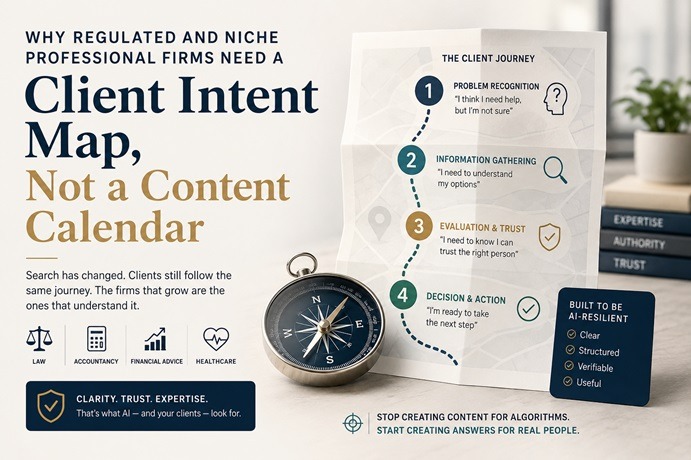
Why Regulated and Niche Professional Firms Need a Client Intent Map, Not a Content Calendar
I've spent time working with small and mid-sized firms in law, accountancy, financial advice, and healthcare — the kind of businesses where one wrong word can mean a compliance problem, not just a bad review. And over the last eighteen months, I've watched the rules of search change more than they did in the previous decade.
If you're an MD, partner, or practice owner in a regulated or niche industry, you've probably felt it too, even if you couldn't quite name it. Enquiries feel harder to predict. Traffic numbers move around for no obvious reason. Your website seems to be doing everything "right" by the old rules, and yet something about it doesn't feel like it's working the way it used to.
I want to explain what's actually happening, why it matters more for firms like yours than for almost anyone else, and what I think a sensible response looks like. This isn't a pitch. It's the framework I now use with every client, and I'd rather you understood it whether you work with me or not.
What's actually changed
Three things have happened at once, and together they've reshaped how your future clients find and choose professional services.
Google now answers many questions directly, through AI Overviews, before anyone clicks a link. A prospective client searching "do I need probate if there's a will" or "what counts as constructive dismissal" might get a confident summary at the top of the page and never scroll further.
AI assistants have become a genuine alternative to search. Perplexity, ChatGPT Search, and a growing list of others are now where a meaningful slice of research happens, especially among people making high-stakes decisions — which, frankly, describes most clients of a solicitor, accountant, IFA, or private clinic.
Generic content is being filtered out, summarised, or simply ignored. The thin, keyword-stuffed blog post that used to scrape together a bit of traffic now tends to get absorbed into someone else's answer, or skipped entirely, because there's nothing in it an AI model or a human reader can't get elsewhere.
Large, well-known brands can absorb this shift. They have name recognition doing a lot of the work for them — people search for them by name, AI models have been trained on years of mentions of them, and a few lost clicks here and there barely register.
Small and specialist firms don't have that cushion. If your visibility was built on a handful of blog posts and a list of services, you're more exposed to this shift than almost anyone.
But here's the part I think gets missed: this shift actually favours firms like yours, if you respond to it properly. AI models are not designed to reward volume. They're designed to reward clarity, structure, and demonstrable expertise — three things a thoughtful small firm can usually do better than a large, generic one. The opportunity isn't to write more. It's to be more useful, more verifiable, and more specific than whatever a general AI answer can produce on its own.
That's what I mean by a Client Intent Map.
What a Client Intent Map is, in plain terms
A Client Intent Map is a structured picture of:
what your potential clients are actually trying to achieve
what questions they ask at each stage of that journey
what they're looking for before they trust a professional with something serious
what content genuinely helps them move forward
how that content needs to be built so it survives, and ideally benefits from, AI-generated answers
It replaces the old approach — publish weekly, hope something ranks, repeat — with something much leaner. Fewer pages, each one doing a specific job, built around how people in your specific field actually think and decide.
I'd argue this matters more in regulated and niche industries than almost anywhere else, for a simple reason: your clients aren't buying on impulse. Nobody picks an employment solicitor, a financial adviser, or a private consultant the way they pick a takeaway. The decision involves risk, money, sometimes deeply personal circumstances, and often a professional body standing behind the relationship. That changes what your website needs to do, and it changes what AI models will and won't do on your behalf.
The four stages every client moves through
I've tested this across law firms, accountancy practices, financial advisers, and healthcare providers, and the pattern holds remarkably well. AI hasn't changed the stages themselves — people still move through the same emotional and practical journey they always did. What's changed is how they gather information at each stage, and what you need to provide to be useful and visible at each one.
1. Problem recognition — "I think I need help, but I'm not sure"
This is where a prospective client first suspects they have a situation that needs professional input, but they don't yet have the vocabulary or confidence to describe it properly.
"Is this unfair dismissal, or am I overreacting?"
"Do I actually need a will, or is this for other people?"
"Is this rash something I should see someone about, or will it pass?"
"Do I need an accountant, or can I manage this myself?"
This is exactly the kind of query that AI Overviews now answer directly, often well, and often without sending anyone to a website at all.
I don't think the answer is to fight that. I think the answer is to write the kind of plain-English explainer that an AI model would be comfortable quoting accurately — because it's clear, well-structured, and doesn't overstate or understate the issue. If your explanation is the clearest and most honest one available, you have a far better chance of being the source behind the summary, and of being remembered when the reader is ready for stage two.
A genuinely useful addition at this stage, where it fits, is some form of eligibility or suitability checker — a simple, honest tool that helps someone work out whether their situation applies to a particular service, rather than a generic "contact us to find out" deflection.
2. Options and risks — "What are my choices, and what's actually entitled or possible?"
Once someone accepts they probably need help, the next question is about the landscape of options and the risks of getting it wrong.
"What are my rights after redundancy?"
"Is mediation better than going to court?"
"What happens if I miss this filing deadline?"
"What are the risks of switching pension providers?"
AI models will summarise rights, processes, and general pathways — but they need a credible, authoritative source to summarise from, and they're noticeably better at handling scenarios and consequences than vague generalities.
This is where risk-based, scenario-based content does real work. Not "five tips for redundancy," but something closer to: "if X applies to you, here's what typically happens, here's what tends to go wrong, and here's what the alternatives look like." AI models, in my experience, respond well to structured comparisons and clearly stated consequences, because that's exactly the kind of content they can extract and represent faithfully. It's also, not coincidentally, exactly what a worried, careful person wants to read at this stage.
3. Evaluating who to trust — "Which firm or adviser is actually right for me?"
This is the stage where, frankly, AI can't help your prospective client much at all. And it's where I think small and specialist firms have the biggest, most under-used advantage.
At this point, people are looking for:
experience with situations that genuinely resemble theirs
a clear sense of what the process will involve and how long it takes
transparent, honest pricing, or at least a transparent way of finding out
credible trust signals — professional body registration, real testimonials, genuine case studies, named experts rather than anonymous "our team"
No AI model can invent your specific case history, your specific way of explaining things, or your specific team's experience. That information only exists if you've actually put it on your own site, in your own words, attached to real people.
This is, in my view, the single biggest opportunity in this whole shift. The firms that win here aren't necessarily the cheapest or the biggest. They're the ones who've made their expertise visible and checkable — proper case studies (anonymised where needed, but specific), real profiles of the people a client would actually meet, and service pages that explain process and pricing honestly rather than vaguely.
4. Decision and action — "I'm ready to talk to someone"
By this point, the thinking is largely done. What the person wants now is reassurance and a low-friction way to act on the decision they've already made.
a fast, simple way to get in touch
some sense of what happens immediately after they make contact
a feeling of safety — that they won't be judged, rushed, or oversold to
No AI assistant can offer genuine human reassurance at the point someone is about to discuss redundancy, a diagnosis, or a tax problem. That reassurance has to come from you, and the easiest way to lose someone at this final stage is to make the next step unclear or effortful.
What survives this shift, and what doesn't
If I had to summarise the practical implications in one place, it would be this.
What's effectively dead as a strategy:
publishing content purely for volume's sake
generic "top 10 tips" listicles with no specific expertise behind them
a content calendar built around keywords rather than client questions
thin pages that exist mainly to "have a presence" rather than to genuinely help
What survives, and tends to be rewarded:
expert-led content that's clearly written by, or checked by, someone who actually does the work
honest explanations of process, risk, and likely outcomes
visible rights, options, and pathways, written in plain language
local and sector-specific authority signals — professional body registration, recognised accreditations, named regulators where relevant
specific, checkable evidence of expertise: real case studies, named experts, genuine client outcomes
The common thread is verifiability. AI models, and increasingly search engines too, are being built to favour content that demonstrates real expertise and experience rather than content that merely claims it. For regulated industries especially, that's a genuinely good thing — it rewards the substance you presumably already have, rather than rewarding whoever published the most.
The page architecture I'd build around this
Once you map content to these four stages, the number of pages you actually need tends to shrink, not grow. In my experience, most small or specialist firms need somewhere around eight or nine core page types, built well, rather than fifty pages built quickly.
Problem recognition
Plain-English explainer pages, each answering one specific question clearly and honestly
A suitability or eligibility checker, where it's genuinely useful rather than a gimmick
Options and risks
Rights and options guides, written around real scenarios
Process walkthroughs that explain, step by step, what actually happens and roughly how long it takes
Evaluating who to trust
Service pages that explain process and pricing honestly, not just a list of areas you cover
Case studies that are specific enough to be credible
Profiles of the actual people a client would deal with, with real qualifications and a human tone
Decision and action
A genuinely easy, low-friction contact page
Next-step pages that tell someone exactly what happens once they get in touch
I want to be clear about why this is shorter than most firms expect. It isn't shorter because doing less is somehow clever. It's shorter because each page is now built to do a specific job for a specific stage of the journey, rather than existing because "the blog needed something this week." Fewer pages, each one earning its place, tends to outperform a large volume of pages that are all trying to do everything at once.
Why this matters more for regulated and niche industries specifically
I think it's worth being explicit about why this framework is particularly suited to firms like yours, rather than a generic small business.
Regulated industries already have built-in trust signals that most businesses don't — professional body registration, named regulators, qualifications, accreditations, complaints procedures. These are precisely the kind of structured, verifiable signals that both traditional search engines and AI models are increasingly built to recognise and reward. You're not starting from nothing. You're often sitting on credibility you simply haven't surfaced clearly enough on your own website.
Niche industries, meanwhile, tend to have something else in their favour: genuinely specific expertise that's hard for a generic AI answer to replicate. A general AI summary of "what to do after redundancy" will always be a fair, sensible, slightly generic answer. It will never be able to say "in my experience handling cases like this in the manufacturing sector locally, here's what tends to actually happen." That specificity is yours to own, and it's exactly the kind of thing that keeps a human reader on your page, and increasingly, the kind of thing that gets a website cited as a source rather than absorbed and replaced.
The firms I'd be genuinely worried for are the ones in the middle — broad enough not to have deep specialist authority, but not big enough to have brand recognition either. If that's not you, this shift is, on balance, an opportunity rather than a threat.
A note on how I'd actually start
If you're reading this and wondering where to begin, I wouldn't suggest rebuilding your entire website at once. I'd start by genuinely mapping your own client journey, in your own words, against these four stages. Write down the real questions clients ask you in initial conversations — not the ones you assume they ask, the ones they actually say. You'll usually find the gaps quite quickly: a problem-recognition stage with nothing written for it, or a trust stage with no real case studies, just a generic "about us" page.
From there, I'd prioritise the stage where you're currently weakest, and the page type that's cheapest to get right with what you already have. Case studies and team profiles, for instance, often require no new expertise to write — just a willingness to be specific about work you've already done. Plain-English explainers are usually the next easiest win, because you almost certainly already explain these things verbally to clients every week; the work is just writing it down clearly.
I'd also gently push back on the instinct to write more, faster, in response to all this. The temptation when something stops working is to do more of it. I think that's the wrong instinct here. The firms that do well from this point forward will be the ones who write less, more carefully, with more of their own genuine expertise visible in it — not the ones who simply increase their publishing pace.
How I'd measure whether this is actually working
One more thing worth saying, because I think it trips a lot of MDs up: the old metrics don't tell the full story any more.
Traffic and rankings still matter, but they're no longer the whole picture, because a meaningful chunk of the value you generate now happens before anyone clicks anything — when an AI Overview or an AI assistant summarises your explainer accurately, mentions your firm, or simply gives someone a correct, confident answer that makes them trust the source enough to come and find you by name later. That's much harder to track in the analytics dashboards most firms are used to, and it's tempting to conclude nothing is happening when, in fact, quite a lot is.
A few things I'd watch instead of, or alongside, the usual numbers:
Branded search volume — are more people searching for your firm's name directly over time? That's often a sign that AI-driven answers or word of mouth are sending people to look you up specifically, even when there's no direct click to measure.
Direct and "I found you through an AI search" enquiries — it's worth simply asking new enquiries, in your intake process, how they found you. You'll often be surprised how many mention ChatGPT, Perplexity, or "I asked Google and it told me to look at your site."
Time on page and depth of engagement on your trust-stage content — case studies, team profiles, and service pages. If people are spending real time there, your evaluation-stage content is doing its job, regardless of what's happening with broader rankings.
Enquiry quality, not just enquiry volume — a smaller number of well-matched enquiries from people who already understand roughly what you do and what it costs is a sign the earlier stages of your content are filtering and preparing people properly, rather than just generating noise.
None of this means rankings and traffic stop mattering — they don't. It just means I'd be cautious about judging this approach a failure after a month because a single metric hasn't moved. The earlier stages of the Client Intent Map are deliberately built to influence decisions that happen away from your analytics, sometimes weeks before anyone fills in a contact form.
Where this leaves you
The honest summary is this: search hasn't become harder for small, specialist, and regulated firms. It's become more honest. The shortcuts that used to work for anyone willing to publish a lot of mediocre content are closing. What's opening up in their place is a system that rewards exactly the things a good professional firm should already have — real expertise, real evidence of it, and a clear, honest explanation of how you help.
If you map your own client journey against the four stages above and build deliberately around it, I think you'll end up with a smaller, stronger website than you have now — one that holds up whether the person reading it is a human deciding who to trust, or an AI model deciding who's worth quoting.
I'd encourage you to map it for your own firm before you change anything on your site. The mapping is where the clarity comes from. The pages are just where you write it down.
If it's useful, you can see how I've applied this on our own site, or get in touch if you'd rather talk it through.
Related blog posts:
Why Compliance Is an SEO Advantage for Regulated SMEs
Protection Broker SEO: YMYL Authority Strategy
Local SEO vs Enterprise Keywords and why Leeds SMEs need long tail precision
SEO for Insurance Brokers UK: Guide from Leeds Consultant
Modern Local SEO Strategy for Yorkshire Businesses
SEO Blueprint Report: The Foundation of a Successful SEO Strategy
Fleet Insurance SEO: How Independent UK Brokers Can Capture High‑Value Leads
What CEOs in Regulated SMEs Should Expect From an SEO Consultant
Why Backlinks and Schema Markup Are Overrated — And What Actually Matters in SEO for Regulated Industries
Expertise
Driving organic traffic and qualified leads with tailored SEO solutions.
Growth
Results
Mail to: jj@jjseo.co.uk
© 2025 JJSEO. All rights reserved. | Expert SEO Consultant in Leeds
Free SEO Toolsour text here...