
Solar Installer SEO: A UK Guide for Decision Makers
A plain-English guide for MDs and CEOs in UK solar installation on why regulation, technical accuracy and trust signals matter more than content volume for SEO.
SMESSEO CONTENTLOCAL SEO
Jorge Jaroslavsky
7/16/202611 min read
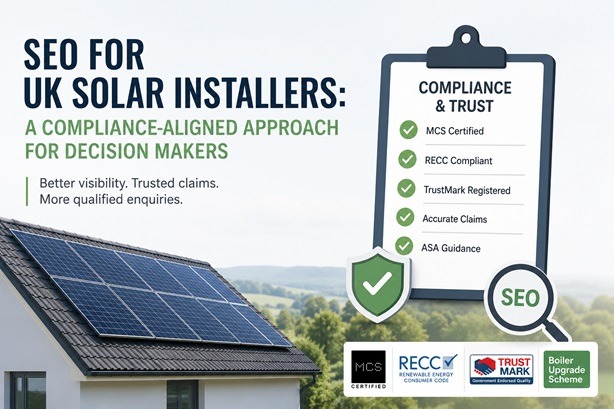
SEO for UK Solar Installers: A Compliance-Aligned Approach for Decision Makers
If you run a solar PV installation company, you already know that this industry doesn't operate like a typical home improvement trade. Everything you say to a customer, in a quote, on a brochure, or on your website, sits inside a framework of rules: MCS certification standards, RECC consumer protection requirements, TrustMark, the Boiler Upgrade Scheme, ECO4, planning regulations, and the Advertising Standards Authority's guidance on environmental and financial claims.
Most SEO advice online is written for industries that don't carry this weight. Generic guides tell you to "publish more blog posts" or "get more backlinks." That advice isn't wrong exactly, it's just built for a different kind of business. A kitchen fitter or a landscaper doesn't need to worry about MCS wording or SCOP-style performance claims. A solar installer does.
This article is written for managing directors and business owners who want a plain-English understanding of what actually matters for solar SEO in a regulated market, and why some of the usual marketing advice can quietly work against you.
1. Regulation shapes what you're allowed to say online, and that affects your rankings
Search engines, and Google in particular, have become far more sensitive to claims made in industries where inaccurate information can cause financial or safety harm. This includes energy savings, environmental impact, and consumer finance. Google's quality systems (often referred to as E-E-A-T: experience, expertise, authoritativeness, and trust) specifically look for signs that a website is careful, accurate, and credible.
For a solar installer, that means a few things in practice:
Savings projections need to be realistic and properly caveated, not presented as guarantees
Payback period claims need to reflect genuine variability rather than a single optimistic figure
Warranty and guarantee language needs to be precise, matching what's actually offered
Grant eligibility (ECO4, the Boiler Upgrade Scheme where relevant, and any local schemes) needs to be described accurately, not simplified to the point of being misleading
Battery storage and inverter performance claims need to be grounded in manufacturer data, not marketing shorthand
This isn't just a compliance box to tick. Vague or overstated claims are exactly the kind of content that search engines are learning to distrust, and they're the kind of content that ASA guidance already restricts. In other words, getting the wording right for RECC and ASA purposes and getting it right for SEO purposes are, increasingly, the same task.
The practical takeaway: if your website currently leans on bold claims like "save thousands on your energy bills" without context, that's not just a regulatory risk, it may also be quietly holding your rankings back. It's worth being specific about why this happens. Search engines have got much better, over the last few years, at spotting patterns that correlate with low-quality or misleading content. Pages that make big financial promises with no supporting detail, no methodology, and no caveats look a lot like the low-quality "get rich quick" style content that these systems were originally built to demote. Your business isn't doing anything remotely comparable, but if the wording on your savings page reads the same way, structurally, as that kind of content, it can end up filed in the same bucket. The fix isn't to remove the claims altogether. Customers genuinely want to know what they might save, and that's a reasonable thing to communicate. The fix is to show your working. A savings estimate that explains the assumptions behind it (roof orientation, system size, current energy usage, tariff type) reads as credible to both a customer and a search engine, because it demonstrates that the figure is calculated rather than invented. A single headline number with nothing behind it does the opposite. The same logic applies to warranty and guarantee language. Vague phrases like "fully guaranteed for life" tend to raise more questions than they answer, both from a consumer protection standpoint and from a trust standpoint. Being specific, for example stating the manufacturer warranty term on panels, the inverter warranty term, and your own workmanship guarantee separately, is not only the safer option under RECC's rules, it also reads as more credible to anyone doing due diligence on your business, including search engines evaluating your expertise and trustworthiness.
2. Technical foundations matter more than content volume
A common assumption is that ranking well means publishing constantly. For most solar installers, that's not where the effort should go. What tends to matter more is:
A clean, logical structure to your site (clear pages for PV installation, battery storage, inverters, commercial solar, and so on, rather than everything crammed onto one page)
Accurate, specific technical pages rather than generic ones that could apply to any installer
Clear, honest explanations of grant eligibility criteria
Correctly implemented schema markup, which is the behind-the-scenes code that helps search engines understand what your business does and where it operates
A site that loads quickly and works properly on a phone, since most enquiries now start on mobile
A homepage that makes your certifications and trust signals visible immediately, not buried in a footer
A local footprint that genuinely reflects the areas you cover
Decision makers sometimes underestimate how much this structural work affects the quality of enquiries coming in, not just the quantity. A site that's vague about what it offers and where tends to attract a wide but low-quality stream of leads: people outside your service area, or people looking for something you don't actually do. A site with clear, specific pages tends to filter itself, so the enquiries that do come in are closer to being ready to buy. There's also a simpler, more human reason clear structure matters. When someone lands on a solar installer's website, they're often comparing you against two or three other companies within the same afternoon. If they can't quickly find the answer to "do they do battery storage" or "do they cover my postcode" or "are they MCS certified", they'll move on to a site that makes that obvious in the first few seconds. A cluttered, all-in-one homepage asks the visitor to do the work of figuring out what you offer. A clearly structured site does that work for them. On the more technical side, page speed deserves a specific mention because it's one of the more commonly overlooked issues. Many installer websites carry large, uncompressed photos of finished installations, which is understandable, since project photography is genuinely valuable trust content, but it can make pages slow to load on mobile data. A slow-loading page doesn't just risk losing the visitor before they've even seen your certifications, it's also a factor search engines weigh directly when deciding how to rank a page. Getting this right usually just means compressing images properly and using a sensibly built website template, rather than anything more complicated.
3. Your certifications are trust signals, and trust signals are ranking signals
Search engines can't inspect your MCS certificate directly. What they can assess is whether your website communicates it properly, consistently, and in a way that matches other public records.
This includes things like:
Whether your MCS certification is clearly and correctly stated on your site
Whether your business details (name, address, company number) match what's registered with Companies House
Whether the engineers or installers you employ appear correctly under the relevant competent person schemes
Whether your claims and guarantees are consistent with RECC and TrustMark's own rules
None of this is "marketing" in the traditional sense. It's closer to due diligence, but it happens to double as one of the more reliable ways to build search visibility in a regulated sector. A site that gets these basics right tends to be treated by search engines as more credible than one that doesn't, even before you consider content or backlinks. There's a wider point here that's worth sitting with. In most industries, "trust signals" are a soft, somewhat abstract marketing concept, things like testimonials or a nicely written "about us" page. In solar, trust signals are largely factual and checkable: certification numbers, company registration details, named installers under competent person schemes. This is actually an advantage for a well-run business, because it means your credibility doesn't rest on how persuasively you can write about yourself. It rests on verifiable facts that a search engine, and a customer, can cross-reference. The practical implication is that this part of your SEO work is largely a one-off job of getting the details correct and consistent, rather than an ongoing content commitment. Once your MCS number, company details, and installer credentials are accurately and consistently represented across your website and your Google Business Profile, that foundation tends to stay solid unless something changes in your business, such as bringing on a new engineer or renewing a certification.
4. Local SEO is not optional for installers
Solar installation is, by nature, a local service. Nobody is choosing a solar installer based purely on national reputation, they're choosing one that can realistically get an engineer to their property, service their system, and respond if something goes wrong.
Google's local search systems reward:
Service area descriptions that are accurate rather than aspirational
Consistent name, address, and phone number details across your website, Google Business Profile, and other directories
Clear categorisation as a solar or renewable energy installer, rather than a generic "electrician" or "contractor" listing
Genuine project photos rather than stock imagery
Real customer reviews, ideally referencing specific work
Dedicated pages for each service area you genuinely cover, rather than one page trying to cover the whole country
Two mistakes are common here, and they pull in opposite directions. Some installers over-extend, claiming coverage across a huge area to appear more available, which tends to dilute local relevance and actually hurt rankings in the areas that matter most. Others under-represent their coverage, listing only their home town when they're perfectly willing to travel further, and lose enquiries as a result. Getting the service area definition right, based on where you can genuinely deliver a good job, tends to fix both problems without adding any extra workload for your team. A useful way to think about this is in terms of concentric circles rather than a single boundary. Most installers have a core area where they can respond quickly and service efficiently, a wider area they'll happily cover for the right job, and a limit beyond which it simply isn't practical. Reflecting that structure on your website, rather than a flat "we cover the whole of Yorkshire" statement, tends to produce better results, because it allows your site to rank strongly in the towns closest to you while still being visible for enquiries further out. It's also worth mentioning reviews specifically, because they sit at the intersection of local SEO and genuine reputation. A handful of detailed, specific reviews (mentioning the type of system installed, the area, and the outcome) tend to carry more weight, both with customers and with search engines, than a large number of generic five-star ratings with no detail. Encouraging customers to mention specifics when leaving a review, rather than simply asking for "a review", is a small habit that compounds over time.
5. Why this should matter to you as a decision maker, not just your marketing person
A question I hear often from MDs and business owners in this space is some version of: "why does SEO feel so unpredictable compared to the engineering side of the business, where standards are clear and outcomes are measurable?"
The honest answer is that most SEO advice circulating online was written for unregulated, low-stakes industries where the worst outcome of a vague claim is a slightly annoyed customer. Solar is different:
Claims need to be precise, because they're regulated
Content needs to be compliant, not just persuasive
Trust signals need to be explicit and verifiable
Technical accuracy affects credibility, both with customers and with search engines
Local targeting needs to be exact, not broad
The quality of enquiries matters more than the sheer number of them
Put simply, SEO for solar installers is closer to a technical and regulatory discipline than a marketing exercise. That's a different mindset to a lot of generic advice, but it's one that tends to make more sense to people running an engineering-led business in the first place.
6. What a sensible SEO approach looks like in this sector
Rather than a generic checklist, a compliance-aware approach for a solar installer typically includes:
A proper technical audit of the existing website, looking specifically at claims, structure, and technical performance, not just a generic SEO scorecard
Corrections to content that overstates savings, misrepresents warranties, or oversimplifies grant eligibility
A clearer service architecture, so PV installation, battery storage, inverters, and commercial work each have their own accurate page
Honest, well-explained grant eligibility pages, since this is one of the most commonly searched and most commonly misrepresented topics
Visible, verifiable trust signals, including MCS certification, TrustMark registration, and consistent business details
Local SEO work that reflects your actual service area rather than an aspirational one
Basic performance improvements, so the site loads quickly and works well on mobile
A degree of lead-quality filtering, so the site naturally attracts enquiries that are a good fit rather than a high volume of the wrong kind
None of this requires publishing dozens of blog posts a month. It requires getting the fundamentals right, in a way that reflects the same standards your installation team already works to.
7. A few common mistakes worth checking for
If you want a quick, practical starting point before commissioning any formal work, it's worth checking your own site for a few common issues:
Savings figures presented as guarantees rather than estimates
A single "typical payback period" quoted without any explanation of the variables that affect it
Grant or scheme eligibility described in a way that could apply to properties that don't actually qualify
MCS or TrustMark logos displayed without a clear, findable explanation of what they mean
A service area list that hasn't been reviewed in a while and no longer matches where you actually work
Warranty terms on the website that don't quite match your actual contracts
Fixing these tends to improve both regulatory compliance and search visibility at the same time, which is a fairly rare case of two priorities pointing in exactly the same direction.
8. Measuring success properly
One of the more useful shifts a decision maker can make is to stop measuring SEO purely by traffic, and start measuring it by enquiry quality. Traffic is easy to report on and easy to make look impressive, but it doesn't tell you whether the people visiting your site are within your service area, whether they're likely to be able to afford a full system, or whether they're just gathering quotes for a school project. More useful measures tend to include:
How many enquiries come from within your genuine service area
How many enquiries convert into a survey or site visit
How many of those surveys convert into a signed job
Whether enquiries are trending toward higher-value work, such as PV plus battery storage, rather than the smallest possible system
Whether the phone calls and form submissions you receive are from people who've clearly already read and understood your service pages, rather than asking questions your website should have already answered
This last point is a useful, low-effort diagnostic in its own right. If your sales team keeps fielding the same basic questions over and over ("do you cover my area", "am I eligible for a grant", "how long is the warranty"), that's usually a sign the website isn't doing enough of the explaining itself, which is both a missed SEO opportunity and an unnecessary drain on your team's time.
9. If you do bring someone in to help
Not every solar installer has the time or inclination to manage this themselves, and that's a reasonable position, particularly for a small or medium-sized business where the MD is also doing quotes, managing installs, and dealing with suppliers. If you do decide to bring in outside help, a few things are worth looking for, regardless of who you end up working with.
Ask whether they've worked in a regulated industry before, and whether they understand the difference between what you can and can't claim under RECC, TrustMark, and ASA guidance
Be wary of anyone proposing a large volume of generic blog content as the main strategy, given everything above about technical accuracy mattering more than volume in this sector
Ask how they'll measure success, and push back if the answer is purely about traffic or rankings rather than enquiry quality
Consider whether you actually need a long, open-ended contract, or whether a focused project (an audit, a set of corrections, a local SEO clean-up) would get you most of the value without an ongoing commitment
Look for someone who's willing to explain what they're doing and why, in plain terms, rather than presenting it as something only they can understand
None of this needs to be complicated or expensive to get right. For most solar installers, the bulk of the value comes from a handful of foundational fixes, done properly once, rather than an ongoing subscription-style arrangement.
Final thought
If your installation work is precise, compliant, and technically sound, it's worth your website reflecting the same standards. SEO for solar installers in the UK isn't really about chasing traffic for its own sake. It's about building a website that's accurate, trustworthy, and specific enough to attract the customers who are the right fit for your business, and to filter out the ones who aren't.
That's a slower, less flashy approach than a lot of SEO marketing suggests, but it tends to hold up better over time, and it sits far more comfortably alongside the regulatory reality that solar installers already work within every day.
If you'd like a second pair of eyes on any of this, feel free to get in touch.
Expertise
Senior technical SEO for SMEs in regulated, automotive, funeral and multilingual markets.
Mail to: jj@jjseo.co.uk
© 2026 JJSEO | Jorge Jaroslavsky, Senior SEO Consultant, Leeds
Free SEO Toolsour text here...