
Used Car SEO UK: Prestige vs Specialist Dealers Explained
Independent used car dealers in two different niches need two different SEO strategies. Here's how to get your keywords, metadata and schema right.
AUTOMOTIVE SEOSMESLOCAL SEO
Jorge Jaroslavsky
6/3/20269 min read
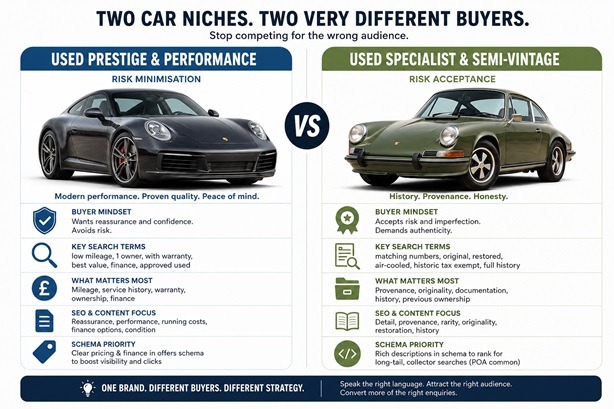
How Independent Dealers in Two Very Different Niches Can Stop Competing for the Wrong Audience
If you run an independent used car dealership in the UK, you already know the market is brutally competitive online. But here is something that does not get talked about enough: not all used car buyers are the same, and treating them as if they are is one of the most expensive SEO mistakes you can make.
Over the years working with independent dealers across the UK, I have seen two distinct niches repeatedly collide in search results — and the dealers caught in the middle wonder why their traffic looks decent on paper but their enquiry rate tells a different story. Those two niches are used prestige and performance cars and used specialist and semi-vintage cars. On the surface, they share a postcode. In SEO terms, they are entirely different worlds.
This article is going to break down exactly how the SEO strategy for each should differ, where independent dealers go wrong, and what you can do right now to make your website speak directly to the buyer who is actually going to pick up the phone.
Why This Distinction Matters More Than You Think
Let us start with the fundamental problem. A dealer selling a 2019 Porsche 911 Carrera S and a dealer selling a 1981 Porsche 911 SC are both selling used Porsche 911s. If both optimise their pages around "used Porsche 911 for sale UK," they are competing head-to-head for traffic from buyers with completely different intentions, different budgets, different risk tolerances, and different definitions of what makes a car worth buying.
The buyer searching for a used 911 Carrera S wants to know about mileage, service history stamps, whether it has a remaining warranty, and what the monthly finance looks like. The buyer searching for a used 1981 SC wants to know whether the engine and chassis numbers match, whether it has been over-restored, and who owned it before. These are not the same person. They are not even close.
When your SEO strategy fails to reflect that, you attract the wrong enquiries, waste your time qualifying people who were never going to buy from you, and signal to Google that your pages are not particularly relevant to anyone specific. That is a losing position.
The Core Difference: Risk Minimisation vs. Risk Acceptance
Here is the lens I use when advising dealers in either niche, and it is the most useful framework I have found for structuring the entire SEO approach.
When someone buys a used prestige or performance car, their primary emotional driver is risk minimisation. They are spending serious money on a modern vehicle, and they want reassurance. They want low mileage, a clean service record, warranty coverage, and ideally a single previous owner. Every anxiety they carry into that search is about avoiding a bad purchase.
When someone buys a used specialist or semi-vintage car, their relationship with risk is entirely different. They accept that the car has history, wear, and imperfection. What they demand instead is documentation, provenance, and honesty. A 1969 Camaro SS with 110,000 miles and a complete paper trail is far more desirable to this buyer than one with 60,000 miles and a vague history. High mileage is not a red flag — an incomplete story is.
This single distinction should shape everything: your keywords, your page copy, your metadata, your schema markup, and the way you describe every car in your stock.
Keyword Strategy: Talking the Right Language to the Right Buyer
Used Prestige and Performance
Buyers in this space search with terms that reflect their concerns about condition, value for money, and financial accessibility. They compare. They use finance. They look for reassurance signals directly in the search result before they even click.
The kinds of terms that work here include: low mileage used [model], 1 owner used [model] UK, used [model] with manufacturer warranty, approved used performance cars, best value used [model] UK, and used [model] PDK finance. Notice how these terms speak to the concerns of someone who wants to know the car is clean, verified, and accessible.
Your stock pages need to lead with mileage, specification, and reassurance. If you have a full service history, that belongs in the title. If the car has remaining warranty, it belongs in the meta description. These are not optional extras — they are the conversion triggers for this buyer.
Used Specialist and Semi-Vintage
This buyer searches differently. They already know the model. What they are researching is whether your specific example is the real thing. Their search terms reflect that obsession with originality and history.
Effective terms here include: matching numbers used [model], restored used [model] UK, used [model] original interior, historic tax exempt used [model], air-cooled used Porsche 911 UK, used 1969 Camaro SS UK, and imported used vintage [model]. These searches are longer, more specific, and lower in volume — but the buyer who uses them knows exactly what they want, and they convert at a far higher rate when your page speaks their language.
Your stock descriptions for these cars need to be detailed and documentary in tone. The number of previous keepers matters. The source of the restoration matters. Whether the interior is original or sympathetically retrimmed matters. Write for the enthusiast, because that is who is reading.
A Real-World Example: Two Dealers, Same Brand, Different Worlds
Let me make this concrete with a comparison that captures the difference clearly.
Dealer A sells a 2010 Porsche 997 Turbo. Their stock page should target terms like used Porsche 997 Turbo for sale, used Porsche 911 PDK finance, and best value used Porsche 911. The page copy should focus on performance metrics, modern reliability, running costs compared to buying new, and the finance options available. The buyer is likely using the car regularly and wants a known quantity.
Dealer B sells a 1980 Porsche 911 G-Series. Their stock page should target terms like classic used air-cooled Porsche, used Porsche 911 G Series UK, and 1980s used Porsche 911 full history. The page copy should speak to investment potential, the significance of the air-cooled lineage, the originality of the car, and the documentation behind it. Finance is rarely the lead for this buyer. Provenance is.
Same brand. Same model family. Completely different SEO approach, because completely different buyer.
The same logic applies across American muscle. A dealer with a 2018 Chevrolet Camaro targets used Chevrolet Camaro V8 UK, modern used Camaro LHD London, and used American muscle car finance. A dealer with a 1969 Camaro targets used 1969 Camaro SS UK, used small block V8 Camaro, and imported used vintage Camaro. The conversation is different at every level.
Getting Your Metadata Right: Where Most Independent Dealers Lose Ground
Meta titles and H1 tags are where a lot of independent dealers inadvertently blur the lines between these two audiences. Here is the practical difference.
For a used prestige or performance stock page, a well-optimised meta title looks something like: Used Porsche 997 Turbo — Low Mileage, Full History | [Your Dealership]. The H1 should reinforce that positioning: something like Quality Used Performance and Prestige Cars. Your meta description is the place to mention inspection standards, finance availability, and warranty coverage directly. These are the triggers that prompt a click from a buyer screening for reassurance.
For a used specialist or semi-vintage stock page, the meta title should read differently: Used Porsche 911 G Series 1980 — Matching Numbers, Documented History | [Your Dealership]. The H1 should reflect curation: something like Handpicked Used Classic and Specialist Cars. Your meta description should reference documented history, originality, and rarity. Mentioning that cars are available on a price-on-application basis is also appropriate here, as it signals to the right buyer that these are not ordinary transactions.
The word choices are not cosmetic. They signal to Google — and to your buyer — which category you belong in, and they determine whether the right person clicks through.
Schema Markup: The Technical Edge Independent Dealers Are Missing
This is the section most dealer websites completely ignore, and it is costing them visibility. Schema markup is the structured data code that tells search engines what your page is actually about, beyond the visible text. For used cars, the differences in how you should implement this are significant.
Both niches correctly use UsedCondition schema to identify their inventory as used vehicles. But that is where the similarity ends.
For prestige and performance dealers, the priority is making the offers section of the schema work hard. These buyers are price-sensitive and comparison-shopping. When your schema correctly signals a clear price and finance information, Google can surface that directly in search results, improving your click-through rate from buyers who are ready to act. If your stock pages are not showing pricing in schema, you are handing an advantage to competitors who have figured this out.
For specialist and semi-vintage dealers, the situation is more nuanced. Many of these cars are listed at price on application, which creates a known problem: Google's systems struggle to index and rank POA listings the same way it handles priced stock. The way around this is to put significant effort into the description field of your schema — using rich, specific language about the car's rarity, originality, and documented history. This is what will help you rank for the long-tail collector queries that are your actual traffic source. Do not leave the description field sparse or generic. It is doing heavy lifting for you in this niche.
The Modified Car Trap: Know Which Side You Are On
One area that catches independent dealers out — particularly those who carry a mix of modern performance and older specialist stock — is how to handle modified vehicles. The SEO implications are opposite depending on which niche you are operating in, and getting this wrong can actively damage your positioning.
In the used prestige and performance world, modifications generally reduce desirability and resale value for the mainstream buyer. Someone searching for a used Porsche 997 GT3 does not want to find one with an aftermarket exhaust and a stage two tune — they want factory specification. If you have modified stock in this category, be careful about leading with those modifications in your titles and headings. They are more likely to reduce your click-through rate than increase it, and they may attract buyers who then walk away when they realise the car will be harder to part-exchange or insure.
In the used specialist and semi-vintage world, the opposite is true — but with an important caveat. Period-correct modifications are a positive feature for many buyers. A Restomod — a classic body with a sympathetically updated drivetrain or interior — is actively desirable and has its own search demand. Terms like used 1967 Mustang Restomod UK or period-correct modified used Porsche are legitimate keyword opportunities in this space. Embrace them on your stock pages, because the buyers using those terms are looking specifically for what you have.
The key is intentionality. Know which side of this line each car sits on, and write accordingly.
Practical Steps to Take This Week
If you are an independent dealer reading this and wondering where to start, here is what I would focus on first.
Audit your current stock pages and decide, honestly, which niche each car belongs in. If you carry both types, they should be in separate sections of your website with distinct URL structures — not lumped together under a generic "used cars" page. Google needs that structural clarity to understand what you offer.
Review your meta titles across your stock. Are they carrying the right signals for your buyer? Low mileage and warranty for prestige stock. Matching numbers and documented history for specialist stock. If your titles read the same regardless of category, that is the first thing to fix.
Look at your schema implementation. If you have none, that is a quick win waiting to happen — particularly for your priced prestige stock where the offers schema can directly improve how you appear in results. If you have POA listings without rich description schema, that is leaving ranking potential on the table.
Finally, read your own stock descriptions as if you are the buyer. Does the copy for your prestige cars reassure someone who is nervous about risk? Does the copy for your specialist cars satisfy someone who is obsessive about provenance? If the answer to either question is no, the words are working against you.
Final Thought
Independent dealers have one genuine advantage over the big franchised operations and the aggregator platforms: the ability to speak with real expertise and specificity to a defined audience. The large platforms have to be everything to everyone. You do not.
The dealers I have seen succeed consistently in both the prestige performance niche and the specialist semi-vintage niche are the ones who commit to that specificity — in their keywords, their metadata, their schema, and their copy. They stop trying to rank for everything and start ranking hard for exactly the right thing.
That is not just good SEO. That is good business.
Need help auditing your dealership's SEO positioning? Get in touch at jjseo.co.uk — I work exclusively with independent businesses who want search visibility that actually converts.
Related blog posts:
How Schema Makes Your Car Dealership Visible in Google’s AI Results
How Independent Car Dealers Can Actually Win More Customers With Voice Search in 2025
The Complete SEO Guide for Campervan & Caravan Dealers
SEO for Insurance Brokers UK: Guide from Leeds Consultant
How to Fix Duplicate Content on Your Campervan Dealer Stock Listings
SEO Strategies for Independent Car Dealers in Leeds and Beyond
Expertise
Senior technical SEO for SMEs in regulated, automotive, funeral and multilingual markets.
Mail to: jj@jjseo.co.uk
© 2026 JJSEO | Jorge Jaroslavsky, Senior SEO Consultant, Leeds
Free SEO Toolsour text here...