
SEO for SME Manufacturers: A Practical Guide
Most agencies avoid manufacturing SEO because it's technical. That's exactly why it's a quiet opportunity for SME manufacturers who get it right.
SMESTECHNICAL SEOLOCAL SEOSEO CONTENT
Jorge Jaroslavsky
6/29/202610 min read
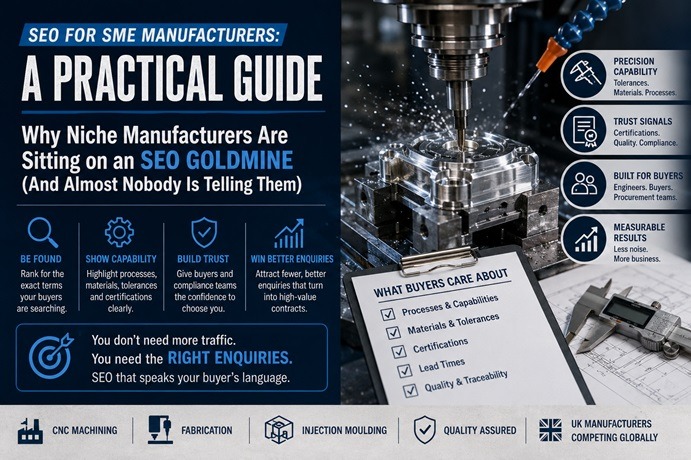
Why Niche Manufacturers Are Sitting on an SEO Goldmine
I have spent twenty years looking at websites that are quietly bleeding business, and some of the worst cases I see are not failing restaurants or struggling retailers. They are well-run, technically excellent manufacturing companies — precision engineering shops, fabricators, injection moulders, finishers — that make genuinely good products, employ skilled people, and have absolutely no idea how invisible they are to the customers searching for exactly what they offer.
I want to explain why that happens, why it is actually good news if you run one of these businesses, and what I would do about it if I were sitting in your chair.
I should say at the outset that this is not a generic observation written from the outside. I came to SEO through an engineering background, not a marketing one, and I spent decades before that inside a regulated commercial sector where buyers make slow, careful, evidence-based decisions rather than impulsive ones. Manufacturing is one of the few niche sectors I work in where all of that experience is genuinely useful at the same time, rather than just one strand of it. That is probably why I find this work more interesting than most of what crosses my desk.
Why most agencies avoid manufacturing SEO
If you have ever spoken to a digital marketing agency about your manufacturing business, you may have noticed something. The conversation drifts quickly towards generic territory — "brand awareness", "engaging content", "social media presence" — and rarely lands on the things that actually matter to your customers: tolerances, materials, certifications, lead times, manufacturing capability.
That is not an accident. It is because most agencies are built around marketing skills, not engineering literacy. They know how to write a blog post about "five tips for choosing a supplier". They do not know the difference between 5-axis milling and screw machining, between PEEK and a standard engineering polymer, or why a procurement manager cares about ±0.01mm tolerance and a marketing manager never will.
So they avoid it. Or worse, they take the work on, write something vague and pleasant, and call it a content strategy. I have reviewed enough of these websites to know the pattern by heart: nice photography, soft language, no actual technical substance anywhere on the page.
This matters because of who is actually doing the searching. Your buyers are not consumers browsing for inspiration. They are engineers, technical buyers, and procurement teams who already know what they need and are trying to verify, as quickly as possible, whether you can deliver it. A website that talks about your "passion for quality" instead of your tolerances, your materials, and your certifications is not speaking their language. It is speaking past them.
Why that is actually good news for you
Here is the part I find genuinely interesting, and the reason I think this sector deserves far more attention than it gets.
If most agencies are avoiding this work because it requires technical understanding they do not have, then most of your competitors' websites have not had proper SEO attention either. I see this constantly when I look at manufacturing sites: outdated content management systems, navigation built around the company's internal departments rather than what a buyer is actually looking for, no clear breakdown of capabilities, no structured way to present materials or tolerances, nothing that tells Google — or a human procurement manager — precisely what this business can and cannot do.
That is not a reason to despair. It is the opposite. It means the bar to stand out is genuinely low, provided someone takes the time to do this properly. You are not competing against polished, search-optimised rivals who have already taken every easy win. You are competing against businesses that, frankly, have not tried.
And the value of getting this right is disproportionately high for a manufacturing SME compared to almost any other sector I work in. You are not chasing volume. You do not need ten thousand visitors a month. You need the right five or ten enquiries — the ones from a buyer who already has a spec in hand and a budget approved. A single production run, a single ongoing supply contract, a single switch from an underperforming supplier to you, can be worth more than an entire year of marketing spend elsewhere. This is a sector where search visibility does not need to be loud. It needs to be precise.
To make that concrete: imagine two small fabrication businesses, otherwise equally capable. The first describes itself online as "high-quality sheet metal fabrication for a range of industries". The second has a page stating, plainly, that it offers laser cutting of stainless steel up to 10mm and mild steel up to 15mm, with in-house bending and welding, ISO 9001 certification, and typical lead times of five to seven working days. A buyer who already knows precisely what they need — which describes almost every serious manufacturing enquiry — will find the second business and never see the first. Nothing else about these two companies needs to differ for that outcome to repeat itself, enquiry after enquiry, for years.
The real reason your site is invisible — and it is not "more content"
If you take one thing away from this article, I would like it to be this: SEO for a manufacturing business is not a content marketing exercise. It is an information architecture exercise.
What I mean by that is simple. Your problem is rarely "we don't write enough blog posts". Your problem is almost always that your website does not clearly and explicitly tell search engines, and human visitors, what you actually do — at the level of detail a technical buyer needs to make a decision.
Think about how your own website is currently structured. Most manufacturing sites I look at have a homepage, an "About Us" page, a generic "Services" page that lists processes in a paragraph, and a "Contact" page. That structure might describe your business adequately to someone who already knows you. It tells a stranger, and more importantly it tells Google, almost nothing useful.
Compare that to a structure built around what a buyer is actually trying to find out:
A dedicated page for each manufacturing process you offer (CNC machining, turning, fabrication, injection moulding, finishing, assembly — whatever applies to you), each one detailing the materials you work with, the tolerances you can hold, the surface finishes available, the relevant certifications, and typical lead times.
A clear breakdown of the products or components you produce, grouped in the way your customers think about them — by industry, by material, by function — rather than the way your own internal departments happen to be organised.
Pages built around the specific industries you serve, because a buyer looking for precision components for medical devices is asking a different question, in different language, to a buyer looking for the same process applied to automotive parts.
None of this requires more writing in the conventional sense. It requires the technical information that already exists somewhere in your business — on a quote sheet, in a quality manual, in your head — being made visible, structured, and indexable on your website. This is precisely the kind of problem an engineering mindset is suited to, because it is a systems problem before it is a marketing problem. You are not trying to persuade anyone with clever copy. You are trying to remove every point of friction between a specific technical question and a specific, correct, verifiable answer.
Your buyers do not search the way you might assume
Here is something I find genuinely useful to understand, and it surprises a lot of the manufacturing clients I talk to.
An engineer or a procurement specialist does not generally search for "best precision engineering company UK" the way a consumer might search for "best Italian restaurant near me". They search the way they think — in spec, not in sentiment. The actual searches behind a real buying decision look more like:
"5-axis CNC machining aluminium 7075"
"precision turned parts tolerance 0.01mm"
"injection moulding PEEK medical grade"
"laser cutting stainless steel 10mm"
If your website never mentions the alloy, the tolerance, the material grade, or the process variant by its correct technical name, you simply will not appear for that search — no matter how good your actual capability is. It is not that Google has misjudged you. It is that you have never told it, in the language your buyer is using, that you can do this.
This is the single biggest blind spot I see. Business owners write their website in the language they use to describe their company to a friend, or to a bank manager. Their actual buyers are typing something closer to a specification sheet. The gap between those two languages is, in my experience, where most of the lost business in this sector quietly disappears.
The decision is longer than one search, and your website needs to support all of it
There is another assumption I want to challenge, because it shapes how a lot of manufacturing websites are built. Most owners I speak to picture SEO as getting found on a first search, as if that one moment of visibility is the whole job. For a manufacturing buyer, it almost never works that way.
A realistic buying journey for a new supplier might run through an initial specification search, a shortlist of two or three candidates, a check of whether each one can genuinely meet the stated capability, a sample request, a compliance or quality check, and only then a procurement decision that may need sign-off from someone who was never part of the earlier steps. That is not one click. It is five or six distinct moments, often spread across different people in the buyer's organisation, each one asking a slightly different question of your website.
This matters because most sites are built to answer only the first question — "what do you do" — and go quiet after that. A site that genuinely supports the whole journey gives the technical buyer enough detail to verify your capability without a phone call, gives whoever runs quality or compliance something concrete to check against, and gives the final decision-maker the trust signals they need to sign off with confidence. Building for all of those moments, rather than just the opening one, is what turns a visit into an enquiry, and an enquiry into a contract.
What this looks like in practice for a business your size
I am conscious that everything I have described so far could sound like a project for a company with an in-house marketing team and a six-figure website budget. It is not. I work alone, with small and medium-sized manufacturers, and I would approach this in stages rather than as one enormous rebuild.
Start with what makes you genuinely capable, and say it plainly. List every process, every material, every tolerance range, every certification you hold, every piece of significant machinery. Most of this information already exists in your business — in a quality manual, on a quote template, in the head of whoever runs your shop floor. The work is in extracting it and putting it on the page in plain, specific, technically accurate language, rather than leaving it buried in a PDF nobody finds.
Give each major capability its own page, not a shared paragraph. If you offer three distinct services, that is three pages, each answering the specific questions a buyer for that service would have — not one page trying to do all three jobs at once and doing none of them properly.
Build pages around the industries you actually serve, if more than one applies to you. A buyer in aerospace, automotive, medical, or construction is asking a subtly different question even when the underlying process is identical. A page that speaks directly to "precision turning for automotive components" will outperform a generic process page every time that specific buyer is searching.
Make your trust signals visible and specific, not vague. "Quality assured" tells a buyer nothing. "ISO 9001:2015 certified, in-house CMM inspection, full material traceability" tells them everything they need to shortlist you with confidence. If you hold a certification, name it. If you have specific inspection equipment, list it. These details are not boring administrative trivia — for your buyer, they are the entire decision.
Use the technical term, not the soft version, wherever it is accurate. If a buyer searches for "5-axis milling" and your site only says "CNC machining", you are invisible to that specific, high-intent search even though you do exactly what they need. This is a small change with an outsized effect, and it costs nothing beyond getting the terminology right.
Tell search engines what you are, not just what you say. This is the one genuinely technical step in the list, so I will keep it simple. Behind the scenes, your website can carry a layer of structured data — small, hidden markers that tell Google "this is a product", "this is a service", "this is the organisation behind it" — rather than leaving the search engine to guess from the surrounding prose. You do not need to understand the code to benefit from it. You just need to know it exists, that it is the difference between Google inferring what you do and Google being told outright, and that it is the kind of thing worth asking whoever builds or maintains your site to check.
None of this needs to happen at once, and none of it needs a large team. For a business your size, I would rather see three or four genuinely thorough capability pages built properly over a couple of months than twenty thin ones rushed out in a week. Depth and accuracy do more work here than volume ever will.
A note on patience, because this sector deserves it
I will be honest with you about timeframe, because I think conservative, technically-minded business owners appreciate straight answers more than enthusiasm. This is not a sector where you see results in a fortnight. Search engines need time to recognise the new structure on your site, and your buyers are not impulsive — the decision cycle for a new supplier or a new component often runs through shortlisting, sample requests, and compliance checks before a single order is placed. Building the right architecture is the work of months, not days, and the payoff tends to arrive as a small, steady stream of well-qualified enquiries rather than a sudden spike in traffic. For a sector where one good enquiry can be worth more than a year of advertising elsewhere, I think that trade is worth making.
Where I would start, if I were you
If you run a small or medium manufacturing business and you recognise any of this in your own website — generic process descriptions, no visible tolerances or materials, no pages built around your actual industries, certifications mentioned once in passing rather than shown clearly — the good news is that none of it is difficult to fix once someone understands what your business actually does at a technical level.
That understanding is, in my experience, the part most agencies cannot offer you. It is the part I find genuinely interesting about working with manufacturers, because it rewards exactly the kind of diagnostic, first-principles thinking I have always preferred over generic marketing playbooks. It also means the work tends to be quick to scope properly: a short conversation about your processes and your customers usually tells me, within an hour, roughly where the gaps are and what order to tackle them in.
I am not going to suggest you need a full agency, a retainer, or a six-month contract to sort this out. Most of what I have described here is a question of structure and accuracy rather than scale, and a great deal of it can be done in stages, at a pace that suits a business your size.
If any of this has struck a chord and you would like a second opinion on how your own site currently presents your capabilities to the people searching for them, I am always happy to have that conversation — no obligation, and no pressure either way.
Expertise
Driving organic traffic and qualified leads with tailored SEO solutions.
Growth
Results
Mail to: jj@jjseo.co.uk
© 2025 JJSEO. All rights reserved. | Expert SEO Consultant in Leeds
Free SEO Toolsour text here...